


Page 220 - (DK) Ocean - The Definitive Visual Guide
P. 220
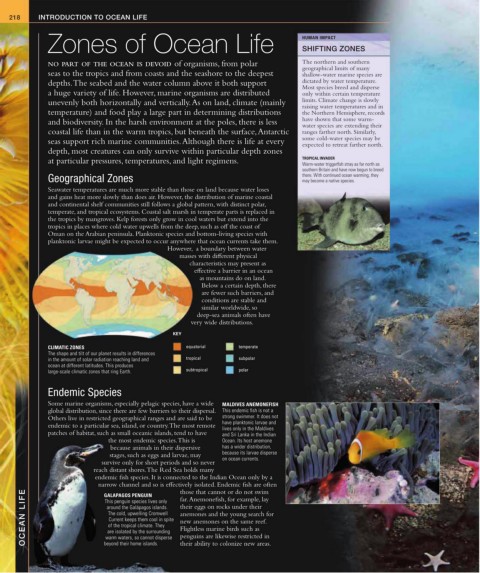
218     INTRODUCTION TO OCEAN LIFE


               Zones of Ocean Life                                                         HUMAN IMPACT
                                                                                           SHIFTING ZONES

               NO PART OF THE OCEAN IS DEVOID of organisms, from polar                     The northern and southern
                                                                                           geographical limits of many
               seas to the tropics and from coasts and the seashore to the deepest         shallow-water marine species are
               depths. The seabed and the water column above it both support               dictated by water temperature.
                                                                                           Most species breed and disperse
               a huge variety of life. However, marine organisms are distributed           only within certain temperature
               unevenly both horizontally and vertically. As on land, climate (mainly      limits. Climate change is slowly
                                                                                           raising water temperatures and in
               temperature) and food play a large part in determining distributions        the Northern Hemisphere, records
               and biodiversity. In the harsh environment at the poles, there is less      have shown that some warm-
                                                                                           water species are extending their
               coastal life than in the warm tropics, but beneath the surface, Antarctic   ranges farther north. Similarly,
               seas support rich marine communities. Although there is life at every       some cold-water species may be
                                                                                           expected to retreat farther north.
               depth, most creatures can only survive within particular depth zones
               at particular pressures, temperatures, and light regimens.                  TROPICAL INVADER
                                                                                           Warm-water triggerfish stray as far north as
                                                                                           southern Britain and have now begun to breed
               Geographical Zones                                                          there. With continued ocean warming, they
                                                                                           may become a native species.
               Seawater temperatures are much more stable than those on land because water loses
               and gains heat more slowly than does air. However, the distribution of marine coastal
               and continental shelf communities still follows a global pattern, with distinct polar,
               temperate, and tropical ecosystems. Coastal salt marsh in temperate parts is replaced in
               the tropics by mangroves. Kelp forests only grow in cool waters but extend into the
               tropics in places where cold water upwells from the deep, such as off the coast of
               Oman on the Arabian peninsula. Planktonic species and bottom-living species with
               planktonic larvae might be expected to occur anywhere that ocean currents take them.
                                                   However,  a boundary between water
                                                      masses with different physical
                                                         characteristics may present as
                                                           effective a barrier in an ocean
                                                            as mountains do on land.
                                                             Below a certain depth, there
                                                             are fewer such barriers, and
                                                             conditions are stable and
                                                             similar worldwide, so
                                                            deep-sea animals often have
                                                          very wide distributions.
                                                    KEY
               CLIMATIC ZONES                           equatorial      temperate
               The shape and tilt of our planet results in differences
               in the amount of solar radiation reaching land and   tropical  subpolar
               ocean at different latitudes. This produces
               large-scale climatic zones that ring Earth.  subtropical  polar

               Endemic Species

               Some marine organisms, especially pelagic species, have a wide   MALDIVES ANEMONEFISH
               global distribution, since there are few barriers to their dispersal.  This endemic fish is not a
               Others live in restricted geographical ranges and are said to be   strong swimmer. It does not
               endemic to a particular sea, island, or country. The most remote   have planktonic larvae and
                                                                   lives only in the Maldives
               patches of habitat, such as small oceanic islands, tend to have   and Sri Lanka in the Indian
                                 the most endemic species. This is   Ocean. Its host anemone
                                  because animals in their dispersive   has a wider distribution,
                                  stages, such as eggs and larvae, may   because its larvae disperse
                                                                   on ocean currents.
                               survive only for short periods and so never
                             reach distant shores. The Red Sea holds many
                             endemic fish species. It is connected to the Indian Ocean only by a
                              narrow channel and so is effectively isolated. Endemic fish are often
                                                       those that cannot or do not swim
        OCEAN LIFE              beyond their home islands.  their eggs on rocks under their
                                GALAPAGOS PENGUIN
                                                       far. Anemonefish, for example, lay
                                This penguin species lives only
                                 around the Galápagos islands.
                                                       anemones and the young search for
                                 The cold, upwelling Cromwell
                                 Current keeps them cool in spite
                                                       new anemones on the same reef.
                                 of the tropical climate. They
                                                       Flightless marine birds such as
                                 are isolated by the surrounding
                                                       penguins are likewise restricted in
                                warm waters, so cannot disperse
                                                       their ability to colonize new areas.

