


Page 221 - (DK) Ocean - The Definitive Visual Guide
P. 221
ZONES OF OCEAN LIFE 219
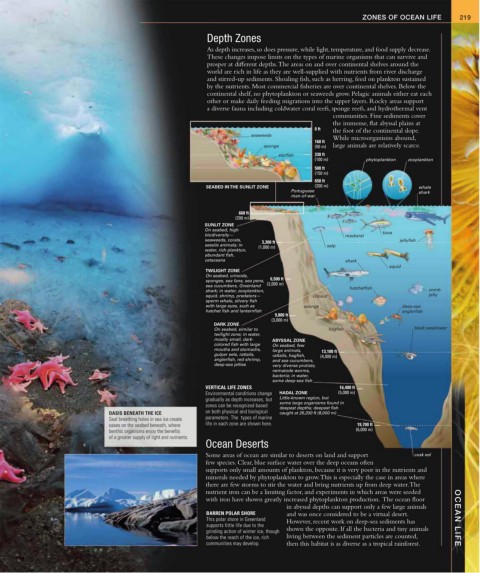
Depth Zones
As depth increases, so does pressure, while light, temperature, and food supply decrease.
These changes impose limits on the types of marine organisms that can survive and
prosper at different depths. The areas on and over continental shelves around the
world are rich in life as they are well-supplied with nutrients from river discharge
and stirred-up sediments. Shoaling fish, such as herring, feed on plankton sustained
by the nutrients. Most commercial fisheries are over continental shelves. Below the
continental shelf, no phytoplankton or seaweeds grow. Pelagic animals either eat each
other or make daily feeding migrations into the upper layers. Rocky areas support
a diverse fauna including coldwater coral reefs, sponge reefs, and hydrothermal vent
communities. Fine sediments cover
the immense, flat abyssal plains at
0 ft the foot of the continental slope.
seaweeds
While microorganisms abound,
160 ft
sponge (50 m) large animals are relatively scarce.
starfish 330 ft
(100 m) phytoplankton zooplankton
500 ft
(150 m)
650 ft
(200 m)
SEABED IN THE SUNLIT ZONE whale
Portuguese shark
man-of-war
660 ft
(200 m)
SUNLIT ZONE
On seabed, high
biodiversity— mackerel tuna
seaweeds, corals, 3,300 ft jellyfish
sessile animals; in (1,000 m) salp
water, rich plankton,
abundant fish,
cetaceans shark
squid
TWILIGHT ZONE
On seabed, crinoids,
sponges, sea fans, sea pens, 6,500 ft
sea cucumbers, Greenland (2,000 m) hatchetfish
shark; in water, zooplankton, comb
squid, shrimp, predators— crinoid jelly
sperm whale, silvery fish
with large eyes, such as sponge deep-sea
hatchet fish and lanternfish anglerfish
9,800 ft
(3,000 m)
DARK ZONE
On seabed, similar to hagfish black swallower
twilight zone; in water,
mostly small, dark-
ABYSSAL ZONE
colored fish with large On seabed, few
mouths and stomachs, large animals, 13,100 ft
gulper eels, rattails, rattails, hagfish, (4,000 m)
anglerfish, red shrimp, and sea cucumbers,
deep-sea jellies very diverse protists,
nematode worms,
bacteria; in water,
some deep-sea fish
VERTICAL LIFE ZONES 16,400 ft
Environmental conditions change HADAL ZONE (5,000 m)
gradually as depth increases, but Little-known region, but
zones can be recognized based some large organisms found in
deepest depths; deepest fish
OASIS BENEATH THE ICE on both physical and biological caught at 26,200 ft (8,000 m)
Seal breathing holes in sea ice create parameters. The types of marine
oases on the seabed beneath, where life in each zone are shown here. 19,700 ft
benthic organisms enjoy the benefits (6,000 m)
of a greater supply of light and nutrients.
Ocean Deserts
Some areas of ocean are similar to deserts on land and support cusk eel
few species. Clear, blue surface water over the deep oceans often
supports only small amounts of plankton, because it is very poor in the nutrients and
minerals needed by phytoplankton to grow. This is especially the case in areas where
there are few storms to stir the water and bring nutrients up from deep water. The
nutrient iron can be a limiting factor, and experiments in which areas were seeded
with iron have shown greatly increased phytoplankton production. The ocean floor
in abyssal depths can support only a few large animals
BARREN POLAR SHORE and was once considered to be a virtual desert.
This polar shore in Greenland However, recent work on deep-sea sediments has OCEAN LIFE
supports little life due to the
grinding action of winter ice, though shown the opposite. If all the bacteria and tiny animals
below the reach of the ice, rich living between the sediment particles are counted,
communities may develop. then this habitat is as diverse as a tropical rainforest.

