


Page 230 - (DK) Ocean - The Definitive Visual Guide
P. 230
228     INTRODUCTION TO OCEAN LIFE


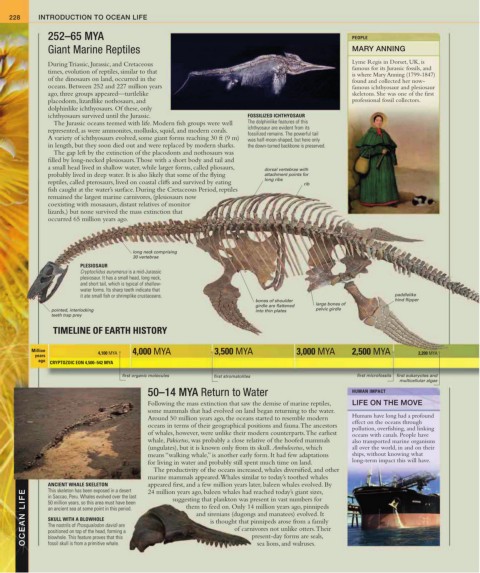
               252–65 MYA                                                                                 PEOPLE
               Giant Marine Reptiles                                                                      MARY ANNING

               During Triassic, Jurassic, and Cretaceous                                                  Lyme Regis in Dorset, UK, is
               times, evolution of reptiles, similar to that                                              famous for its Jurassic fossils, and
                                                                                                          is where Mary Anning (1799-1847)
               of the dinosaurs on land, occurred in the                                                  found and collected her now-
               oceans. Between 252 and 227 million years                                                  famous ichthyosaur and plesiosaur
               ago, three groups appeared—turtlelike                                                      skeletons. She was one of the first
               placodonts, lizardlike nothosaurs, and                                                     professional fossil collectors.
               dolphinlike ichthyosaurs. Of these, only
               ichthyosaurs survived until the Jurassic.                   FOSSILIZED ICHTHYOSAUR
                 The Jurassic oceans teemed with life. Modern fish groups were well   The dolphinlike features of this
                                                                           ichthyosaur are evident from its
               represented, as were ammonites, mollusks, squid, and modern corals.
                                                                           fossilized remains. The powerful tail
               A variety of ichthyosaurs evolved, some giant forms reaching 30 ft (9 m)   was half-moon-shaped, but here only
               in length, but they soon died out and were replaced by modern sharks.   the down-turned backbone is preserved.
                 The gap left by the extinction of the placodonts and nothosaurs was
               filled by long-necked plesiosaurs. Those with a short body and tail and
               a small head lived in shallow water, while larger forms, called pliosaurs,   dorsal vertebrae with
               probably lived in deep water. It is also likely that some of the flying   attachment points for
                                                                                long ribs
               reptiles, called pterosaurs, lived on coastal cliffs and survived by eating   rib
               fish caught at the water’s surface. During the Cretaceous Period, reptiles
               remained the largest marine carnivores, (plesiosaurs now
               coexisting with mosasaurs, distant relatives of monitor
               lizards,) but none survived the mass extinction that
               occurred 65 million years ago.


                                        long neck comprising
                                        30 vertebrae
                         PLESIOSAUR
                         Cryptoclidus eurymerus is a mid-Jurassic
                         plesiosaur. It has a small head, long neck,
                         and short tail, which is typical of shallow-
                         water forms. Its sharp teeth indicate that
                         it ate small fish or shrimplike crustaceans.                                                   paddlelike
                                                                             bones of shoulder                         hind flipper
                                                                             girdle are flattened    large bones of
                pointed, interlocking                                        into thin plates  pelvic girdle
                teeth trap prey
                 TIMELINE OF EARTH HISTORY


          Million             4,100 MYA  4,000 MYA               3,500 MYA               3,000 MYA        2,500 MYA           2,200 MYA
           years
            ago
                CRYPTOZOIC EON 4,500–542 MYA
                                     first organic molecules      first stromatolites                        first microfossils   first eukaryotes and
                                                                                                                        multicellular algae
                                             50–14 MYA Return to Water                                    HUMAN IMPACT

                                             Following the mass extinction that saw the demise of marine reptiles,   LIFE ON THE MOVE
                                             some mammals that had evolved on land began returning to the water.
                                             Around 50 million years ago, the oceans started to resemble modern   Humans have long had a profound
                                             oceans in terms of their geographical positions and fauna. The ancestors   effect on the oceans through
                                                                                                          pollution, overfishing, and linking
                                             of whales, however, were unlike their modern counterparts. The earliest   oceans with canals. People have
                                             whale, Pakicetus, was probably a close relative of the hoofed mammals   also transported marine organisms
                                             (ungulates), but it is known only from its skull. Ambulocetus, which   all over the world, in and on their
                                             means “walking whale,” is another early form. It had few adaptations    ships, without knowing what
                                             for living in water and probably still spent much time on land.   long-term impact this will have.
                                               The productivity of the oceans increased, whales diversified, and other
                                             marine mammals appeared. Whales similar to today’s toothed whales
               ANCIENT WHALE SKELETON        appeared first, and a few million years later, baleen whales evolved. By
               This skeleton has been exposed in a desert
        OCEAN LIFE  50 million years, so this area must have been   them to feed on. Only 14 million years ago, pinnipeds
                                             24 million years ago, baleen whales had reached today’s giant sizes,
               in Saccao, Peru. Whales evolved over the last
                                                    suggesting that plankton was present in vast numbers for
               an ancient sea at some point in this period.
                                                           and sirenians (dugongs and manatees) evolved. It
               SKULL WITH A BLOWHOLE
                                                                is thought that pinnipeds arose from a family
               The nostrils of Prosqualodon davidi are
                                                                       of carnivores not unlike otters. Their
               positioned on top of the head, forming a
                                                                            present-day forms are seals,
               blowhole. This feature proves that this
                                                                              sea lions, and walruses.
               fossil skull is from a primitive whale.

