


Page 229 - (DK) Ocean - The Definitive Visual Guide
P. 229
THE HISTORY OF OCEAN LIFE           227


                                                      550–530 MYA

                                                      Cambrian Explosion
                                                      Over the course of 20 million years, around the start of
                                                      the Cambrian Period, many life-forms made a sudden
                                                      appearance. Indeed, most of today’s major animal
                                                      groups (phyla) abruptly appear in the fossil record. The
                                                      Cambrian Explosion of evolution may have been caused
                                                      by the creation of new ecological niches as the coastline
                                                      increased, due to the breakup of the Rodinia supercontinent.
                                                       Further niches arose as a rise in sea level produced large
                                                         expanses of warm, shallow water. The Cambrian seas were
                                                                                                        BRACHIOPODS
                                                          dominated by arthropods, chiefly trilobites, but there
                                                                                                        Brachiopods may
                                                             were also foraminiferans, sponges, corals, bivalves,   resemble bivalve
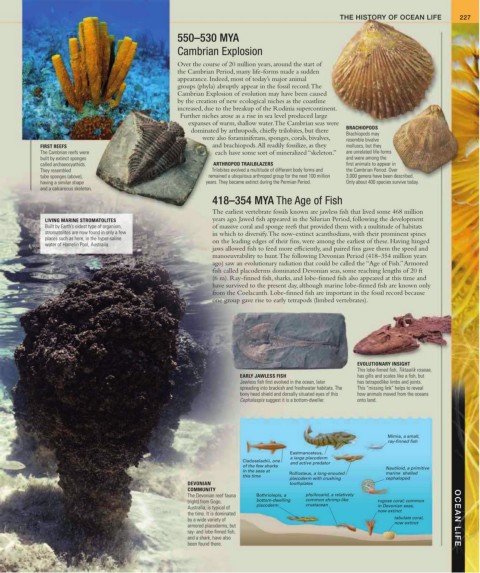
             FIRST REEFS                                        and brachiopods. All readily fossilize, as they   molluscs, but they
             The Cambrian reefs were                             each have some sort of mineralized “skeleton.”  are unrelated life-forms
             built by extinct sponges                                                                   and were among the
             called archaeocyathids.                            ARTHROPOD TRAILBLAZERS                  first animals to appear in
             They resembled                                     Trilobites evolved a multitude of different body forms and   the Cambrian Period. Over
             tube sponges (above),                             remained a ubiquitous arthropod group for the next 100 million   3,000 genera have been described.
             having a similar shape                           years. They became extinct during the Permian Period.  Only about 400 species survive today.
             and a calcareous skeleton.
                                                                418–354 MYA The Age of Fish

                                                                The earliest vertebrate fossils known are jawless fish that lived some 468 million
              LIVING MARINE STROMATOLITES                       years ago. Jawed fish appeared in the Silurian Period, following the development
              Built by Earth’s oldest type of organism,         of massive coral and sponge reefs that provided them with a multitude of habitats
              stromatolites are now found in only a few         in which to diversify. The now-extinct acanthodians, with their prominent spines
              places such as here, in the hyper-saline          on the leading edges of their fins, were among the earliest of these. Having hinged
              water of Hamelin Pool, Australia.
                                                                jaws allowed fish to feed more efficiently, and paired fins gave them the speed and
                                                                manoeuvrability to hunt. The following Devonian Period (418–354 million years
                                                                ago) saw an evolutionary radiation that could be called the “Age of Fish.” Armored
                                                                fish called placoderms dominated Devonian seas, some reaching lengths of 20 ft
                                                                (6 m). Ray-finned fish, sharks, and lobe-finned fish also appeared at this time and
                                                                have survived to the present day, although marine lobe-finned fish are known only
                                                                from the Coelacanth. Lobe-finned fish are important in the fossil record because
                                                                one group gave rise to early tetrapods (limbed vertebrates).


                                                                                                           EVOLUTIONARY INSIGHT
                                                                                                           This lobe-finned fish, Tiktaalik roseae,
                                                                        EARLY JAWLESS FISH                 has gills and scales like a fish, but
                                                                        Jawless fish first evolved in the ocean, later   has tetrapodlike limbs and joints.
                                                                        spreading into brackish and freshwater habitats. The   This “missing link” helps to reveal
                                                                        bony head shield and dorsally situated eyes of this   how animals moved from the oceans
                                                                        Cephalaspis suggest it is a bottom-dweller.  onto land.


                                                                                                                     Mimia, a small,
                                                                                                                     ray-finned fish
                                                                                       Eastmanosteus,
                                                                                       a large placoderm
                                                                         Cladoselachii, one   and active predator
                                                                         of the few sharks                          Nautiloid, a primitive
                                                                         in the seas at    Rolfosteus, a long-snouted   marine  shelled
                                                                         this time
                                                                                       placoderm with crushing      cephalopod
                                                         DEVONIAN                      toothplates
                                                         COMMUNITY
                                                         The Devonian reef fauna   Bothriolepis, a   phyllocarid, a relatively
                                                         (right) from Gogo,   bottom-dwelling   common shrimp-like   rugose coral; common
                                                         Australia, is typical of   placoderm  crustacean        in Devonian seas,
                                                         the time. It is dominated                               now extinct
                                                         by a wide variety of                                         tabulate coral,    OCEAN LIFE
                                                                                                                      now extinct
                                                         armored placoderms, but
                                                         ray- and lobe-finned fish,
                                                         and a shark, have also
                                                         been found there.

