


Page 249 - (DK) Ocean - The Definitive Visual Guide
P. 249
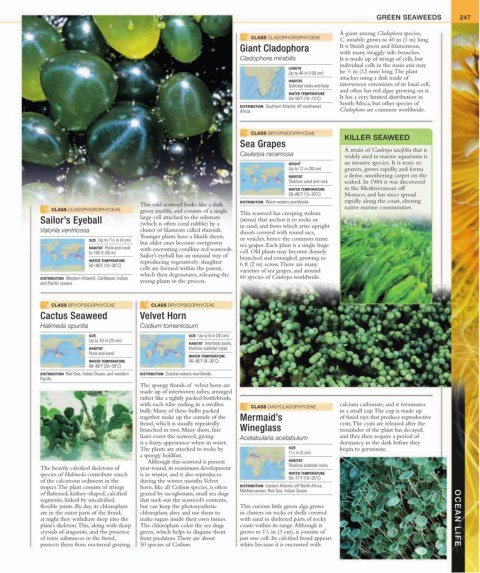
GREEN SEAWEEDS 247
A giant among Cladophora species,
CLASS CLADOPHOROPHYCEAE C. mirabilis grows to 40 in (1 m) long.
Giant Cladophora It is bluish green and filamentous,
with many straggly side-branches.
It is made up of strings of cells, but
Cladophora mirabilis
individual cells in the main axis may
LENGTH
1
Up to 40 in (100 cm) be /2 in (12 mm) long. The plant
attaches using a disk made of
HABITAT
Subtidal rocks and kelp interwoven extensions of its basal cell,
and often has red algae growing on it.
WATER TEMPERATURE
50–59˚F (10–15˚C) It has a very limited distribution in
South Africa, but other species of
DISTRIBUTION Southern Atlantic off southwest
Africa Cladophora are common worldwide.
CLASS BRYOPSIDOPHYCEAE
KILLER SEAWEED
Sea Grapes
A strain of Caulerpa taxifolia that is
Caulerpa racemosa widely used in marine aquariums is
HEIGHT an invasive species. It is toxic to
Up to 12 in (30 cm) grazers, grows rapidly, and forms
HABITAT a dense, smothering carpet on the
Shallow sand and rock seabed. In 1984 it was discovered
WATER TEMPERATURE in the Mediterranean off
59–86˚F (15–30˚C) Monaco, and has since spread
DISTRIBUTION Warm waters worldwide rapidly along the coast, altering
This odd seaweed looks like a dark
CLASS CLADOPHOROPHYCEAE green marble, and consists of a single This seaweed has creeping stolons native marine communities.
Sailor’s Eyeball large cell attached to the substrate (stems) that anchor it to rocks or
(which is often coral rubble) by a
cluster of filaments called rhizoids. in sand, and from which arise upright
Valonia ventricosa shoots covered with round sacs,
Younger plants have a bluish sheen,
1
SIZE Up to 1 / 2 in (4 cm) or vesicles, hence the common name
but older ones become overgrown sea grapes. Each plant is a single huge
HABITAT Rock and coral with encrusting coralline red seaweeds.
to 100 ft (30 m) cell. Old plants may become densely
Sailor’s eyeball has an unusual way of branched and entangled, growing to
WATER TEMPERATURE reproducing vegetatively: daughter
50–86˚F (10–30˚C) 6 ft (2 m) across. There are many
cells are formed within the parent, varieties of sea grapes, and around
which then degenerates, releasing the
DISTRIBUTION Western Atlantic, Caribbean, Indian 60 species of Caulerpa worldwide.
and Pacific oceans young plants in the process.
CLASS BRYOPSIDOPHYCEAE CLASS BRYOPSIDOPHYCEAE
Cactus Seaweed Velvet Horn
Halimeda opuntia Codium tomentosum
SIZE SIZE Up to 8 in (20 cm)
Up to 10 in (25 cm)
HABITAT Intertidal pools,
HABITAT shallow subtidal rocks
Rock and sand
WATER TEMPERATURE
WATER TEMPERATURE 46–86˚F (8–30˚C)
68–86˚F (20–30˚C)
DISTRIBUTION Red Sea, Indian Ocean, and western DISTRIBUTION Coastal waters worldwide
Pacific
The spongy fronds of velvet horn are
made up of interwoven tubes, arranged
rather like a tightly packed bottlebrush,
with each tube ending in a swollen CLASS DASYCLADOPHYCEAE calcium carbonate, and it terminates
bulb. Many of these bulbs packed in a small cup. The cup is made up
together make up the outside of the Mermaid’s of fused rays that produce reproductive
frond, which is usually repeatedly cysts. The cysts are released after the
branched in two. Many short, fine Wineglass remainder of the plant has decayed,
hairs cover the seaweed, giving and they then require a period of
Acetabularia acetabulum
it a fuzzy appearance when in water. dormancy in the dark before they
The plants are attached to rocks by SIZE begin to germinate.
1 1 / 4 in (3 cm)
a spongy holdfast.
Although this seaweed is present HABITAT
Shallow subtidal rocks
The heavily calcified skeletons of year-round, its maximum development
species of Halimeda contribute much is in winter, and it also reproduces WATER TEMPERATURE
50–77˚F (10–25˚C)
of the calcareous sediment in the during the winter months. Velvet
tropics. The plant consists of strings horn, like all Codium species, is often DISTRIBUTION Eastern Atlantic off North Africa,
Mediterranean, Red Sea, Indian Ocean
of flattened, kidney-shaped, calcified grazed by sacoglossans, small sea slugs
segments, linked by uncalcified, that suck out the seaweed’s contents,
flexible joints. By day, its chloroplasts but can keep the photosynthetic This curious little green alga grows
are in the outer parts of the frond; chloroplasts alive and use them to in clusters on rocks or shells covered
at night they withdraw deep into the make sugars inside their own tissues. with sand in sheltered parts of rocky OCEAN LIFE
plant’s skeleton. This, along with sharp The chloroplasts color the sea slugs coasts within its range. Although it
1
crystals of aragonite, and the presence green, which helps to disguise them grows to 1/2 in (3 cm), it consists of
of toxic substances in the frond, from predators. There are about just one cell. Its calcified frond appears
protects them from nocturnal grazing. 50 species of Codium. white because it is encrusted with

