


Page 247 - (DK) Ocean - The Definitive Visual Guide
P. 247
RED SEAWEEDS 245
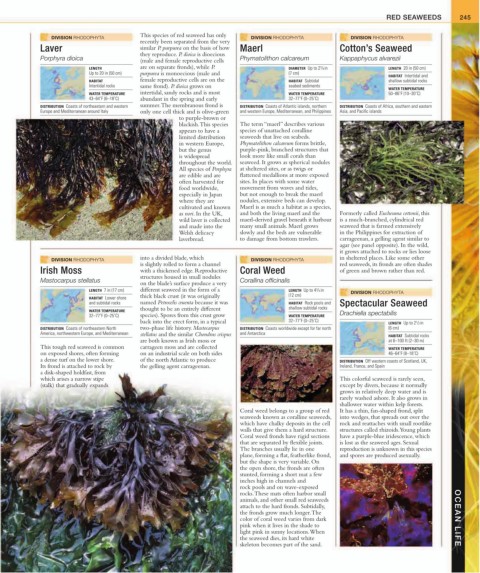
DIVISION RHODOPHYTA This species of red seaweed has only DIVISION RHODOPHYTA DIVISION RHODOPHYTA
recently been separated from the very
Laver similar P. purpurea on the basis of how Maerl Cotton’s Seaweed
they reproduce. P. dioica is dioecious
Porphyra dioica (male and female reproductive cells Phymatolithon calcareum Kappaphycus alvarezii
3
LENGTH are on separate fronds), while P. DIAMETER Up to 2 / 4 in LENGTH 20 in (50 cm)
Up to 20 in (50 cm) purpurea is monoecious (male and (7 cm)
HABITAT Intertidal and
HABITAT female reproductive cells are on the HABITAT Subtidal shallow subtidal rocks
Intertidal rocks same frond). P. dioica grows on seabed sediments WATER TEMPERATURE
WATER TEMPERATURE intertidal, sandy rocks and is most WATER TEMPERATURE 50–86˚F (10–30˚C)
43–64˚F (6–18˚C) abundant in the spring and early 32–77˚F (0–25˚C)
DISTRIBUTION Coasts of northeastern and western summer. The membranous frond is DISTRIBUTION Coasts of Atlantic islands, northern DISTRIBUTION Coasts of Africa, southern and eastern
Europe and Mediterranean around Italy only one cell thick and is olive-green and western Europe, Mediterranean, and Philippines Asia, and Pacific islands
to purple-brown or
blackish. This species The term “maerl” describes various
appears to have a species of unattached coralline
limited distribution seaweeds that live on seabeds.
in western Europe, Phymatolithon calcareum forms brittle,
but the genus purple-pink, branched structures that
is widespread look more like small corals than
throughout the world. seaweed. It grows as spherical nodules
All species of Porphyra at sheltered sites, or as twigs or
are edible and are flattened medallions at more exposed
often harvested for sites. In places with some water
food worldwide, movement from waves and tides,
especially in Japan but not enough to break the maerl
where they are nodules, extensive beds can develop.
cultivated and known Maerl is as much a habitat as a species,
as nori. In the UK, and both the living maerl and the Formerly called Eucheuma cottonii, this
wild laver is collected maerl-derived gravel beneath it harbour is a much-branched, cylindrical red
and made into the many small animals. Maerl grows seaweed that is farmed extensively
Welsh delicacy slowly and the beds are vulnerable in the Philippines for extraction of
laverbread. to damage from bottom trawlers. carrageenan, a gelling agent similar to
agar (see panel opposite). In the wild,
it grows attached to rocks or lies loose
DIVISION RHODOPHYTA into a divided blade, which DIVISION RHODOPHYTA in sheltered places. Like some other
is slightly rolled to form a channel red seaweeds, its fronds are often shades
Irish Moss with a thickened edge. Reproductive Coral Weed of green and brown rather than red.
structures housed in small nodules
Mastocarpus stellatus on the blade’s surface produce a very Corallina officinalis
LENGTH 7 in (17 cm) different seaweed in the form of a LENGTH Up to 4 / 4 in DIVISION RHODOPHYTA
3
thick black crust (it was originally (12 cm)
HABITAT Lower shore
and subtidal rocks named Petrocelis cruenta because it was HABITAT Rock pools and Spectacular Seaweed
thought to be an entirely different shallow subtidal rocks
WATER TEMPERATURE
32–77˚F (0–25˚C) species). Spores from this crust grow WATER TEMPERATURE Drachiella spectabilis
back into the erect form, in a typical 32–77˚F (0–25˚C) LENGTH Up to 2 / 2 in
1
DISTRIBUTION Coasts of northeastern North two-phase life history. Mastocarpus DISTRIBUTION Coasts worldwide except for far north (6 cm)
America, northwestern Europe, and Mediterranean stellatus and the similar Chondrus crispus and Antarctica HABITAT Subtidal rocks
are both known as Irish moss or at 6–100 ft (2–30 m)
This tough red seaweed is common carrageen moss and are collected WATER TEMPERATURE
on exposed shores, often forming on an industrial scale on both sides 46–64˚F (8–18˚C)
a dense turf on the lower shore. of the north Atlantic to produce DISTRIBUTION Off western coasts of Scotland, UK,
Its frond is attached to rock by the gelling agent carrageenan. Ireland, France, and Spain
a disk-shaped holdfast, from
which arises a narrow stipe This colorful seaweed is rarely seen,
(stalk) that gradually expands except by divers, because it normally
grows in relatively deep water and is
rarely washed ashore. It also grows in
shallower water within kelp forests.
Coral weed belongs to a group of red It has a thin, fan-shaped frond, split
seaweeds known as coralline seaweeds, into wedges, that spreads out over the
which have chalky deposits in the cell rock and reattaches with small rootlike
walls that give them a hard structure. structures called rhizoids. Young plants
Coral weed fronds have rigid sections have a purple-blue iridescence, which
that are separated by flexible joints. is lost as the seaweed ages. Sexual
The branches usually lie in one reproduction is unknown in this species
plane, forming a flat, featherlike frond, and spores are produced asexually.
but the shape is very variable. On
the open shore, the fronds are often
stunted, forming a short mat a few
inches high in channels and
rock pools and on wave-exposed
rocks. These mats often harbor small
animals, and other small red seaweeds
attach to the hard fronds. Subtidally,
the fronds grow much longer. The
color of coral weed varies from dark OCEAN LIFE
pink when it lives in the shade to
light pink in sunny locations. When
the seaweed dies, its hard white
skeleton becomes part of the sand.

