


Page 246 - (DK) Ocean - The Definitive Visual Guide
P. 246
244     RED SEAWEEDS


               Red Seaweeds                                                Habitats and
                                                                           Distribution

                                                                           On the shore, red seaweeds
                                           RED SEAWEEDS are attractive
                       DOMAIN  Eucarya                                     mostly live at the lowest levels
                                           marine plants and are found  where they are less likely to
                       KINGDOM Plantae
                                           in shallow seas around          dry out. In deeper water their
                       DIVISION Rhodophyta                                 additional pigments allow them
                                           the world. Their red color
                       CLASSES 2 or more                                   to flourish in the dim blue light
                                           comes from the extra
                       SPECIES 6,394                                       that remains and they extend
                                           pigments they have in           deeper than brown and green
                                                                           seaweeds. Red (and brown)
               addition to green chlorophyll. While they appear
                                                                           seaweeds are less abundant in
               to be plants, they differ in some cellular details and      tropical waters, an exception   BARBED COLONIZER
               metabolism. Many scientists do not consider them            being the red oralline encrusting   This red seaweed has barbed branches
                                                                                                         enabling detached fragments to hook onto
               to be true plants, but there is as yet no full consensus.   seaweeds, which play a very   other organisms and even ships’ hulls.
                                                                           important role in cementing    It disperses in this way and has been
                                                                           coral reefs.                  transported outside its native range.
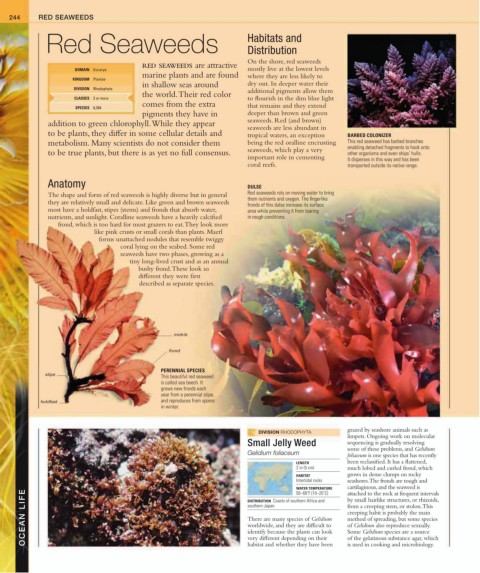
               Anatomy                                                     DULSE

               The shape and form of red seaweeds is highly diverse but in general   Red seaweeds rely on moving water to bring
                                                                           them nutrients and oxygen. The fingerlike
               they are relatively small and delicate. Like green and brown seaweeds
                                                                           fronds of this dulse increase its surface
               most have a holdfast, stipes (stems) and fronds that absorb water,   area while preventing it from tearing
               nutrients, and sunlight. Coralline seaweeds have a heavily calcified   in rough conditions.
                  frond, which is too hard for most grazers to eat. They look more
                             like pink crusts or small corals than plants. Maerl
                              forms unattached nodules that resemble twiggy
                                     coral lying on the seabed. Some red
                                     seaweeds have two phases, growing as a
                                        tiny long-lived crust and as an annual
                                          bushy frond. These look so
                                          different they were first
                                          described as separate species.


                                                     midrib

                                                   frond


                                                 PERENNIAL SPECIES
              stipe
                                                 This beautiful red seaweed
                                                 is called sea beech. It
                                                 grows new fronds each
                                                 year from a perennial stipe,
             holdfast                            and reproduces from spores
                                                 in winter.


                                                                              DIVISION RHODOPHYTA       grazed by seashore animals such as
                                                                                                        limpets. Ongoing work on molecular
                                                                           Small Jelly Weed             sequencing is gradually resolving
                                                                                                        some of these problems, and Gelidium
                                                                           Gelidium foliaceum           foliaceum is one species that has recently
                                                                                         LENGTH         been reclassified. It has a flattened,
                                                                                         2 in (5 cm)    much lobed and curled frond, which
                                                                                         HABITAT        grows in dense clumps on rocky
                                                                                         Intertidal rocks  seashores. The fronds are tough and
                                                                                         WATER TEMPERATURE     cartilaginous, and the seaweed is
        OCEAN LIFE                                                         There are many species of Gelidium   from a creeping stem, or stolon. This
                                                                                                        attached to the rock at frequent intervals
                                                                                         50–68˚F (10–20˚C)
                                                                                                        by small hairlike structures, or rhizoids,
                                                                           DISTRIBUTION  Coasts of southern Africa and
                                                                           southern Japan
                                                                                                        creeping habit is probably the main
                                                                                                        method of spreading, but some species
                                                                                                        of Gelidium also reproduce sexually.
                                                                           worldwide, and they are difficult to
                                                                                                        Some Gelidium species are a source
                                                                           identify because the plants can look
                                                                                                        of the gelatinous substance agar, which
                                                                           very different depending on their
                                                                           habitat and whether they have been
                                                                                                        is used in cooking and microbiology.

