


Page 248 - (DK) Ocean - The Definitive Visual Guide
P. 248
246     PLANT LIFE


               Green Seaweeds                                                                       frond


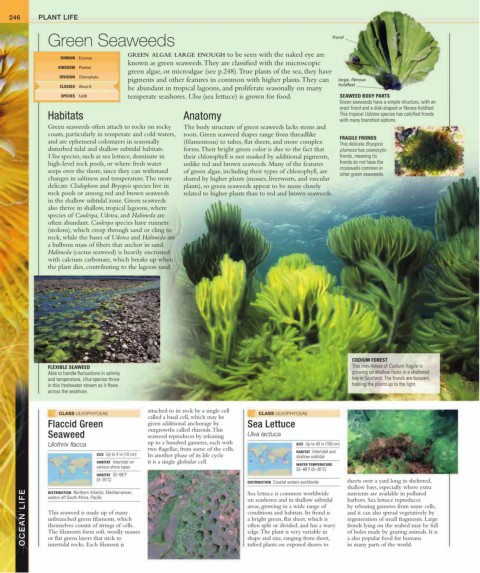
                                       GREEN ALGAE LARGE ENOUGH to be seen with the naked eye are
                   DOMAIN  Eucarya
                                       known as green seaweeds. They are classified with the microscopic
                  KINGDOM Plantae
                                       green algae, or microalgae (see p.248). True plants of the sea, they have
                   DIVISION Chlorophyta
                                       pigments and other features in common with higher plants. They can   large, fibrous
                                                                                                      holdfast
                   CLASSES About 8     be abundant in tropical lagoons, and proliferate seasonally on many
                   SPECIES 5,426       temperate seashores. Ulva (sea lettuce) is grown for food.     SEAWEED BODY PARTS
                                                                                                      Green seaweeds have a simple structure, with an
                                                                                                      erect frond and a disk-shaped or fibrous holdfast.
               Habitats                                 Anatomy                                       This tropical Udotea species has calcified fronds
                                                                                                      with many branched siphons.
               Green seaweeds often attach to rocks on rocky   The body structure of green seaweeds lacks stems and
               coasts, particularly in temperate and cold waters,   roots. Green seaweed shapes range from threadlike
               and are ephemeral colonizers in seasonally   (filamentous) to tubes, flat sheets, and more complex   FRAGILE FRONDS
                                                                                                      This delicate Bryopsis
               disturbed tidal and shallow subtidal habitats.   forms. Their bright green color is due to the fact that   plumosa has coenocytic
               Ulva species, such as sea lettuce, dominate in   their chlorophyll is not masked by additional pigments,   fronds, meaning its
               high-level rock pools, or where fresh water   unlike red and brown seaweeds. Many of the features    fronds do not have the
                                                                                                      crosswalls common in
               seeps over the shore, since they can withstand   of green algae, including their types of chlorophyll, are   other green seaweeds.
               changes in saltiness and temperature. The more   shared by higher plants (mosses, liverworts, and vascular
               delicate Cladophora and Bryopsis species live in   plants), so green seaweeds appear to be more closely
               rock pools or among red and brown seaweeds   related to higher plants than to red and brown seaweeds.
               in the shallow subtidal zone. Green seaweeds
               also thrive in shallow, tropical lagoons, where
               species of Caulerpa, Udotea, and Halimeda are
               often abundant. Caulerpa species have runners
               (stolons), which creep through sand or cling to
               rock, while the bases of Udotea and Halimeda are
               a bulbous mass of fibers that anchor in sand.
               Halimeda (cactus seaweed) is heavily encrusted
               with calcium carbonate, which breaks up when
               the plant dies, contributing to the lagoon sand.


                                                                                                          CODIUM FOREST
               FLEXIBLE SEAWEED                                                                           This mini-forest of Codium fragile is
               Able to handle fluctuations in salinity                                                     growing on shallow rocks in a sheltered
               and temperature, Ulva species thrive                                                       bay in Scotland. The fronds are buoyant,
               in this freshwater stream as it flows                                                       holding the plants up to the light.
               across the seashore.


                                             attached to its rock by a single cell
                  CLASS ULVOPHYCEAE                                           CLASS ULVOPHYCEAE
                                             called a basal cell, which may be
               Flaccid Green                 given additional anchorage by   Sea Lettuce
               Seaweed                       outgrowths called rhizoids. This   Ulva lactuca
                                             seaweed reproduces by releasing
                                             up to a hundred gametes, each with          SIZE  Up to 40 in (100 cm)
               Ulothrix flacca
                                             two flagellae, from some of the cells.
                              SIZE  Up to 4 in (10 cm)  In another phase of its life cycle    HABITAT  Intertidal and
                                                                                         shallow subtidal
                              HABITAT  Intertidal on   it is a single globular cell.     WATER TEMPERATURE
                              various shore types
                                                                                         32–86˚F (0–30˚C)
                              HABITAT  32–68˚F
                              (0–20˚C)
                                                                           DISTRIBUTION  Coastal waters worldwide  sheets over a yard long in sheltered,
                                                                                                        shallow bays, especially where extra
        OCEAN LIFE  This seaweed is made up of many                        areas, growing in a wide range of   by releasing gametes from some cells,
               DISTRIBUTION  Northern Atlantic, Mediterranean,
                                                                           Sea lettuce is common worldwide
                                                                                                        nutrients are available in polluted
               waters off South Africa, Pacific
                                                                           on seashores and in shallow subtidal
                                                                                                        harbors. Sea lettuce reproduces
                                                                           conditions and habitats. Its frond is
                                                                                                        and it can also spread vegetatively by
               unbranched green filaments, which
                                                                           a bright green, flat sheet, which is
                                                                                                        regeneration of small fragments. Large
                                                                                                        fronds lying on the seabed may be full
                                                                           often split or divided, and has a wavy
               themselves consist of strings of cells.
                                                                           edge. The plant is very variable in
                                                                                                        of holes made by grazing animals. It is
               The filaments form soft, woolly masses
                                                                                                        a also popular food for humans
                                                                           shape and size, ranging from short,
               or flat green layers that stick to
                                                                                                        in many parts of the world.
               intertidal rocks. Each filament is
                                                                           tufted plants on exposed shores to

