


Page 251 - (DK) Ocean - The Definitive Visual Guide
P. 251
MOSSES        249


             Mosses                                                     Anatomy

                                                                        Most mosses have a recognizable structure of stems and leaves, which,
                                     MOSSES ARE LOW-GROWING plants
                 DOMAIN  Eucarya                                        as in other plants, gather sunlight and perform photosynthesis. However,
                                     that thrive in damp habitats on land,   unlike flowering plants (see p.250), they do not have woody tissues for
                KINGDOM Plantae
                                     where they may carpet the ground or   support, and they also lack the conducting tissues that transport water
                DIVISION Bryophyta   rocks. They dislike salty environments   and nutrients. Mosses have a very thin outer layer of cells, or cuticle, that
                 SPECIES 13, 365     and only a few species manage to live   can absorb (and lose) water, nutrients, and gases over their entire surface.
                                     in the intertidal zone of coasts, mainly   Their “roots” are simple strands called rhizoids, which anchor the plant
                                                                        to its growing surface. Mosses
             in cooler climates. A much wider variety of mosses can be found                          SPORE PRODUCTION
                                                                        reproduce sexually by means of
             slightly farther inland, away from the direct effects of sea spray but                   Mosses have low-growing leaves, but sprout
                                                                        wind-blown spores, or asexually   taller structures with bulbous tips called
             within range of moisture-laden sea mists.
                                                                        by spreading across the ground.  capsules, from which spores are released.
             Habitats

             Mosses generally prefer moist, shady places and are most numerous in
             the cooler and damper climates of temperate regions. This is because
             they lack the thick cuticle that enables other types of plant to retain
             moisture. Without the protection of this skinlike surface, mosses soon
             shrivel up in dry conditions. However, some mosses have an amazing
             capacity to recover quickly when wetted after a long period of
             drought. A few species grow in salt marshes or among the lichens at
             the top of rocky shores; on sheltered coasts, where there is little salt
             spray, they may live only just above the high tide level. Sand-dune
             mosses grow rapidly to keep pace with accumulating sand, and blown
                                           fragments of moss can colonize
                                           new areas of dunes. Many more
                                           moss species grow on sea cliffs
                                           and in damp gullies away from
                                           the intertidal zone.

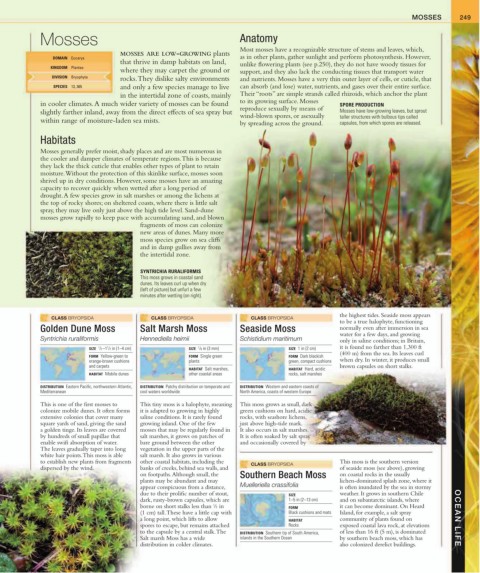
                                           SYNTRICHIA RURALIFORMIS
                                           This moss grows in coastal sand
                                           dunes. Its leaves curl up when dry
                                           (left of picture) but unfurl a few
                                           minutes after wetting (on right).


                CLASS BRYOPSIDA               CLASS BRYOPSIDA               CLASS BRYOPSIDA           the highest tides. Seaside moss appears
                                                                                                      to be a true halophyte, functioning
             Golden Dune Moss              Salt Marsh Moss              Seaside Moss                  normally even after immersion in sea
                                                                                                      water for a few days, and growing
             Syntrichia ruraliformis       Hennediella heimii           Schistidium maritimum         only in saline conditions; in Britain,
                           SIZE   / 2 –1 / 2 in (1–4 cm)  SIZE   / 8 in (3 mm)         SIZE  1 in (2 cm)  it is found no farther than 1,300 ft
                                                            1
                                 1
                              1
                                                                                                      (400 m) from the sea. Its leaves curl
                           FORM  Yellow-green to         FORM  Single green            FORM  Dark blackish
                           orange-brown cushions         plants                        green, compact cushions  when dry. In winter, it produces small
                           and carpets                                                                brown capsules on short stalks.
                                                         HABITAT  Salt marshes,        HABITAT  Hard, acidic
                           HABITAT  Mobile dunes         other coastal areas           rocks, salt marshes
             DISTRIBUTION  Eastern Pacific, northwestern Atlantic,   DISTRIBUTION  Patchy distribution on temperate and   DISTRIBUTION  Western and eastern coasts of
             Mediterranean                 cool waters worldwide        North America, coasts of western Europe
             This is one of the first mosses to   This tiny moss is a halophyte, meaning   This moss grows as small, dark
             colonize mobile dunes. It often forms   it is adapted to growing in highly   green cushions on hard, acidic
             extensive colonies that cover many   saline conditions. It is rarely found   rocks, with seashore lichens,
             square yards of sand, giving the sand    growing inland. One of the few   just above high-tide mark.
             a golden tinge. Its leaves are covered   mosses that may be regularly found in   It also occurs in salt marshes.
             by hundreds of small papillae that   salt marshes, it grows on patches of   It is often soaked by salt spray
             enable swift absorption of water.    bare ground between the other   and occasionally covered by
             The leaves gradually taper into long   vegetation in the upper parts of the
             white hair points. This moss is able    salt marsh. It also grows in various
             to establish new plants from fragments   other coastal habitats, including the   CLASS BRYOPSIDA  This moss is the southern version
             dispersed by the wind.        banks of creeks, behind sea walls, and                     of seaside moss (see above), growing
                                           on footpaths. Although small, the   Southern Beach Moss    on coastal rocks in the usually
                                           plants may be abundant and may                             lichen-dominated splash zone, where it
                                           appear conspicuous from a distance,   Muelleriella crassifolia  is often inundated by the sea in stormy
                                           due to their prolific number of stout,      SIZE           weather. It grows in southern Chile
                                           dark, rusty-brown capsules, which are       1–5 in (2–13 cm)  and on subantarctic islands, where
                                           borne on short stalks less than /2 in       FORM           it can become dominant. On Heard
                                                                1
                                           (1 cm) tall. These have a little cap with   Black cushions and mats  Island, for example, a salt spray
                                           a long point, which lifts to allow          HABITAT        community of plants found on       OCEAN LIFE
                                           spores to escape, but remains attached      Rocks          exposed coastal lava rock, at elevations
                                           to the capsule by a central stalk. The   DISTRIBUTION  Southern tip of South America,   of less than 16 ft (5 m), is dominated
                                           Salt marsh Moss has a wide   islands in the Southern Ocean  by southern beach moss, which has
                                           distribution in colder climates.                           also colonized derelict buildings.

