


Page 290 - (DK) Ocean - The Definitive Visual Guide
P. 290
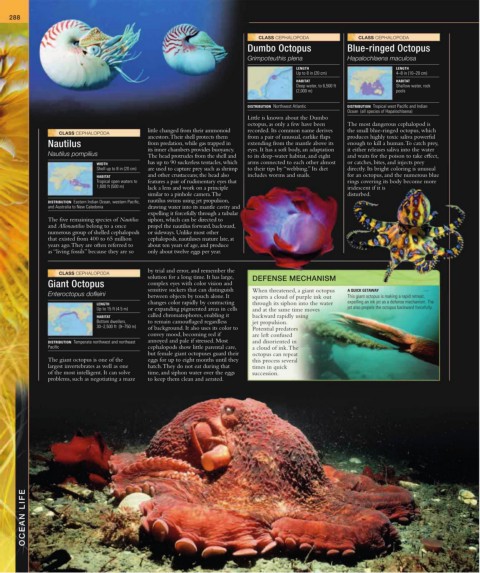
288


                                                                              CLASS CEPHALOPODA             CLASS CEPHALOPODA
                                                                           Dumbo Octopus                Blue-ringed Octopus

                                                                           Grimpoteuthis plena          Hapalochlaena maculosa
                                                                                         LENGTH                        LENGTH
                                                                                         Up to 8 in (20 cm)            4–8 in (10–20 cm)
                                                                                         HABITAT                       HABITAT
                                                                                         Deep water, to 6,500 ft       Shallow water, rock
                                                                                         (2,000 m)                     pools
                                                                           DISTRIBUTION  Northwest Atlantic  DISTRIBUTION  Tropical west Pacific and Indian
                                                                                                        Ocean  (all species of Hapalochlaena)
                                                                           Little is known about the Dumbo
                                                                           octopus, as only a few have been   The most dangerous cephalopod is
                                             little changed from their ammonoid   recorded. Its common name derives   the small blue-ringed octopus, which
                  CLASS CEPHALOPODA
                                             ancestors. Their shell protects them   from a pair of unusual, earlike flaps   produces highly toxic saliva powerful
               Nautilus                      from predation, while gas trapped in    extending from the mantle above its   enough to kill a human. To catch prey,
                                             its inner chambers provides buoyancy.   eyes. It has a soft body, an adaptation   it either releases saliva into the water
                                             The head protrudes from the shell and   to its deep-water habitat, and eight   and waits for the poison to take effect,
               Nautilus pompilius
                              WIDTH          has up to 90 suckerless tentacles, which   arms connected to each other almost   or catches, bites, and injects prey
                              Shell up to 8 in (20 cm)   are used to capture prey such as shrimp   to their tips by “webbing.” Its diet   directly. Its bright coloring is unusual
                              HABITAT        and other crustaceans; the head also   includes worms and snails.  for an octopus, and the numerous blue
                              Tropical open waters to   features a pair of rudimentary eyes that        rings covering its body become more
                              1,600 ft (500 m)  lack a lens and work on a principle                     iridescent if it is
                                             similar to a pinhole camera. The                           disturbed.
               DISTRIBUTION  Eastern Indian Ocean, western Pacific,   nautilus swims using jet propulsion,
               and Australia to New Caledonia  drawing water into its mantle cavity and
                                             expelling it forcefully through a tubular
               The five remaining species of Nautilus   siphon, which can be directed to
               and Allonautilus belong to a once   propel the nautilus forward, backward,
               numerous group of shelled cephalopods   or sideways. Unlike most other
               that existed from 400 to 65 million   cephalopods, nautiluses mature late, at
               years ago. They are often referred to    about ten years of age, and produce
               as “living fossils” because they are so   only about twelve eggs per year.


                                             by trial and error, and remember the
                  CLASS CEPHALOPODA
                                             solution for a long time. It has large,   DEFENSE MECHANISM
               Giant Octopus                 complex eyes with color vision and
                                             sensitive suckers that can distinguish   When threatened, a giant octopus   A QUICK GETAWAY
                                             between objects by touch alone. It                          This giant octopus is making a rapid retreat,
               Enteroctopus dofleini                                         squirts a cloud of purple ink out
                              LENGTH         changes color rapidly by contracting   through its siphon into the water   expelling an ink jet as a defense mechanism. The
                              Up to 15 ft (4.5 m)  or expanding pigmented areas in cells   and at the same time moves   jet also propels the octopus backward forcefully.
                              HABITAT        called chromatophores, enabling it    backward rapidly using
                              Bottom dwellers,    to remain camouflaged regardless    jet propulsion.
                              30–2,500 ft  (9–750 m)   of background. It also uses its color to   Potential predators
                                             convey mood, becoming red if   are left confused
               DISTRIBUTION  Temperate northwest and northeast   annoyed and pale if stressed. Most   and disoriented in
               Pacific                        cephalopods show little parental care,   a cloud of ink. The
                                             but female giant octopuses guard their   octopus can repeat
               The giant octopus is one of the    eggs for up to eight months until they   this process several
               largest invertebrates as well as one    hatch. They do not eat during that   times in quick
               of the most intelligent. It can solve   time, and siphon water over the eggs   succession.
               problems, such as negotiating a maze   to keep them clean and aerated.


        OCEAN LIFE

