


Page 308 - (DK) Ocean - The Definitive Visual Guide
P. 308
306     ANIMAL LIFE


               Echinoderms


                                       THE NAME OF THIS PURELY MARINE group of invertebrates
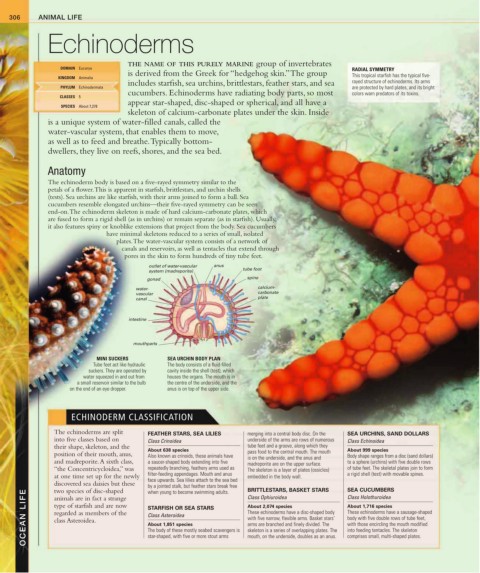
                   DOMAIN  Eucarya                                                                        RADIAL SYMMETRY
                                       is derived from the Greek for “hedgehog skin.” The group           This tropical starfish has the typical five-
                  KINGDOM Animalia
                                       includes starfish, sea urchins, brittlestars, feather stars, and sea   rayed structure of echinoderms. Its arms
                   PHYLUM Echinodermata                                                                   are protected by hard plates, and its bright
                                       cucumbers. Echinoderms have radiating body parts, so most          colors warn predators of its toxins.
                   CLASSES 5
                                       appear star-shaped, disc-shaped or spherical, and all have a
                   SPECIES About 7,278
                                       skeleton of calcium-carbonate plates under the skin. Inside
               is a unique system of water-filled canals, called the
               water-vascular system, that enables them to move,
               as well as to feed and breathe. Typically bottom-
               dwellers, they live on reefs, shores, and the sea bed.

               Anatomy
               The echinoderm body is based on a five-rayed symmetry similar to the
               petals of a flower. This is apparent in starfish, brittlestars, and urchin shells
               (tests). Sea urchins are like starfish, with their arms joined to form a ball. Sea
               cucumbers resemble elongated urchins —their five-rayed symmetry can be seen
               end-on. The echinoderm skeleton is made of hard calcium-carbonate plates, which
               are fused to form a rigid shell (as in urchins) or remain separate (as in starfish). Usually,
               it also features spiny or knoblike extensions that project from the body. Sea cucumbers
                                 have minimal skeletons reduced to a series of small, isolated
                                    plates. The water-vascular system consists of a network of
                                     canals and reservoirs, as well as tentacles that extend through
                                      pores in the skin to form hundreds of tiny tube feet.
                                             outlet of water-vascular   anus
                                             system (madreporite)        tube foot
                                             gonad                         spine
                                         water-                               calcium-
                                         vascular                             carbonate
                                         canal                                plate


                                       intestine


                                         mouthparts
                              MINI SUCKERS         SEA URCHIN BODY PLAN
                             Tube feet act like hydraulic   The body consists of a fluid-filled
                           suckers. They are operated by   cavity inside the shell (test), which
                          water squeezed in and out from    houses the organs. The mouth is in
                        a small reservoir similar to the bulb   the centre of the underside, and the
                      on the end of an eye dropper.   anus is on top of the upper side.


                      ECHINODERM CLASSIFICATION

                 The echinoderms are split                                 merging into a central body disc. On the
                                             FEATHER STARS, SEA LILIES                                  SEA URCHINS, SAND DOLLARS
                 into five classes based on    Class Crinoidea             underside of the arms are rows of numerous   Class Echinoidea
                 their shape, skeleton, and the                            tube feet and a groove, along which they
                 position of their mouth, anus,   About 638 species        pass food to the central mouth. The mouth    About 999 species
                                                                                                        Body shape ranges from a disc (sand dollars)
                                             Also known as crinoids, these animals have
                 and madreporite. A sixth class,   a saucer-shaped body extending into five   is on the underside, and the anus and   to a sphere (urchins) with five double rows
                                                                           madreporite are on the upper surface.
                 “the Concentricycloidea,” was   repeatedly branching, feathery arms used as   The skeleton is a layer of plates (ossicles)   of tube feet. The skeletal plates join to form
                 at one time set up for the newly   filter-feeding appendages. Mouth and anus   embedded in the body wall.  a rigid shell (test) with movable spines.
                                             face upwards. Sea lilies attach to the sea bed
                 discovered sea daisies but these
                                             by a jointed stalk, but feather stars break free   BRITTLESTARS, BASKET STARS  SEA CUCUMBERS
                 two species of disc-shaped
        OCEAN LIFE  type of starfish and are now   STARFISH OR SEA STARS   About 2,074 species          About 1,716 species
                                             when young to become swimming adults.
                                                                                                        Class Holothuroidea
                                                                           Class Ophiuroidea
                 animals are in fact a strange
                                                                           These echinoderms have a disc-shaped body
                                                                                                        These echinoderms have a sausage-shaped
                 regarded as members of the
                                             Class Asteroidea
                                                                           with five narrow, flexible arms. Basket stars’
                                                                                                        body with five double rows of tube feet,
                 class Asteroidea.
                                                                           arms are branched and finely divided. The
                                                                                                        with those encircling the mouth modified
                                             About 1,851 species
                                             The body of these mostly seabed scavengers is
                                                                           skeleton is a series of overlapping plates. The
                                                                                                        into feeding tentacles. The skeleton
                                                                                                        comprises small, multi-shaped plates.
                                                                           mouth, on the underside, doubles as an anus.
                                             star-shaped, with five or more stout arms

