


Page 328 - (DK) Ocean - The Definitive Visual Guide
P. 328
326     ANIMAL LIFE


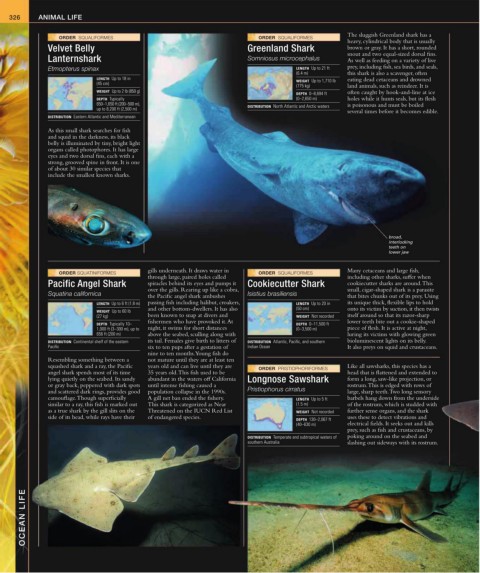
                  ORDER  SQUALIFORMES                                         ORDER  SQUALIFORMES       The sluggish Greenland shark has a
                                                                                                        heavy, cylindrical body that is usually
               Velvet Belly                                                Greenland Shark              brown or gray. It has a short, rounded
                                                                                                        snout and two equal-sized dorsal fins.
               Lanternshark                                                Somniosus microcephalus      As well as feeding on a variety of live
                                                                                         LENGTH  Up to 21 ft    prey, including fish, sea birds, and seals,
               Etmopterus spinax
                                                                                         (6.4 m)        this shark is also a scavenger, often
                              LENGTH  Up to 18 in                                        WEIGHT  Up to 1,710 lb   eating dead cetaceans and drowned
                              (45 cm)
                                                                                         (775 kg)       land animals, such as reindeer. It is
                              WEIGHT  Up to 2 lb (850 g)                                                often caught by hook-and-line at ice
                                                                                         DEPTH  0–8,694 ft
                              DEPTH  Typically                                           (0–2,650 m)    holes while it hunts seals, but its flesh
                              650–1,650 ft (200–500 m),                    DISTRIBUTION  North Atlantic and Arctic waters  is poisonous and must be boiled
                              up to 8,200 ft (2,500 m)
                                                                                                        several times before it becomes edible.
               DISTRIBUTION  Eastern Atlantic and Mediterranean
               As this small shark searches for fish
               and squid in the darkness, its black
               belly is illuminated by tiny, bright light
               organs called photophores. It has large
               eyes and two dorsal fins, each with a
               strong, grooved spine in front. It is one
               of about 30 similar species that
               include the smallest known sharks.


                                                                                                                     broad,
                                                                                                                     interlocking
                                                                                                                     teeth on
                                                                                                                     lower jaw

                  ORDER SQUATINIFORMES       gills underneath. It draws water in   ORDER  SQUALIFORMES  Many cetaceans and large fish,
                                             through large, paired holes called                         including other sharks, suffer when
               Pacific Angel Shark           spiracles behind its eyes and pumps it   Cookiecutter Shark  cookiecutter sharks are around. This
                                             over the gills. Rearing up like a cobra,                   small, cigar-shaped shark is a parasite
               Squatina californica          the Pacific angel shark ambushes   Isistius brasiliensis   that bites chunks out of its prey. Using
                              LENGTH  Up to 6 ft (1.8 m)  passing fish including halibut, croakers,   LENGTH  Up to 20 in   its unique thick, flexible lips to hold
                                             and other bottom-dwellers. It has also      (50 cm)        onto its victim by suction, it then twists
                              WEIGHT  Up to 60 lb
                              (27 kg)        been known to snap at divers and            WEIGHT  Not recorded  itself around so that its razor-sharp
                                             fishermen who have provoked it. At                         lower teeth bite out a cookie-shaped
                              DEPTH  Typically 10–                                       DEPTH  0–11,500 ft
                              1,000 ft (3–300 m), up to   night, it swims for short distances   (0–3,500 m)   piece of flesh. It is active at night,
                              656 ft (200 m)  above the seabed, sculling along with                     luring its victims with glowing green
               DISTRIBUTION  Continental shelf of the eastern   its tail. Females give birth to litters of   DISTRIBUTION  Atlantic, Pacific, and southern    bioluminescent lights on its belly.
               Pacific                        six to ten pups after a gestation of   Indian Ocean        It also preys on squid and crustaceans.
                                             nine to ten months. Young fish do
               Resembling something between a   not mature until they are at least ten
               squashed shark and a ray, the Pacific   years old and can live until they are   ORDER  PRISTIOPHORIFORMES  Like all sawsharks, this species has a
               angel shark spends most of its time   35 years old. This fish used to be                 head that is flattened and extended to
               lying quietly on the seabed. Its sandy   abundant in the waters off California   Longnose Sawshark  form a long, saw-like projection, or
               or gray back, peppered with dark spots   until intense fishing caused a                  rostrum. This is edged with rows of
               and scattered dark rings, provides good  population collapse in the 1990s.    Pristiophorus cirratus  large, sharp teeth. Two long sensory
               camouflage. Though superficially   A gill net ban ended the fishery.      LENGTH  Up to 5 ft   barbels hang down from the underside
               similar to a ray, this fish is marked out   This shark is categorized as Near   (1.5 m)  of the rostrum, which is studded with
               as a true shark by the gill slits on the   Threatened on the IUCN Red List    WEIGHT  Not recorded  further sense organs, and the shark
               side of its head, while rays have their   of endangered species.                         uses these to detect vibrations and
                                                                                         DEPTH  130–2,067 ft
                                                                                         (40–630 m)     electrical fields. It seeks out and kills
                                                                                                        prey, such as fish and crustaceans, by
                                                                           DISTRIBUTION  Temperate and subtropical waters of   poking around on the seabed and
                                                                           southern Australia           slashing out sideways with its rostrum.


        OCEAN LIFE

