


Page 329 - (DK) Ocean - The Definitive Visual Guide
P. 329
SHARKS, RAYS, AND CHIMAERAS            327


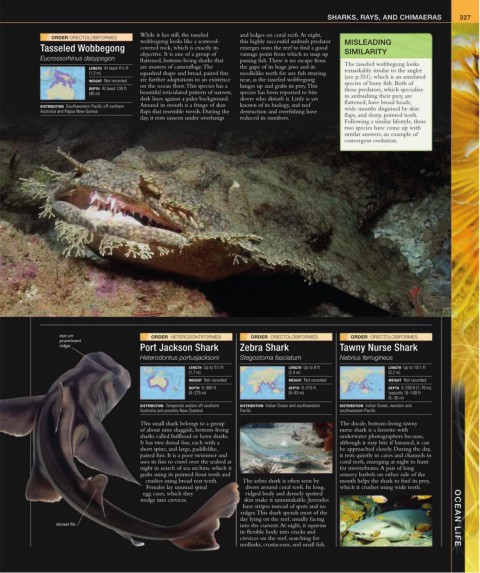
                ORDER ORECTOLOBIFORMES     While it lies still, the tasseled   and ledges on coral reefs. At night,
                                           wobbegong looks like a seaweed-  this highly successful ambush predator   MISLEADING
             Tasseled Wobbegong            covered rock, which is exactly its   emerges onto the reef to find a good   SIMILARITY
                                           objective. It is one of a group of   vantage point from which to snap up
             Eucrossorhinus dasypogon      flattened, bottom-living sharks that    passing fish. There is no escape from   The tasseled wobbegong looks
                           LENGTH  At least 4 / 4 ft   are masters of camouflage. The   the gape of its huge jaws and its   remarkably similar to the angler
                                     1
                           (1.3 m)         squashed shape and broad, paired fins   needlelike teeth for any fish straying   (see p.351), which is an unrelated
                           WEIGHT  Not recorded  are further adaptations to an existence   near, as the tasseled wobbegong    species of bony fish. Both of
                                           on the ocean floor. This species has a   lunges up and grabs its prey. This
                           DEPTH  At least 130 ft                                                       these predators, which specialize
                           (40 m)          beautiful reticulated pattern of narrow,   species has been reported to bite   in ambushing their prey, are
                                           dark lines against a paler background.   divers who disturb it. Little is yet   flattened, have broad heads,
             DISTRIBUTION  Southwestern Pacific off northern   Around its mouth is a fringe of skin   known of its biology, and reef
             Australia and Papua New Guinea  flaps that resemble weeds. During the   destruction and overfishing have   wide mouths disguised by skin
                                           day, it rests unseen under overhangs   reduced its numbers.  flaps, and sharp, pointed teeth.
                                                                                                        Following a similar lifestyle, these
                                                                                                        two species have come up with
                                                                                                        similar answers, an example of
                                                                                                        convergent evolution.


                   eye on                     ORDER  HETERODONTIFORMES      ORDER  ORECTOLOBIFORMES      ORDER  ORECTOLOBIFORMES
                   prominent
                   ridge                   Port Jackson Shark           Zebra Shark                   Tawny Nurse Shark

                                           Heterodontus portusjacksoni  Stegostoma fasciatum          Nebrius ferrugineus
                                                                                                                              1
                                                                 1
                                                         LENGTH  Up to 5 / 2 ft        LENGTH  Up to 8 ft            LENGTH  Up to 10 / 2 ft
                                                         (1.7 m)                       (2.4 m)                       (3.2 m)
                                                         WEIGHT  Not recorded          WEIGHT  Not recorded          WEIGHT  Not recorded
                                                         DEPTH  0–900 ft               DEPTH  0–210 ft               DEPTH  3–230 ft (1–70 m),
                                                         (0–275 m)                     (0–63 m)                      typically 16–100 ft
                                                                                                                     (5–30 m)
                                           DISTRIBUTION  Temperate waters off southern   DISTRIBUTION  Indian Ocean and southwestern   DISTRIBUTION  Indian Ocean, western and
                                           Australia and possibly New Zealand  Pacific                 southwestern Pacific
                                           This small shark belongs to a group                        The docile, bottom-living tawny
                                           of about nine sluggish, bottom-living                      nurse shark is a favorite with
                                           sharks called bullhead or horn sharks.                     underwater photographers because,
                                           It has two dorsal fins, each with a                        although it may bite if harassed, it can
                                           short spine, and large, paddlelike,                        be approached closely. During the day,
                                           paired fins. It is a poor swimmer and                      it rests quietly in caves and channels in
                                           uses its fins to crawl over the seabed at                  coral reefs, emerging at night to hunt
                                           night in search of sea urchins, which it                   for invertebrates. A pair of long
                                           grabs using its pointed front teeth and                    sensory barbels on either side of the
                                            crushes using broad rear teeth.   The zebra shark is often seen by   mouth helps the shark to find its prey,
                                            Females lay unusual spiral    divers around coral reefs. Its long,   which it crushes using wide teeth.
                                           egg cases, which they          ridged body and densely spotted
                                           wedge into crevices.           skin make it unmistakable. Juveniles
                                                                         have stripes instead of spots and no
                                                                         ridges. This shark spends most of the
                                                                        day lying on the reef, usually facing                            OCEAN LIFE
                  dorsal fin                                             into the current. At night, it squirms
                                                                        its flexible body into cracks and
                                                                        crevices on the reef, searching for
                                                                        mollusks, crustaceans, and small fish.

