


Page 331 - (DK) Ocean - The Definitive Visual Guide
P. 331
SHARKS, RAYS, AND CHIMAERAS            329


                ORDER LAMNIFORMES           HUMAN IMPACT
             White Shark                    SHARK ATTACK

                                            The white shark has made more
             Carcharodon carcharias
                           LENGTH  Up to about    unprovoked attacks on humans
                           20 ft (6 m)      than any other shark. However,
                           WEIGHT  Over 3.7 tons   humans are not its natural prey
                           (3.4 metric tons)  and many such attacks can be
                           DEPTH  0–4,300 ft    put down to the shark mistaking a
                           (0–1,300 m)      diver for a seal or turtle. When
             DISTRIBUTION  Wide range through most oceans   stimulated by bait in the water,
             except polar waters            white sharks will bite anything,
                                            even a metal diving cage.
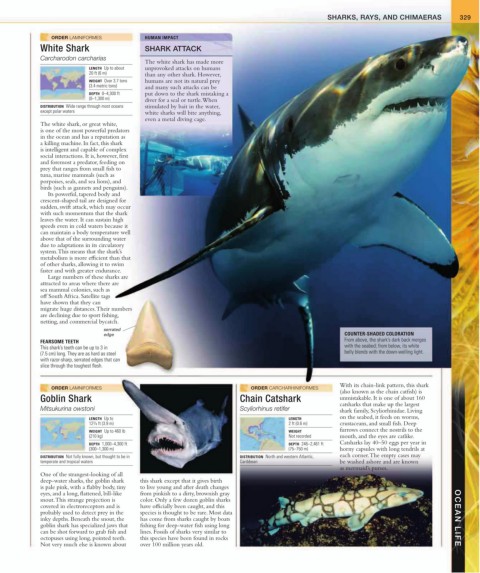
             The white shark, or great white,
             is one of the most powerful predators
             in the ocean and has a reputation as
             a killing machine. In fact, this shark
             is intelligent and capable of complex
             social interactions. It is, however, first
             and foremost a predator, feeding on
             prey that ranges from small fish to
             tuna, marine mammals (such as
             porpoises, seals, and sea lions), and
             birds (such as gannets and penguins).
               Its powerful, tapered body and
             crescent-shaped tail are designed for
             sudden, swift attack, which may occur
             with such momentum that the shark
             leaves the water. It can sustain high
             speeds even in cold waters because it
             can maintain a body temperature well
             above that of the surrounding water
             due to adaptations in its circulatory
             system. This means that the shark’s
             metabolism is more efficient than that
             of other sharks, allowing it to swim
             faster and with greater endurance.
               Large numbers of these sharks are
             attracted to areas where there are
             sea mammal colonies, such as
             off South Africa. Satellite tags
             have shown that they can
             migrate huge distances. Their numbers
             are declining due to sport fishing,
             netting, and commercial bycatch.
                                serrated
                                edge                                                                    COUNTER-SHADED COLORATION
             FEARSOME TEETH                                                                             From above, the shark’s dark back merges
             This shark’s teeth can be up to 3 in                                                       with the seabed; from below, its white
             (7.5 cm) long. They are as hard as steel                                                   belly blends with the down-welling light.
             with razor-sharp, serrated edges that can
             slice through the toughest flesh.

                                                                                                      With its chain-link pattern, this shark
                ORDER LAMNIFORMES                                           ORDER CARCHARHINIFORMES
                                                                                                      (also known as the chain catfish) is
             Goblin Shark                                               Chain Catshark                unmistakable. It is one of about 160
                                                                                                      catsharks that make up the largest
                                                                                                      shark family, Scyliorhinidae. Living
             Mitsukurina owstoni                                        Scyliorhinus retifer
                           LENGTH  Up to                                               LENGTH         on the seabed, it feeds on worms,
                           12 / 4 ft (3.9 m)                                           2 ft (0.6 m)   crustaceans, and small fish. Deep
                             3
                           WEIGHT  Up to 460 lb                                        WEIGHT         furrows connect the nostrils to the
                           (210 kg)                                                    Not recorded   mouth, and the eyes are catlike.
                           DEPTH  1,000–4,300 ft                                       DEPTH  246–2,461 ft   Catsharks lay 40–50 eggs per year in
                           (300–1,300 m)                                               (75–750 m)     horny capsules with long tendrils at
             DISTRIBUTION  Not fully known, but thought to be in        DISTRIBUTION  North and western Atlantic,   each corner. The empty cases may
             temperate and tropical waters                              Caribbean                     be washed ashore and are known
                                                                                                      as mermaid’s purses.
             One of the strangest-looking of all
             deep-water sharks, the goblin shark    this shark except that it gives birth
             is pale pink, with a flabby body, tiny   to live young and after death changes
             eyes, and a long, flattened, bill-like   from pinkish to a dirty, brownish gray
             snout. This strange projection is   color. Only a few dozen goblin sharks
             covered in electroreceptors and is   have officially been caught, and this
             probably used to detect prey in the   species is thought to be rare. Most data
             inky depths. Beneath the snout, the   has come from sharks caught by boats                                                  OCEAN LIFE
             goblin shark has specialized jaws that   fishing for deep-water fish using long
             can be shot forward to grab fish and   lines. Fossils of sharks very similar to
             octopuses using long, pointed teeth.   this species have been found in rocks
             Not very much else is known about   over 100 million years old.

