


Page 327 - (DK) Ocean - The Definitive Visual Guide
P. 327
SHARKS, RAYS, AND CHIMAERAS            325


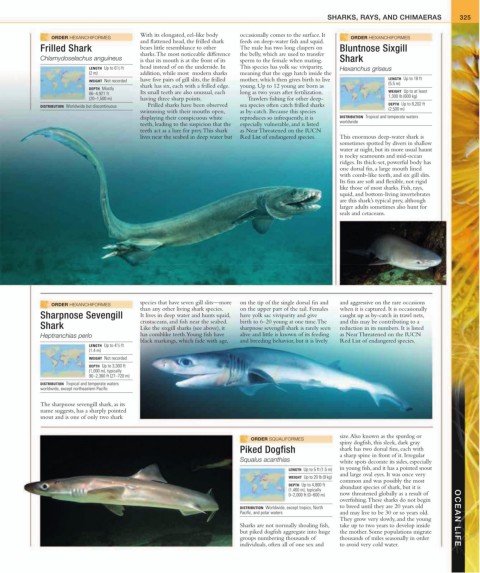
                ORDER HEXANCHIFORMES       With its elongated, eel-like body    occasionally comes to the surface. It   ORDER HEXANCHIFORMES
                                           and flattened head, the frilled shark   feeds on deep-water fish and squid.
             Frilled Shark                 bears little resemblance to other   The male has two long claspers on    Bluntnose Sixgill
                                           sharks. The most noticeable difference   the belly, which are used to transfer
             Chlamydoselachus anguineus    is that its mouth is at the front of its   sperm to the female when mating.   Shark
                           LENGTH  Up to 6 / 2 ft   head instead of on the underside. In   This species has yolk sac viviparity,
                                    1
                           (2 m)           addition, while most  modern sharks   meaning that the eggs hatch inside the   Hexanchus griseus
                           WEIGHT  Not recorded  have five pairs of gill slits, the frilled   mother, which then gives birth to live   LENGTH  Up to 18 ft
                                                                                                                     (5.5 m)
                                           shark has six, each with a frilled edge.   young. Up to 12 young are born as
                           DEPTH  Mostly
                           66–4,921 ft     Its small teeth are also unusual, each   long as two years after fertilization.   WEIGHT  Up to at least
                           (20–1,500 m)    having three sharp points.      Trawlers fishing for other deep-          1,300 lb (600 kg)
             DISTRIBUTION  Worldwide but discontinuous  Frilled sharks have been observed   sea species often catch frilled sharks    DEPTH  Up to 8,202 ft
                                                                                                                     (2,500 m)
                                           swimming with their mouths open,   as by-catch. Because this species
                                           displaying their conspicuous white   reproduces so infrequently, it is   DISTRIBUTION  Tropical and temperate waters
                                           teeth, leading to the suspicion that the   especially vulnerable, and is listed    worldwide
                                           teeth act as a lure for prey. This shark   as Near Threatened on the IUCN
                                           lives near the seabed in deep water but   Red List of endangered species.  This enormous deep-water shark is
                                                                                                      sometimes spotted by divers in shallow
                                                                                                      water at night, but its more usual haunt
                                                                                                      is rocky seamounts and mid-ocean
                                                                                                      ridges. Its thick-set, powerful body has
                                                                                                      one dorsal fin, a large mouth lined
                                                                                                      with comb-like teeth, and six gill slits.
                                                                                                      Its fins are soft and flexible, not rigid
                                                                                                      like those of most sharks. Fish, rays,
                                                                                                      squid, and bottom-living invertebrates
                                                                                                      are this shark’s typical prey, although
                                                                                                      larger adults sometimes also hunt for
                                                                                                      seals and cetaceans.


                ORDER HEXANCHIFORMES       species that have seven gill slits—more   on the tip of the single dorsal fin and   and aggressive on the rare occasions
                                           than any other living shark species.    on the upper part of the tail. Females   when it is captured. It is occasionally
             Sharpnose Sevengill           It lives in deep water and hunts squid,   have yolk sac viviparity and give    caught up as by-catch in trawl nets,
             Shark                         crustaceans, and fish near the seabed.   birth to 6–20 young at one time. The   and this may be contributing to a
                                                                        sharpnose sevengill shark is rarely seen
                                           Like the sixgill sharks (see above), it
                                                                                                      reduction in its numbers. It is listed
                                           has comblike teeth. Young fish have   alive and little is known of its feeding   as Near Threatened on the IUCN
             Heptranchias perlo
                                           black markings, which fade with age,   and breeding behavior, but it is lively   Red List of endangered species.
                                    1
                           LENGTH  Up to 4 / 2 ft
                           (1.4 m)
                           WEIGHT  Not recorded
                           DEPTH  Up to 3,300 ft
                           (1,000 m), typically
                           90–2,360 ft (27–720 m)
             DISTRIBUTION  Tropical and temperate waters
             worldwide, except northeastern Pacific
             The sharpnose sevengill shark, as its
             name suggests, has a sharply pointed
             snout and is one of only two shark

                                                                                                      size. Also known as the spurdog or
                                                                            ORDER SQUALIFORMES
                                                                                                      spiny dogfish, this sleek, dark gray
                                                                        Piked Dogfish                 shark has two dorsal fins, each with
                                                                                                      a sharp spine in front of it. Irregular
                                                                                                      white spots decorate its sides, especially
                                                                        Squalus acanthias
                                                                                       LENGTH  Up to 5 ft (1.5 m)  in young fish, and it has a pointed snout
                                                                                                      and large oval eyes. It was once very
                                                                                       WEIGHT  Up to 20 lb (9 kg)
                                                                                                      common and was possibly the most
                                                                                       DEPTH  Up to 4,800 ft   abundant species of shark, but it is
                                                                                       (1,460 m), typically
                                                                                       0–2,000 ft (0–600 m)   now threatened globally as a result of
                                                                                                      overfishing. These sharks do not begin
                                                                        DISTRIBUTION  Worldwide, except tropics, North   to breed until they are 20 years old
                                                                        Pacific, and polar waters      and may live to be 30 or so years old.
                                                                                                      They grow very slowly, and the young   OCEAN LIFE
                                                                        Sharks are not normally shoaling fish,   take up to two years to develop inside
                                                                        but piked dogfish aggregate into huge   the mother. Some populations migrate
                                                                        groups numbering thousands of   thousands of miles seasonally in order
                                                                        individuals, often all of one sex and   to avoid very cold water.

