Page 325 - (DK) Ocean - The Definitive Visual Guide
P. 325
CARTILAGINOUS FISH CLASSIFICATION                          323

             Reproduction                                                 Sharks and rays are classified together in one class (the Elasmobranchii),
                                                                          while chimaeras, which include ratfish and rabbitfish, are placed in
             In all cartilaginous fishes, the eggs are fertilized inside    their own class (Holocephali). Sharks comprise nine orders and rays
             the female’s body. Adult males have organs on the belly      four orders. Chimaeras have one order, the Chimaeriformes.
             called claspers—rodlike appendages derived from the
             pelvic fins. During mating, one or both claspers are         CHIMAERAS                   spiracles. They have large pectoral and
             inserted into the female’s cloaca (the shared opening of     Order Chimaeriformes        pelvic fins, two small dorsal fins, but no
             the digestive and reproductive tracts) to introduce the                                  anal fin. Reproduction is yolk sac viviparity.
                                                                          About 49 species
             sperm. In sharks, mating can be a rough affair, although     Chimaeras have a long, flabby body without
             there may be some courtship.                                 scales, a large head with sensory canals,   BULLHEAD AND HORN SHARKS
                                                                                                      Order Heterodontiformes
                Chimaeras, as well as some sharks and rays, lay           plate-like teeth, and one gill opening. The
                                                                          first of two dorsal fins is erectile with a
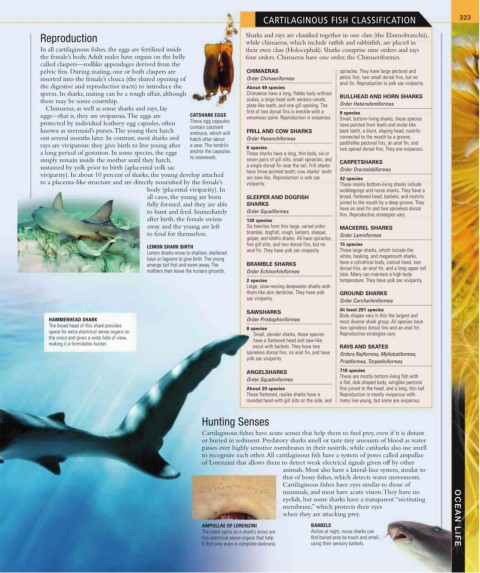
             eggs—that is, they are oviparous. The eggs are   CATSHARK EGGS  venomous spine. Reproduction is oviparous.   9 species
                                                                                                      Small, bottom-living sharks, these species
             protected by individual leathery egg capsules, often   These egg capsules                have pointed front teeth and molar-like
                                                          contain catshark
             known as mermaid’s purses. The young then hatch                                          back teeth, a blunt, sloping head, nostrils
                                                          embryos, which will   FRILL AND COW SHARKS
             out several months later. In contrast, most sharks and   hatch after about    Order Hexanchiformes  connected to the mouth by a groove,
             rays are viviparous: they give birth to live young after   a year. The tendrils          paddlelike pectoral fins, an anal fin, and
                                                                                                      two spined dorsal fins. They are oviparous.
             a long period of gestation. In some species, the eggs   anchor the capsules   6 species
                                                                          These sharks have a long, thin body, six or
                                                          to seaweeds.
             simply remain inside the mother until they hatch,            seven pairs of gill slits, small spiracles, and
             sustained by yolk prior to birth (aplacental yolk sac        a single dorsal fin near the tail. Frill sharks   CARPETSHARKS
                                                                                                      Order Orectolobiformes
             viviparity). In about 10 percent of sharks, the young develop attached    have three-pointed teeth; cow sharks’ teeth
                                                                          are saw-like. Reproduction is yolk sac
             to a placenta-like structure and are directly nourished by the female’s   viviparity.    42 species
                                                                                                      These mainly bottom-living sharks include
                                             body (placental viviparity). In                          wobbegongs and nurse sharks. They have a
                                             all cases, the young are born   SLEEPER AND DOGFISH      broad, flattened head, barbels, and nostrils
                                             fully formed, and they are able   SHARKS                 joined to the mouth by a deep groove. They
                                             to hunt and feed. Immediately   Order Squaliformes       have an anal fin and two spineless dorsal
                                                                                                      fins. Reproductive strategies vary.
                                             after birth, the female swims
                                                                          130 species
                                             away and the young are left    Six families form this large, varied order:
                                                                                                      MACKEREL SHARKS
                                             to fend for themselves.      bramble, dogfish, rough, lantern, sleeper,   Order Lamniformes
                                                                          gulper, and kitefin sharks. All have spiracles,
                                                                          five gill slits, and two dorsal fins, but no
                                             LEMON SHARK BIRTH                                        15 species
                                             Lemon sharks move to shallow, sheltered   anal fin. They have yolk sac viviparity.   These large sharks, which include the
                                             bays or lagoons to give birth. The young                 white, basking, and megamouth sharks,
                                             emerge tail first and swim away. The   BRAMBLE SHARKS     have a cylindrical body, conical head, two
                                             mothers then leave the nursery grounds.  Order Echinorhiniformes  dorsal fins, an anal fin, and a long upper tail
                                                                                                      lobe. Many can maintain a high body
                                                                                                      temperature. They have yolk sac viviparity.
                                                                          2 species
                                                                          Large, slow-moving deepwater sharks with
                                                                          thorn-like skin denticles. They have yolk
                                                                                                      GROUND SHARKS
                                                                          sac viviparity.             Order Carcharhiniformes
                                                                                                      At least 291 species
                                                                          SAWSHARKS                   Body shapes vary in this the largest and
               HAMMERHEAD SHARK                                           Order Pristiophoriformes
                                                                                                      most diverse shark group. All species have
               The broad head of this shark provides
                                                                                                      two spineless dorsal fins and an anal fin.
               space for extra electrical sense organs on                 8 species
                                                                            Small, slender sharks, these species   Reproductive strategies vary.
               the snout and gives a wide field of view,
                                                                            have a flattened head and saw-like
               making it a formidable hunter.
                                                                            snout with barbels. They have two
                                                                                                      RAYS AND SKATES
                                                                          spineless dorsal fins, no anal fin, and have   Orders Rajiformes, Myliobatiformes,
                                                                          yolk sac viviparity.
                                                                                                      Pristiformes, Torpediniformes
                                                                                                      718 species
                                                                          ANGELSHARKS                 These are mostly bottom-living fish with
                                                                          Order Squatiniformes
                                                                                                      a flat, disk-shaped body, winglike pectoral
                                                                                                      fins joined to the head, and a long, thin tail.
                                                                          About 20 species
                                                                          These flattened, raylike sharks have a   Reproduction is mostly viviparous with
                                                                          rounded head with gill slits on the side, and   many live young, but some are oviparous.
                                                             Hunting Senses
                                                             Cartilaginous fishes have acute senses that help them to find prey, even if it is distant
                                                             or buried in sediment. Predatory sharks smell or taste tiny amounts of blood as water
                                                             passes over highly sensitive membranes in their nostrils, while catsharks also use smell
                                                             to recognize each other. All cartilaginous fish have a system of pores called ampullae
                                                             of Lorenzini that allows them to detect weak electrical signals given off by other
                                                                                     animals. Most also have a lateral-line system, similar to
                                                                                     that of bony fishes, which detects water movements.
                                                                                     Cartilaginous fishes have eyes similar to those of
                                                                                     mammals, and most have acute vision. They have no
                                                                                     eyelids, but some sharks have a transparent “nictitating
                                                                                     membrane,” which protects their eyes
                                                                                     when they are attacking prey.                       OCEAN LIFE
                                                             AMPULLAE OF LORENZINI            BARBELS
                                                             The black spots on a shark’s snout are   Active at night, nurse sharks can
                                                             tiny electrical sense organs that help    find buried prey by touch and smell,
                                                             it find prey even in complete darkness.   using their sensory barbels.
   320   321   322   323   324   325   326   327   328   329   330