


Page 324 - (DK) Ocean - The Definitive Visual Guide
P. 324
322     ANIMAL LIFE


               Sharks, Rays, and Chimaeras


                                       SHARKS, RAYS, AND CHIMAERAS are often informally grouped
                   DOMAIN  Eucarya                                                                        HUMAN IMPACT
                                       together as cartilaginous fish as they all have similar flexible
                  KINGDOM Animalia                                                                        SHARK
                                       skeletons. Within the group are some of Earth’s most efficient
                   PHYLUM Chordata                                                                        FISHING
                                       predators, such as the white shark, as well as filter feeders, such
                    CLASS Elasmobranchii
                                       as the manta way. Some have features unusual for fish, such as     Sharks are heavily fished all over
                 SUBCLASSES 2                                                                             the world for their meat, fins, liver
                                       large brains, live birth, and warm blood. Fossils show that
                   SPECIES 1,290                                                                          oil, and skin. They reproduce very
                                       cartilaginous fishes have changed little in form in hundreds of    slowly, producing only a few
                                                                                                          young every one to two years, and
               millions of years. All have a skeleton of cartilage, teeth that are replaced by new ones   many species take a decade or
               when necessary, and toothlike scales covering their skin.                     snout        more to reach full maturity. This
                                                                                                          slow rate of both reproduction
                                                                     mouth
                                                                                                nostril   and growth means that shark
               Anatomy                                            pectoral fin                             populations cannot sustain heavy
                                                                                                 gill slits  fishing pressure, and take many
               The internal skeleton of all the fishes in this group is made from                         years to recover. Worldwide, most
               flexible cartilage. In some species, parts of the skull and skeleton                       stocks are currently being fished at
                                                                                                          rates above safe biological limits.
               are strengthened by mineral deposits. The teeth are covered by
               very hard enamel and are formidable weapons. Sharks have several
               rows of teeth lying flat behind the active ones. These gradually
               move forward, and individual teeth may be replaced as often as
               every 8–15 days. Cartilaginous fishes have extremely tough skin. It
               is extra-thick in female sharks because males use their teeth to hold   pelvic fin
               onto them when mating. A shark’s skin is covered in tiny, backward-      RAY BODY SHAPE
               pointing, toothlike structures called dermal denticles, which feel like   cloaca  Skates and rays have flat
               sandpaper. Rays have scattered denticles, some enlarged to form spines,   tail  bodies and large pectoral
                                                                                      fins. The mouth is on the
               while chimaeras mostly have no denticles. Unlike bony fishes (see     underside, so water for
               pp.338–41), cartilaginous fishes do not have a                       breathing is sucked in through   SHARK FINS
                                                               first dorsal fin
               gas-filled swim bladder. Sharks living in the                        a pair of holes, called spiracles,   Thousands of sharks are killed every year for
               open ocean, however, often have a very                              on the upper side, then passed   their valuable fins, which are dried and then
                                                                                                          made into shark-fin soup. The body is often
               large, oil-filled liver, which aids buoyancy.                      over the gills.         discarded while the shark is still alive.
                                                                      gill slit
                                   second dorsal fin
                                                                                eye


                                             pelvic fin                      underslung
                                     anal fin
                                                                            mouth
                    heterocercal tail                    pectoral fin
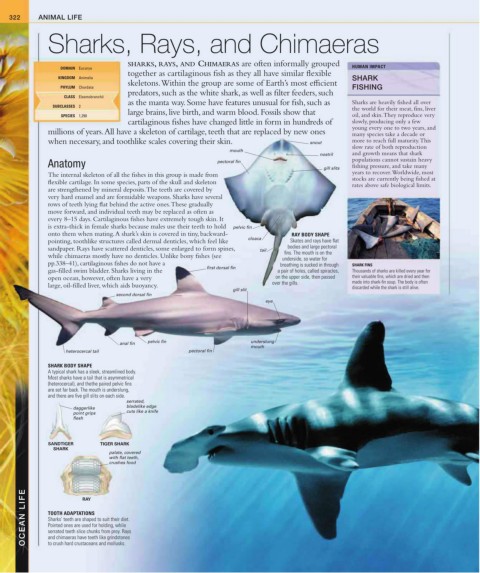
               SHARK BODY SHAPE
               A typical shark has a sleek, streamlined body.
               Most sharks have a tail that is asymmetrical
               (heterocercal), and thethe paired pelvic fins
               are set far back. The mouth is underslung,
               and there are five gill slits on each side.
                                       serrated,
                       daggerlike      bladelike edge
                       point grips     cuts like a knife
                       flesh


               SANDTIGER       TIGER SHARK
                 SHARK
                                 palate, covered
                                 with flat teeth,
                                 crushes food


        OCEAN LIFE  TOOTH ADAPTATIONS
                         RAY

               Sharks’ teeth are shaped to suit their diet.
               Pointed ones are used for holding, while
               serrated teeth slice chunks from prey. Rays
               and chimaeras have teeth like grindstones
               to crush hard crustaceans and mollusks.

