


Page 326 - (DK) Ocean - The Definitive Visual Guide
P. 326
324
ORDER CHIMAERIFORMES
Pacific Spookfish
Rhinochimaera pacifica
LENGTH About 4 / 4 ft
1
(1.3 m), plus tail filament
WEIGHT Not recorded
DEPTH 1,100–4,900 ft
(330–1,500 m)
DISTRIBUTION Parts of Pacific and eastern Indian
Ocean
When scientists first hauled a Pacific
spookfish up from the ocean depths,
REPRODUCTIVE they were astonished by the sight of its
enormously long, conical snout. The
EMBRACE long, brownish body of this strange-
looking fish tapers to a thin tail, so
Mating underwater is a slippery that the fish gives the impression of
business, so the male plownose being pointed at both ends. The snout
chimaera has a retractable, is whitish, flexible, and covered in
clublike, spiny clasper on its head sensory pores and canals.
that helps it hang onto the female. Living in the dark depths of the
The plownose chimaera is also The male transfers his sperm ocean where its small eyes are of at
ORDER CHIMAERIFORMES
known as the elephant fish due to when he inserts his pelvic clasper best limited use, the spookfish uses its
Plownose Chimaera its most distinctive feature, a long, into the female’s cloaca. snout to find food and sense objects
fleshy snout. The plownose uses this around it. The beak-shaped mouth
bizarre appendage to snuffle through retractable under the base of the snout contains
Callorhinchus milii
clasper
LENGTH mud of the ocean floor in search of pairs of black, platelike teeth. Its tail
1
Up to about 4 / 4 ft (1.3 m) shellfish, which it crunches up using has only a small lower lobe, while the
WEIGHT its plate-like teeth. A network of upper lobe consists of a row of fleshy
Not recorded prominent sensory canals crisscrosses tubercles. Like other chimaeras, the
DEPTH its head. In spring, these fish come spookfish relies mainly on its pectoral
At least 750 ft (230 m) inshore into estuaries and bays to fins for propulsion rather than using
DISTRIBUTION Temperate waters in the southwest breed, and lay their eggs in horny, its tail as most species of fish do.
Pacific, off southern Australia and along the east yellow-brown capsules. This chimaera A very similar species of spookfish
coast of South Island, New Zealand is fished commercially for food. is found in the Atlantic Ocean.
and tails ending in a long, thin filament,
ORDER CHIMAERIFORMES
giving rise to their alternative name of
Rabbit Fish ratfishes. The long, sharp spine in front
of the first dorsal fin of the rabbit
fish is venomous and can inflict a
Chimaera monstrosa
LENGTH Up to 5 ft (1.5 m) serious wound. Unlike sharks but in
common with all other chimaeras,
WEIGHT Up to 5 / 2 lb
1
(2.5 kg) the rabbit fish can raise and lower this
fin. The second dorsal fin is low and
DEPTH Typically
1,000–1,300 ft long and almost reaches the tail fin.
(300–400 m) Rabbit fish swim sluggishly in small
DISTRIBUTION Eastern Atlantic and Mediterranean groups and feed mainly on seabed
invertebrates using their paired, rabbit-
Beautifully patterned with wavy like teeth. These
brown and white lines, the rabbit fish are often
fish belongs to a family called caught by accident
Chimaeridae, whose members have in shrimp nets in
ORDER CHIMAERIFORMES spots help to camouflage deer in a rounded snouts, long, tapering bodies, the North Sea.
forest. The spotted ratfish uses its
Spotted Ratfish large pectoral fins to glide and flap
its way over the seabed in search
Hydrolagus colliei of its prey, which consists mainly of
1
LENGTH Up to 3 / 4 ft mollusks and crustaceans. Like other
(1 m) chimaeras, the female lays eggs, each
WEIGHT Not recorded one encased in a tadpole-shaped,
protective capsule. The eggs are laid
DEPTH Close inshore to
at least 2,950 ft (900 m) in the summer, two at a time, and
are dropped onto the seabed.
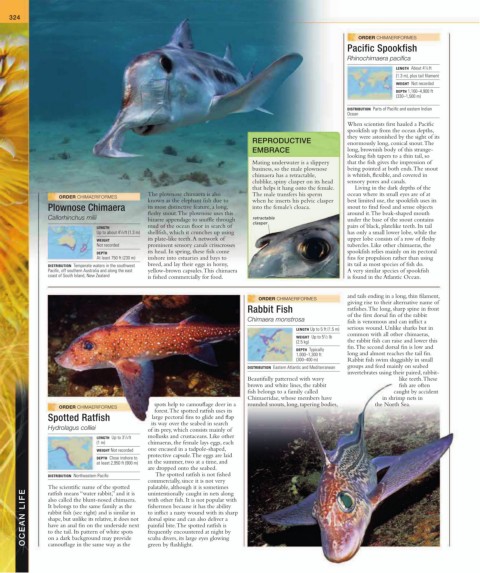
DISTRIBUTION Northeastern Pacific The spotted ratfish is not fished
commercially, since it is not very
The scientific name of the spotted palatable, although it is sometimes
OCEAN LIFE It belongs to the same family as the fishermen because it has the ability
unintentionally caught in nets along
ratfish means “water rabbit,” and it is
also called the blunt-nosed chimaera.
with other fish. It is not popular with
to inflict a nasty wound with its sharp
rabbit fish (see right) and is similar in
shape, but unlike its relative, it does not
dorsal spine and can also deliver a
painful bite. The spotted ratfish is
have an anal fin on the underside next
to the tail. Its pattern of white spots
frequently encountered at night by
on a dark background may provide
scuba divers, its large eyes glowing
camouflage in the same way as the
green by flashlight.

