


Page 39 - (DK) Ocean - The Definitive Visual Guide
P. 39
LIGHT AND SOUND 37
Sea Colours
LOOKING UP
Seen from underwater, only a Seawater has no intrinsic colour – a glass of seawater is
part of the surface of the sea transparent. But on a clear, sunny day, the sea usually looks
appears lit up, while the rest blue or turquoise. In part, this is due to the sea surface
looks dark. This is an effect
of the way light waves are reflecting the sky, but the main reason is that most of the
bent (refracted) when they light coming off the surface has already penetrated it
enter the sea from the air. and been reflected back by particles in the water or
by the sea bed. During its journey through the
water, most of the light is absorbed, except for VIVID GREEN FROM ALGAL BLOOM
some blue and green light, which are the
colours seen. Other factors can modify the
sea’s colour. In windy weather, the surface
becomes flecked with white, caused by
trapped bubbles of air, which reflect most
of the light that hits them. Rain interferes
with seawater’s light-transmitting
properties, so rainy, overcast weather
generally produces dark, grey-green TROPICAL TURQUOISE
seas. Occasionally, living organisms,
such as “blooms” of plankton can
turn patches of the sea vivid colours.
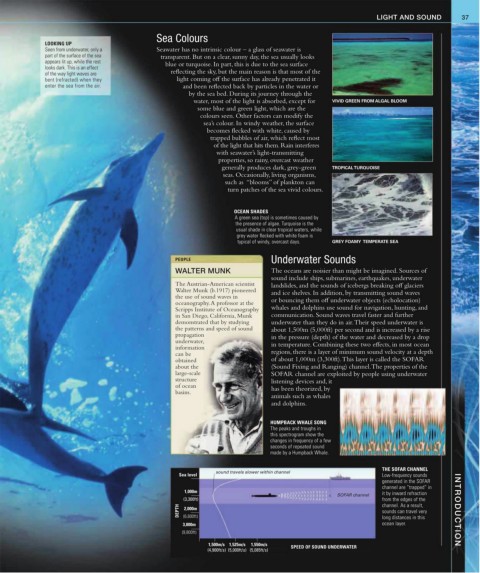
OCEAN SHADES
A green sea (top) is sometimes caused by
the presence of algae. Turquoise is the
usual shade in clear tropical waters, while
grey water flecked with white foam is
typical of windy, overcast days. GREY FOAMY TEMPERATE SEA
PEOPLE Underwater Sounds
WALTER MUNK The oceans are noisier than might be imagined. Sources of
sound include ships, submarines, earthquakes, underwater
The Austrian-American scientist landslides, and the sounds of icebergs breaking off glaciers
Walter Munk (b.1917) pioneered and ice shelves. In addition, by transmitting sound waves
the use of sound waves in
oceanography. A professor at the or bouncing them off underwater objects (echolocation)
Scripps Institute of Oceanography whales and dolphins use sound for navigation, hunting, and
in San Diego, California, Munk communication. Sound waves travel faster and further
demonstrated that by studying underwater than they do in air. Their speed underwater is
the patterns and speed of sound about 1,500m (5,000ft) per second and is increased by a rise
propagation in the pressure (depth) of the water and decreased by a drop
underwater,
information in temperature. Combining these two effects, in most ocean
can be regions, there is a layer of minimum sound velocity at a depth
obtained of about 1,000m (3,300ft). This layer is called the SOFAR
about the (Sound Fixing and Ranging) channel. The properties of the
large-scale SOFAR channel are exploited by people using underwater
structure listening devices and, it
of ocean has been theorized, by
basins.
animals such as whales
and dolphins.
HUMPBACK WHALE SONG
The peaks and troughs in
this spectrogram show the
changes in frequency of a few
seconds of repeated sound
made by a Humpback Whale.
THE SOFAR CHANNEL
sound travels slower within channel
Sea level Low-frequency sounds
generated in the SOFAR
channel are “trapped” in
1,000m
SOFAR channel it by inward refraction
(3,300ft) from the edges of the
DEPTH (6,600ft) channel. As a result, INTRODUCTION
2,000m
sounds can travel very
long distances in this
3,000m ocean layer.
(9,800ft)
1,500m/s 1,525m/s 1,550m/s SPEED OF SOUND UNDERWATER
(4,900ft/s) (5,000ft/s) (5,085ft/s)

