


Page 346 - (DK) Ocean - The Definitive Visual Guide
P. 346
344


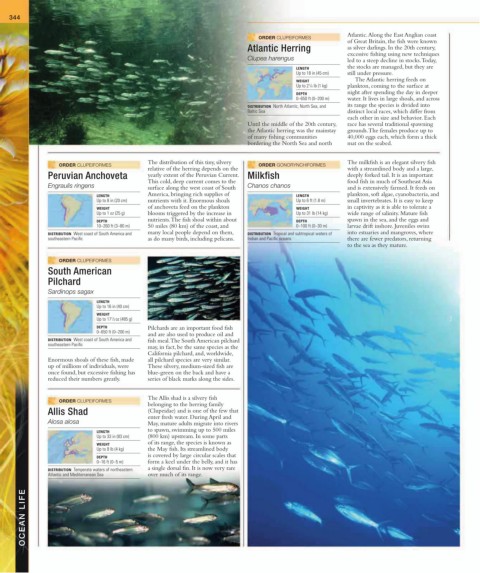
                                                                              ORDER CLUPEIFORMES        Atlantic. Along the East Anglian coast
                                                                                                        of Great Britain, the fish were known
                                                                           Atlantic Herring             as silver darlings. In the 20th century,
                                                                                                        excessive fishing using new techniques
                                                                           Clupea harengus              led to a steep decline in stocks. Today,
                                                                                         LENGTH         the stocks are managed, but they are
                                                                                         Up to 18 in (45 cm)   still under pressure.
                                                                                         WEIGHT            The Atlantic herring feeds on
                                                                                         Up to 2 1 / 4 lb (1 kg)  plankton, coming to the surface at
                                                                                         DEPTH          night after spending the day in deeper
                                                                                         0–650 ft (0–200 m)  water. It lives in large shoals, and across
                                                                           DISTRIBUTION  North Atlantic, North Sea, and    its range the species is divided into
                                                                           Baltic Sea                   distinct local races, which differ from
                                                                                                        each other in size and behavior. Each
                                                                           Until the middle of the 20th century,   race has several traditional spawning
                                                                           the Atlantic herring was the mainstay   grounds. The females produce up to
                                                                           of many fishing communities   40,000 eggs each, which form a thick
                                                                           bordering the North Sea and north   mat on the seabed.


                  ORDER CLUPEIFORMES         The distribution of this tiny, silvery   ORDER GONORYNCHIFORMES  The milkfish is an elegant silvery fish
                                             relative of the herring depends on the                     with a streamlined body and a large,
               Peruvian Anchoveta            yearly extent of the Peruvian Current.   Milkfish          deeply forked tail. It is an important
                                             This cold, deep current comes to the                       food fish in much of Southeast Asia
               Engraulis ringens             surface along the west coast of South   Chanos chanos      and is extensively farmed. It feeds on
                              LENGTH         America, bringing rich supplies of          LENGTH         plankton, soft algae, cyanobacteria, and
                              Up to 8 in (20 cm)  nutrients with it. Enormous shoals     Up to 6 ft (1.8 m)   small invertebrates. It is easy to keep
                              WEIGHT         of anchoveta feed on the plankton           WEIGHT         in captivity as it is able to tolerate a
                              Up to 1 oz (25 g)  blooms triggered by the increase in     Up to 31 lb (14 kg)  wide range of salinity. Mature fish
                              DEPTH          nutrients. The fish shoal within about      DEPTH          spawn in the sea, and the eggs and
                              10–260 ft (3–80 m)  50 miles (80 km) of the coast, and     0–100 ft (0–30 m)  larvae drift inshore. Juveniles swim
               DISTRIBUTION  West coast of South America and   many local people depend on them,    DISTRIBUTION  Tropical and subtropical waters of   into estuaries and mangroves, where
               southeastern Pacific           as do many birds, including pelicans.  Indian and Pacific oceans  there are fewer predators, returning
                                                                                                        to the sea as they mature.

                  ORDER CLUPEIFORMES
               South American
               Pilchard

               Sardinops sagax
                              LENGTH
                              Up to 16 in (40 cm)
                              WEIGHT
                              Up to 17 1 / 2 oz (485 g)
                              DEPTH          Pilchards are an important food fish
                              0–650 ft (0–200 m)
                                             and are also used to produce oil and
               DISTRIBUTION  West coast of South America and   fish meal. The South American pilchard
               southeastern Pacific
                                             may, in fact, be the same species as the
                                             California pilchard, and, worldwide,
               Enormous shoals of these fish, made   all pilchard species are very similar.
               up of millions of individuals, were   These silvery, medium-sized fish are
               once found, but excessive fishing has   blue-green on the back and have a
               reduced their numbers greatly.   series of black marks along the sides.


                                             The Allis shad is a silvery fish
                  ORDER CLUPEIFORMES
                                             belonging to the herring family
               Allis Shad                    (Clupeidae) and is one of the few that
                                             enter fresh water. During April and
                                             May, mature adults migrate into rivers
               Alosa alosa
                              LENGTH         to spawn, swimming up to 500 miles
                              Up to 33 in (83 cm)  (800 km) upstream. In some parts
                              WEIGHT         of its range, the species is known as
                              Up to 9 lb (4 kg)  the May fish. Its streamlined body
                              DEPTH          is covered by large circular scales that
                              0–16 ft (0–5 m)  form a keel under the belly, and it has
               DISTRIBUTION  Temperate waters of northeastern   a single dorsal fin. It is now very rare
               Atlantic and Mediterranean Sea  over much of its range.

        OCEAN LIFE

