


Page 376 - (DK) Ocean - The Definitive Visual Guide
P. 376
374 ANIMAL LIFE
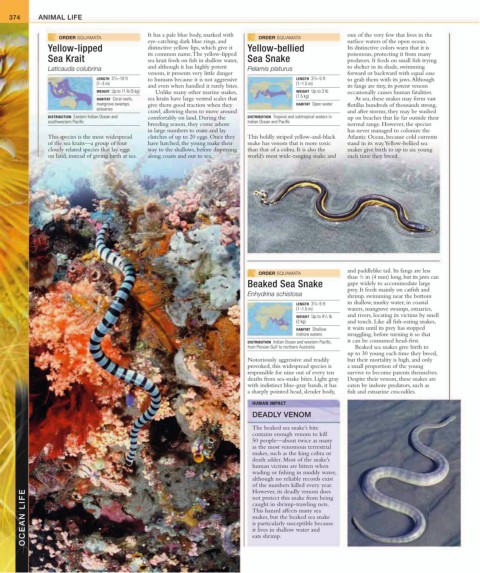
ORDER SQUAMATA It has a pale blue body, marked with ORDER SQUAMATA one of the very few that lives in the
eye-catching dark blue rings, and surface waters of the open ocean.
Yellow-lipped distinctive yellow lips, which give it Yellow-bellied Its distinctive colors warn that it is
its common name. The yellow-lipped poisonous, protecting it from many
Sea Krait sea krait feeds on fish in shallow water, Sea Snake predators. It feeds on small fish trying
and although it has highly potent to shelter in its shade, swimming
venom, it presents very little danger forward or backward with equal ease
Laticauda colubrina Pelamis platurus
1
1
LENGTH 3 / 4–10 ft to humans because it is not aggressive LENGTH 3 / 4–5 ft to grab them with its jaws. Although
(1–3 m) (1–1.5 m)
and even when handled it rarely bites. its fangs are tiny, its potent venom
WEIGHT Up to 11 lb (5 kg) Unlike many other marine snakes, WEIGHT Up to 3 lb occasionally causes human fatalities.
(1.5 kg)
HABITAT Coral reefs, sea kraits have large ventral scales that At sea, these snakes may form vast
mangrove swamps, give them good traction when they HABITAT Open water flotillas hundreds of thousands strong,
estuaries
crawl, allowing them to move around and after storms, they may be washed
DISTRIBUTION Eastern Indian Ocean and comfortably on land. During the DISTRIBUTION Tropical and subtropical waters in up on beaches that lie far outside their
southwestern Pacific Indian Ocean and Pacific
breeding season, they come ashore normal range. However, the species
in large numbers to mate and lay has never managed to colonize the
This species is the most widespread clutches of up to 20 eggs. Once they This boldly striped yellow-and-black Atlantic Ocean, because cold currents
of the sea kraits—a group of four have hatched, the young make their snake has venom that is more toxic stand in its way. Yellow-bellied sea
closely related species that lay eggs way to the shallows, before dispersing than that of a cobra. It is also the snakes give birth to up to six young
on land, instead of giving birth at sea. along coasts and out to sea. world’s most wide-ranging snake and each time they breed.
and paddlelike tail. Its fangs are less
ORDER SQUAMATA
than /5 in (4 mm) long, but its jaws can
1
Beaked Sea Snake gape widely to accommodate large
prey. It feeds mainly on catfish and
shrimp. swimming near the bottom
Enhydrina schistosa
1
LENGTH 3 / 4–5 ft in shallow, murky water, in coastal
(1–1.5 m) waters, mangrove swamps, estuaries,
WEIGHT Up to 4 / 2 lb and rivers, locating its victims by smell
1
(2 kg) and touch. Like all fish-eating snakes,
HABITAT Shallow it waits until its prey has stopped
inshore waters struggling, before turning it so that
DISTRIBUTION Indian Ocean and western Pacific, it can be consumed head-first.
from Persian Gulf to northern Australia Beaked sea snakes give birth to
up to 30 young each time they breed,
Notoriously aggressive and readily but their mortality is high, and only
provoked, this widespread species is a small proportion of the young
responsible for nine out of every ten survive to become parents themselves.
deaths from sea-snake bites. Light gray Despite their venom, these snakes are
with indistinct blue-gray bands, it has eaten by inshore predators, such as
a sharply pointed head, slender body, fish and estuarine crocodiles.
HUMAN IMPACT
DEADLY VENOM
The beaked sea snake’s bite
contains enough venom to kill
50 people—about twice as many
as the most venomous terrestrial
snakes, such as the king cobra or
death adder. Most of the snake’s
human victims are bitten when
wading or fishing in muddy water,
although no reliable records exist
of the numbers killed every year.
However, its deadly venom does
OCEAN LIFE caught in shrimp-trawling nets.
not protect this snake from being
This hazard affects many sea
snakes, but the beaked sea snake
is particularly susceptible because
it lives in shallow water and
eats shrimp.

