


Page 377 - (DK) Ocean - The Definitive Visual Guide
P. 377
375


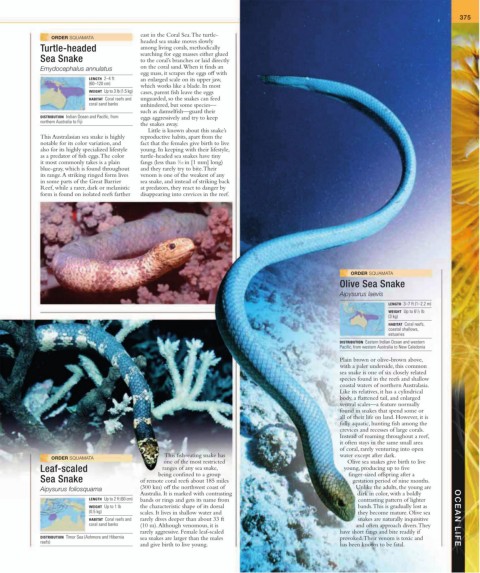
                ORDER SQUAMATA             east in the Coral Sea. The turtle-
                                           headed sea snake moves slowly
             Turtle-headed                 among living corals, methodically
                                           searching for egg masses either glued
             Sea Snake                     to the coral’s branches or laid directly
                                           on the coral sand. When it finds an
             Emydocephalus annulatus
                                           egg mass, it scrapes the eggs off with
                           LENGTH  2–4 ft   an enlarged scale on its upper jaw,
                           (60–120 cm)
                                           which works like a blade. In most
                           WEIGHT  Up to 3 lb (1.5 kg)  cases, parent fish leave the eggs
                           HABITAT  Coral reefs and   unguarded, so the snakes can feed
                           coral sand banks   unhindered, but some species—
                                           such as damselfish—guard their
             DISTRIBUTION  Indian Ocean and Pacific, from   eggs aggressively and try to keep
             northern Australia to Fiji
                                           the snakes away.
                                             Little is known about this snake’s
             This Australasian sea snake is highly   reproductive habits, apart from the
             notable for its color variation, and    fact that the females give birth to live
             also for its highly specialized lifestyle   young. In keeping with their lifestyle,
             as a predator of fish eggs. The color    turtle-headed sea snakes have tiny
             it most commonly takes is a plain   fangs (less than / 32 in [1 mm] long)
                                                      1
             blue-gray, which is found throughout   and they rarely try to bite. Their
             its range. A striking ringed form lives   venom is one of the weakest of any
             in some parts of the Great Barrier   sea snake, and instead of striking back
             Reef, while a rarer, dark or melanistic   at predators, they react to danger by
             form is found on isolated reefs farther   disappearing into crevices in the reef.


                                                                                                         ORDER SQUAMATA
                                                                                                      Olive Sea Snake

                                                                                                      Aipysurus laevis
                                                                                                                     LENGTH  3–7 ft (1–2.2 m)
                                                                                                                     WEIGHT  Up to 6 / 2 lb
                                                                                                                             1
                                                                                                                     (3 kg)
                                                                                                                     HABITAT  Coral reefs,
                                                                                                                     coastal shallows,
                                                                                                                     estuaries
                                                                                                      DISTRIBUTION  Eastern Indian Ocean and western
                                                                                                      Pacific, from western Australia to New Caledonia
                                                                                                      Plain brown or olive-brown above,
                                                                                                      with a paler underside, this common
                                                                                                      sea snake is one of six closely related
                                                                                                      species found in the reefs and shallow
                                                                                                      coastal waters of northern Australasia.
                                                                                                      Like its relatives, it has a cylindrical
                                                                                                      body, a flattened tail, and enlarged
                                                                                                      ventral scales—a feature normally
                                                                                                      found in snakes that spend some or
                                                                                                      all of their life on land. However, it is
                                                                                                      fully aquatic, hunting fish among the
                                                                                                      crevices and recesses of large corals.
                                                                                                      Instead of roaming throughout a reef,
                                                                                                      it often stays in the same small area
                                                                                                      of coral, rarely venturing into open
                ORDER SQUAMATA                    This fish-eating snake has                          water except after dark.
                                                  one of the most restricted                            Olive sea snakes give birth to live
             Leaf-scaled                         ranges of any sea snake,                              young, producing up to five
                                                being confined to a group                                finger-sized offspring after a
             Sea Snake                     of remote coral reefs about 185 miles                          gestation period of nine months.
                                           (300 km) off the northwest coast of                             Unlike the adults, the young are
             Aipysurus foliosquama
                                           Australia. It is marked with contrasting                        dark in color, with a boldly
                           LENGTH  Up to 2 ft (60 cm)  bands or rings and gets its name from                contrasting pattern of lighter
                           WEIGHT  Up to 1 lb   the characteristic shape of its dorsal                      bands. This is gradually lost as
                           (0.5 kg)        scales. It lives in shallow water and                            they become mature. Olive sea
                           HABITAT  Coral reefs and   rarely dives deeper than about 33 ft                  snakes are naturally inquisitive   OCEAN LIFE
                           coral sand banks   (10 m). Although venomous, it is                             and often approach divers. They
                                           rarely aggressive. Female leaf-scaled                      have short fangs and bite readily if
             DISTRIBUTION  Timor Sea (Ashmore and Hibernia   sea snakes are larger than the males     provoked. Their venom is toxic and
             reefs)
                                           and give birth to live young.                              has been known to be fatal.

