


Page 378 - (DK) Ocean - The Definitive Visual Guide
P. 378
376


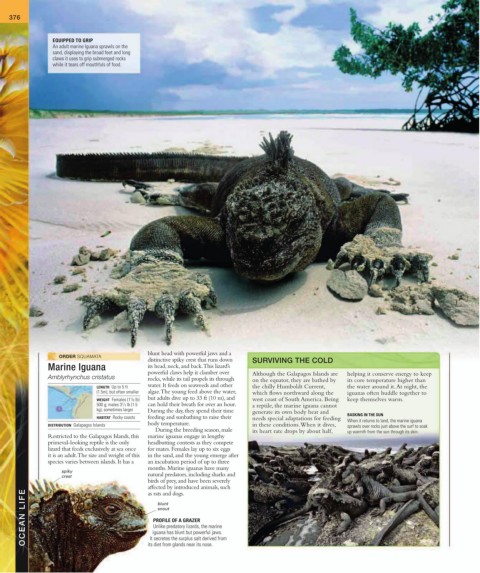
                 EQUIPPED TO GRIP
                 An adult marine Iguana sprawls on the
                 sand, displaying the broad feet and long
                 claws it uses to grip submerged rocks
                 while it tears off mouthfuls of food.


                                             blunt head with powerful jaws and a
                  ORDER SQUAMATA
                                             distinctive spiky crest that runs down    SURVIVING THE COLD
               Marine Iguana                 its head, neck, and back. This lizard’s
                                             powerful claws help it clamber over   Although the Galapagos Islands are   helping it conserve energy to keep
                                             rocks, while its tail propels its through
               Amblyrhynchus cristatus                                      on the equator, they are bathed by   its core temperature higher than
                                             water. It feeds on seaweeds and other
                              LENGTH  Up to 5 ft                            the chilly Humboldt Current,   the water around it. At night, the
                              (1.5m), but often smaller  algae. The young feed above the water,   which flows northward along the   iguanas often huddle together to
                                        1
                              WEIGHT  Females (1 / 8  lb)   but adults dive up to 33 ft (10 m), and   west coast of South America. Being   keep themselves warm.
                              500 g; males 3 1 / 3  lb (1.5   can hold their breath for over an hour.   a reptile, the marine iguana cannot
                              kg), sometimes larger  During the day, they spend their time   generate its own body heat and
                              HABITAT  Rocky coasts  feeding and sunbathing to raise their   needs special adaptations for feeding   BASKING IN THE SUN
                                                                                                        When it returns to land, the marine iguana
               DISTRIBUTION  Galapagos Islands  body temperature.           in these conditions. When it dives,   sprawls over rocks just above the surf to soak
                                               During the breeding season, male   its heart rate drops by about half,   up warmth from the sun through its skin.
               Restricted to the Galapagos Islands, this   marine iguanas engage in lengthy
               primeval-looking reptile is the only   headbutting contests as they compete
               lizard that feeds exclusively at sea once   for mates. Females lay up to six eggs
               it is an adult. The size and weight of this   in the sand, and the young emerge after
               species varies between islands. It has a   an incubation period of up to three
                                             months. Marine iguanas have many
                   spiky
                   crest                     natural predators, including sharks and
                                             birds of prey, and have been severely
                                             affected by introduced animals, such
        OCEAN LIFE                           its diet from glands near its nose.
                                             as rats and dogs.
                                                blunt
                                                snout
                                               PROFILE OF A GRAZER
                                               Unlike predatory lizards, the marine
                                              iguana has blunt but powerful jaws.
                                              It secretes the surplus salt derived from

