


Page 384 - (DK) Ocean - The Definitive Visual Guide
P. 384
382


                                                                                                            ORDER SPHENISCIFORMES
                                                                                                        King Penguin

                                                                                                        Aptenodytes patagonicus
                                                                                                                       HEIGHT  33 / 2 –37 / 2 in
                                                                                                                                1
                                                                                                                            1
                                                                                                                       (85–95 cm)
                                                                                                                       WEIGHT  26–31 lb
                                                                                                                       (12–14 kg)
                                                                                                                       HABITAT  Rocky coasts,
                                                                                                                       open ocean
                                                                                                        DISTRIBUTION  Southern Ocean, subantarctic islands
                                                                                                        including Falkland Islands
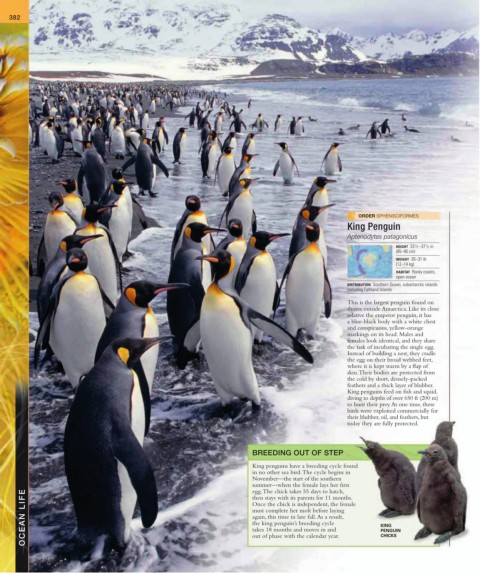
                                                                                                        This is the largest penguin found on
                                                                                                        shores outside Antarctica. Like its close
                                                                                                        relative the emperor penguin, it has
                                                                                                        a blue-black body with a white chest
                                                                                                        and conspicuous, yellow-orange
                                                                                                        markings on its head. Males and
                                                                                                        females look identical, and they share
                                                                                                        the task of incubating the single egg.
                                                                                                        Instead of building a nest, they cradle
                                                                                                        the egg on their broad webbed feet,
                                                                                                        where it is kept warm by a flap of
                                                                                                        skin. Their bodies are protected from
                                                                                                        the cold by short, densely-packed
                                                                                                        feathers and a thick layer of blubber.
                                                                                                        King penguins feed on fish and squid,
                                                                                                        diving to depths of over 650 ft (200 m)
                                                                                                        to hunt their prey. At one time, these
                                                                                                        birds were exploited commercially for
                                                                                                        their blubber, oil, and feathers, but
                                                                                                        today they are fully protected.


                                                                            BREEDING OUT OF STEP
                                                                            King penguins have a breeding cycle found
                                                                            in no other sea bird. The cycle begins in
                                                                            November—the start of the southern
                                                                            summer—when the female lays her first
        OCEAN LIFE                                                          Once the chick is independent, the female    KING
                                                                            egg. The chick takes 55 days to hatch,
                                                                            then stays with its parents for 11 months.
                                                                            must complete her molt before laying
                                                                            again, this time in late fall. As a result,
                                                                            the king penguin’s breeding cycle
                                                                            takes 18 months and moves in and
                                                                                                                  PENGUIN
                                                                            out of phase with the calendar year.
                                                                                                                  CHICKS

