


Page 380 - (DK) Ocean - The Definitive Visual Guide
P. 380
378     ANIMAL LIFE


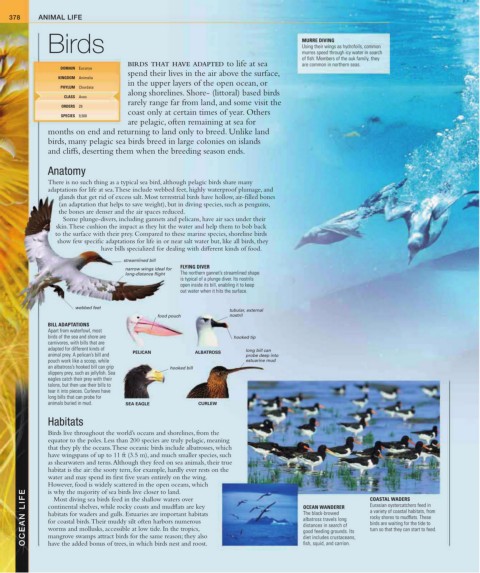
               Birds                                                                       MURRE DIVING
                                                                                           Using their wings as hydrofoils, common
                                                                                           murres speed through icy water in search
                                                                                           of fish. Members of the auk family, they
                                       BIRDS THAT HAVE ADAPTED to life at sea              are common in northern seas.
                   DOMAIN  Eucarya
                                       spend their lives in the air above the surface,
                  KINGDOM Animalia
                                       in the upper layers of the open ocean, or
                   PHYLUM Chordata
                                       along shorelines. Shore- (littoral) based birds
                    CLASS Aves
                                       rarely range far from land, and some visit the
                   ORDERS 29
                                       coast only at certain times of year. Others
                   SPECIES 9,500
                                       are pelagic, often remaining at sea for
               months on end and returning to land only to breed. Unlike land
               birds, many pelagic sea birds breed in large colonies on islands
               and cliffs, deserting them when the breeding season ends.

               Anatomy
               There is no such thing as a typical sea bird, although pelagic birds share many
               adaptations for life at sea. These include webbed feet, highly waterproof plumage, and
                  glands that get rid of excess salt. Most terrestrial birds have hollow, air-filled bones
                  (an adaptation that helps to save weight), but in diving species, such as penguins,
                  the bones are denser and the air spaces reduced.
                    Some plunge-divers, including gannets and pelicans, have air sacs under their
                  skin. These cushion the impact as they hit the water and help them to bob back
                 to the surface with their prey. Compared to these marine species, shoreline birds
                  show few specific adaptations for life in or near salt water but, like all birds, they
                               have bills specialized for dealing with different kinds of food.
                                      streamlined bill
                                                       FLYING DIVER
                                      narrow wings ideal for
                                      long-distance flight  The northern gannet’s streamlined shape
                                                       is typical of a plunge diver. Its nostrils
                                                       open inside its bill, enabling it to keep
                                                       out water when it hits the surface.

                       webbed feet
                                                                     tubular, external
                                                food pouch           nostril
               BILL ADAPTATIONS
               Apart from waterfowl, most
               birds of the sea and shore are                          hooked tip
               carnivores, with bills that are
               adapted for different kinds of                             long bill can
               animal prey. A pelican’s bill and   PELICAN  ALBATROSS     probe deep into
               pouch work like a scoop, while                             estuarine mud
               an albatross’s hooked bill can grip   hooked bill
               slippery prey, such as jellyfish. Sea
               eagles catch their prey with their
               talons, but then use their bills to
               tear it into pieces. Curlews have
               long bills that can probe for
               animals buried in mud.
                                      SEA EAGLE             CURLEW
               Habitats
               Birds live throughout the world’s oceans and shorelines, from the
               equator to the poles. Less than 200 species are truly pelagic, meaning
               that they ply the oceans. These oceanic birds include albatrosses, which
               have wingspans of up to 11 ft (3.5 m), and much smaller species, such
               as shearwaters and terns. Although they feed on sea animals, their true
               habitat is the air: the sooty tern, for example, hardly ever rests on the
               water and may spend its first five years entirely on the wing.
               However, food is widely scattered in the open oceans, which                                     COASTAL WADERS
        OCEAN LIFE  continental shelves, while rocky coasts and mudflats are key           OCEAN WANDERER      Eurasian oystercatchers feed in
               is why the majority of sea birds live closer to land.
                 Most diving sea birds feed in the shallow waters over
                                                                                                               a variety of coastal habitats, from
                                                                                           The black-browed
               habitats for waders and gulls. Estuaries are important habitats
                                                                                                               rocky shores to mudflats. These
                                                                                           albatross travels long
               for coastal birds. Their muddy silt often harbors numerous
                                                                                                               birds are waiting for the tide to
                                                                                           distances in search of
               worms and mollusks, accessible at low tide. In the tropics,
                                                                                                               turn so that they can start to feed.
                                                                                           good feeding grounds. Its
               mangrove swamps attract birds for the same reason; they also
                                                                                           diet includes crustaceans,
               have the added bonus of trees, in which birds nest and roost.
                                                                                           fish, squid, and carrion.

