Page 382 - (DK) Ocean - The Definitive Visual Guide
P. 382
380     ANIMAL LIFE


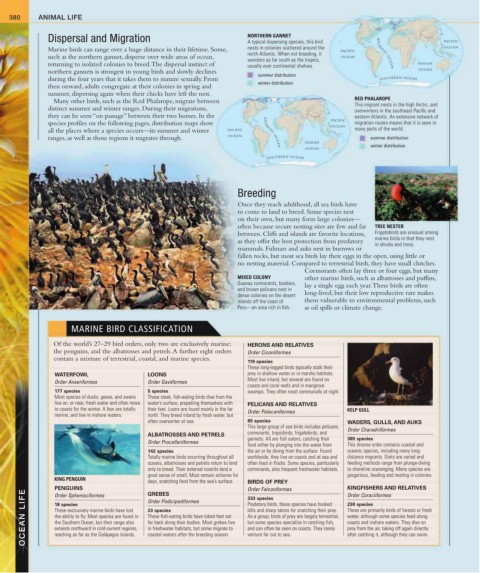
               Dispersal and Migration                                     NORTHERN GANNET                                           PACIFIC
                                                                           A typical dispersing species, this bird
               Marine birds can range over a huge distance in their lifetime. Some,   nests in colonies scattered around the   PACIFIC   OCEAN
               such as the northern gannet, disperse over wide areas of ocean,    north Atlantic. When not breeding, it   OCEAN  ATLANTIC OCEAN
                                                                           wanders as far south as the tropics,
               returning to isolated colonies to breed. The dispersal instinct of    usually over continental shelves.        INDIAN
               northern gannets is strongest in young birds and slowly declines                                               OCEAN
                                                                              summer distribution
               during the four years that it takes them to mature sexually. From                                  SOUTHERN OCEAN
                                                                              winter distribution
               then onward, adults congregate at their colonies in spring and
               summer, dispersing again when their chicks have left the nest.
                 Many other birds, such as the Red Phalarope, migrate between                              RED PHALAROPE
                                                                                                           This migrant nests in the high Arctic, and
               distinct summer and winter ranges. During their migrations,                                 overwinters in the southeast Pacific and
               they can be seen “on passage” between their two homes. In the                               eastern Atlantic. An extensive network of
                                                                                                    PACIFIC
               species profiles on the following pages, distribution maps show                             migration routes means that it is seen in
                                                                                                    OCEAN
               all the places where a species occurs—its summer and winter   PACIFIC   ATLANTIC OCEAN      many parts of the world.
               ranges, as well as those regions it migrates through.  OCEAN                                    summer distribution
                                                                                            INDIAN
                                                                                                               winter distribution
                                                                                            OCEAN
                                                                                SOUTHERN OCEAN


                                                                        Breeding

                                                                        Once they reach adulthood, all sea birds have
                                                                        to come to land to breed. Some species nest
                                                                        on their own, but many form large colonies—
                                                                        often because secure nesting sites are few and far   TREE NESTER
                                                                        between. Cliffs and islands are favorite locations,   Frigatebirds are unusual among
                                                                                                                 marine birds in that they nest
                                                                        as they offer the best protection from predatory
                                                                                                                 in shrubs and tress.
                                                                        mammals. Fulmars and auks nest in burrows or
                                                                        fallen rocks, but most sea birds lay their eggs in the open, using little or
                                                                        no nesting material. Compared to terrestrial birds, they have small clutches.
                                                                                            Cormorants often lay three or four eggs, but many
                                                                        MIXED COLONY        other marine birds, such as albatrosses and puffins,
                                                                        Guanay cormorants, boobies,   lay a single egg each year. These birds are often
                                                                        and brown pelicans nest in
                                                                        dense colonies on the desert   long-lived, but their low reproductive rate makes
                                                                        islands off the coast of   them vulnerable to environmental problems, such
                                                                        Peru—an area rich in fish.  as oil spills or climate change.

                      MARINE BIRD CLASSIFICATION


                 Of the world’s 27–29 bird orders, only two are exclusively marine:
                                                                           HERONS AND RELATIVES
                 the penguins, and the albatrosses and petrels. A further eight orders   Order Ciconiiformes
                 contain a mixture of terrestrial, coastal, and marine species.
                                                                           119 species
                                                                           These long-legged birds typically stalk their
                                                                           prey in shallow water or in marshy habitats.
                 WATERFOWL                   LOONS
                 Order Anseriformes          Order Gaviiformes             Most live inland, but several are found on
                                                                           coasts and coral reefs and in mangrove
                                                                           swamps. They often roost communally at night.
                 177 species                 5 species
                 Most species of ducks, geese, and swans   These sleek, fish-eating birds dive from the
                 live on, or near, fresh water and often move   water’s surface, propelling themselves with
                                                                           PELICANS AND RELATIVES
                 to coasts for the winter. A few are totally   their feet. Loons are found mainly in the far   Order Pelecaniformes  KELP GULL
                 marine, and live in inshore waters.  north. They breed inland by fresh water, but
                                             often overwinter at sea.      65 species
                                                                           This large group of sea birds includes pelicans,   WADERS, GULLS, AND AUKS
                                                                                                        Order Charadriiformes
                                                                           cormorants, tropicbirds, frigatebirds, and
                                             ALBATROSSES AND PETRELS       gannets. All are fish eaters, catching their
                                             Order Procellariiformes                                    385 species
                                                                           food either by plunging into the water from    This diverse order contains coastal and
                                                                           the air or by diving from the surface. Found   oceanic species, including many long-
                                             142 species
                                             Totally marine birds occurring throughout all    worldwide, they live on coasts and at sea and   distance migrants. Diets are varied and
                                             oceans, albatrosses and petrels return to land   often feed in flocks. Some species, particularly   feeding methods range from plunge-diving
                                             only to breed. Their external nostrils lend a   cormorants, also frequent freshwater habitats.  to shoreline scavenging. Many species are
                                             good sense of smell. Most remain airborne for              gregarious, feeding and nesting in colonies.
                 KING PENGUIN
                                             days, snatching food from the sea’s surface.
                                                                           BIRDS OF PREY
                                                                           Order Falconiformes          KINGFISHERS AND RELATIVES
        OCEAN LIFE  18 species               23 species                    Predatory birds, these species have hooked   230 species
                 PENGUINS
                                                                                                        Order Coraciiformes
                 Order Sphenisciformes
                                             GREBES
                                             Order Podicipediformes
                                                                           333 species
                 These exclusively marine birds have lost
                                                                                                        These are primarily birds of forests or fresh
                                                                           bills and sharp talons for snatching their prey.
                                                                                                        water, although some species feed along
                                             These fish-eating birds have lobed feet set
                                                                           As a group, birds of prey are largely terrestrial,
                 the ability to fly. Most species are found in
                 the Southern Ocean, but their range also
                                                                                                        coasts and inshore waters. They dive on
                                             far back along their bodies. Most grebes live
                                                                           but some species specialize in catching fish,
                                                                           and can often be seen on coasts. They rarely
                                             in freshwater habitats, but some migrate to
                                                                                                        prey from the air, taking off again directly
                 extends northward in cold-current regions,
                                             coastal waters after the breeding season.
                                                                           venture far out to sea.
                 reaching as far as the Galápagos Islands.
                                                                                                        after catching it, although they can swim.
   377   378   379   380   381   382   383   384   385   386   387