


Page 385 - (DK) Ocean - The Definitive Visual Guide
P. 385
BIRDS       383


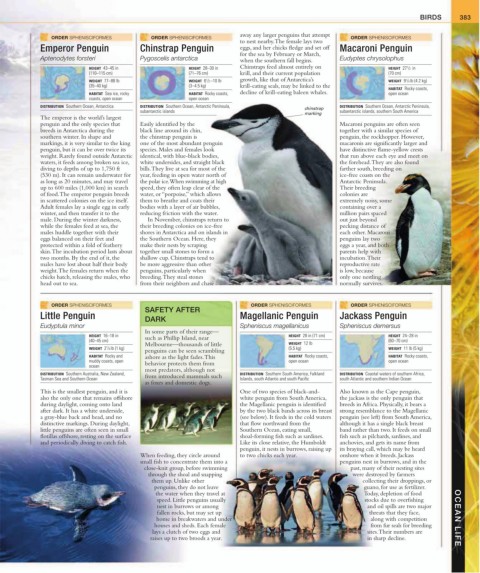
                ORDER SPHENISCIFORMES         ORDER SPHENISCIFORMES     away any larger penguins that attempt   ORDER SPHENISCIFORMES
                                                                        to nest nearby. The female lays two
             Emperor Penguin               Chinstrap Penguin            eggs, and her chicks fledge and set off   Macaroni Penguin
                                                                        for the sea by February or March,
             Aptenodytes forsteri          Pygoscelis antarctica        when the southern fall begins.   Eudyptes chrysolophus
                                                                                                                          1
                           HEIGHT  43–45 in              HEIGHT  28–30 in   Chinstraps feed almost entirely on       HEIGHT  27 / 2  in
                           (110–115 cm)                  (71–76 cm)     krill, and their current population          (70 cm)
                           WEIGHT  77–88 lb              WEIGHT  6 / 2 –10 lb    growth, like that of Antarctica’s   WEIGHT  9 / 4 lb (4.2 kg)
                                                                                                                          1
                                                              1
                           (35–40 kg)                    (3–4.5 kg)     krill-eating seals, may be linked to the     HABITAT  Rocky coasts,
                           HABITAT  Sea ice, rocky       HABITAT  Rocky coasts,   decline of krill-eating baleen whales.  open ocean
                           coasts, open ocean            open ocean
             DISTRIBUTION  Southern Ocean, Antarctica  DISTRIBUTION  Southern Ocean, Antarctic Peninsula,   chinstrap   DISTRIBUTION  Southern Ocean, Antarctic Peninsula,
                                           subantarctic islands                                       subantarctic islands, southern South America
                                                                                            marking
             The emperor is the world’s largest
             penguin and the only species that   Easily identified by the                             Macaroni penguins are often seen
             breeds in Antarctica during the   black line around its chin,                            together with a similar species of
             southern winter. In shape and   the chinstrap penguin is                                 penguin, the rockhopper. However,
             markings, it is very similar to the king   one of the most abundant penguin              macaronis are significantly larger and
             penguin, but it can be over twice its   species. Males and females look                  have distinctive flame-yellow crests
             weight. Rarely found outside Antarctic   identical, with blue-black bodies,              that run above each eye and meet on
             waters, it feeds among broken sea ice,   white undersides, and straight black            the forehead. They are also found
             diving to depths of up to 1,750 ft   bills. They live at sea for most of the             farther south, breeding on
             (530 m). It can remain underwater for   year, feeding in open water north of             ice-free coasts on the
             as long as 20 minutes, and may travel   the polar ice. When swimming at high             Antarctic Peninsula.
             up to 600 miles (1,000 km) in search   speed, they often leap clear of the               Their breeding
             of food. The emperor penguin breeds   water, or “porpoise,” which allows                 colonies are
             in scattered colonies on the ice itself.   them to breathe and coats their               extremely noisy, some
             Adult females lay a single egg in early   bodies with a layer of air bubbles,            containing over a
             winter, and then transfer it to the   reducing friction with the water.                  million pairs spaced
             male. During the winter darkness,   In November, chinstraps return to                    out just beyond
             while the females feed at sea, the   their breeding colonies on ice-free                 pecking distance of
             males huddle together with their    shores in Antarctica and on islands in               each other. Macaroni
             eggs balanced on their feet and   the Southern Ocean. Here, they                         penguins lay two
             protected within a fold of feathery   make their nests by scraping                       eggs a year, and both
             skin. The incubation period lasts about   together small stones to form a                parents help with
             two months. By the end of it, the   shallow cup. Chinstraps tend to                      incubation. Their
             males have lost about half their body   be more aggressive than other                    reproductive rate
             weight. The females return when the   penguins, particularly when                        is low, because
             chicks hatch, releasing the males, who   breeding. They steal stones                     only one nestling
             head out to sea.              from their neighbors and chase                             normally survives.


                ORDER SPHENISCIFORMES                                       ORDER SPHENISCIFORMES        ORDER SPHENISCIFORMES
                                            SAFETY AFTER
             Little Penguin                 DARK                        Magellanic Penguin            Jackass Penguin

             Eudyptula minor                                            Spheniscus magellanicus       Spheniscus demersus
                                            In some parts of their range—
                           HEIGHT  16–18 in   such as Phillip Island, near             HEIGHT  28 in (71 cm)         HEIGHT  24–28 in
                           (40–45 cm)                                                  WEIGHT  12 lb                 (60–70 cm)
                                            Melbourne—thousands of little
                                 1
                           WEIGHT  2 / 4 lb (1 kg)                                     (5.5 kg)                      WEIGHT  11 lb (5 kg)
                                            penguins can be seen scrambling
                           HABITAT  Rocky and   ashore as the light fades. This        HABITAT  Rocky coasts,        HABITAT  Rocky coasts,
                           muddy coasts, open                                          open ocean                    open ocean
                           ocean            behavior protects them from
                                            most predators, although not
             DISTRIBUTION  Southern Australia, New Zealand,             DISTRIBUTION  Southern South America, Falkland   DISTRIBUTION  Coastal waters of southern Africa,
             Tasman Sea and Southern Ocean  from introduced mammals such   Islands, south Atlantic and south Pacific  south Atlantic and southern Indian Ocean
                                            as foxes and domestic dogs.
             This is the smallest penguin, and it is                    One of two species of black-and-  Also known as the Cape penguin,
             also the only one that remains offshore                    white penguin from South America,   the jackass is the only penguin that
             during daylight, coming onto land                          the Magellanic penguin is identified   breeds in Africa. Physically, it bears a
             after dark. It has a white underside,                      by the two black bands across its breast   strong resemblance to the Magellanic
             a gray-blue back and head, and no                          (see below). It feeds in the cold waters   penguin (see left) from South America,
             distinctive markings. During daylight,                     that flow northward from the   although it has a single black breast
             little penguins are often seen in small                    Southern Ocean, eating small,   band rather than two. It feeds on small
             flotillas offshore, resting on the surface                 shoal-forming fish such as sardines.   fish such as pilchards, sardines, and
             and periodically diving to catch fish.                     Like its close relative, the Humboldt   anchovies, and gets its name from
                                                                        penguin, it nests in burrows, raising up   its braying call, which may be heard
                                           When feeding, they circle around   to two chicks each year.  onshore when it breeds. Jackass
                                           small fish to concentrate them into a                      penguins nest in burrows, and in the
                                            close-knit group, before swimming                            past, many of their nesting sites
                                             through the shoal and snapping                               were destroyed by farmers
                                              them up. Unlike other                                          collecting their droppings, or
                                               penguins, they do not leave                                   guano, for use as fertilizer.
                                               the water when they travel at                                 Today, depletion of food
                                                speed. Little penguins usually                                stocks due to overfishing
                                                nest in burrows or among                                      and oil spills are two major
                                                fallen rocks, but may set up                                   threats that they face,
                                               home in breakwaters and under                                   along with competition    OCEAN LIFE
                                               houses and sheds. Each female                                   from fur seals for breeding
                                              lays a clutch of two eggs and                                   sites. Their numbers are
                                              raises up to two broods a year.                                 in sharp decline.

