


Page 389 - (DK) Ocean - The Definitive Visual Guide
P. 389
387


                ORDER PROCELLARIIFORMES
             Wandering Albatross

             Diomedea exulans
                           LENGTH  1.1–1.35m
                            1
                               1
                           (3 / 2 –4 / 2 ft)
                           WEIGHT  8–11.5kg
                           (18–25lb)
                           HABITAT  Remote islands
                           (breeding); open ocean
             DISTRIBUTION  Southern Ocean, south Atlantic,
             southern Indian and Pacific oceans
                                                                                                        LONG
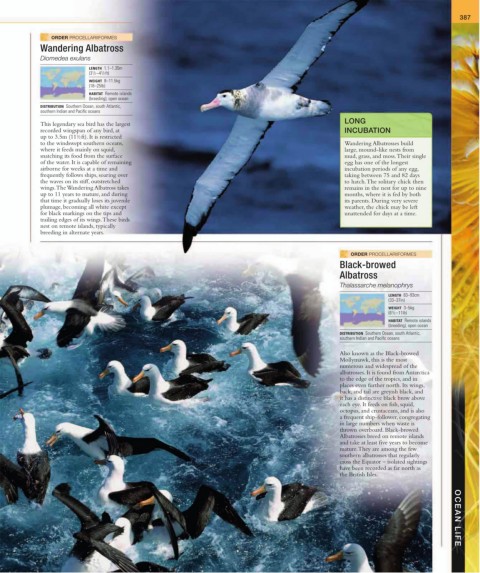
             This legendary sea bird has the largest
             recorded wingspan of any bird, at                                                          INCUBATION
             up to 3.5m (11/2 ft). It is restricted
                        1
             to the windswept southern oceans,                                                          Wandering Albatrosses build
             where it feeds mainly on squid,                                                            large, mound-like nests from
             snatching its food from the surface                                                        mud, grass, and moss. Their single
             of the water. It is capable of remaining                                                   egg has one of the longest
             airborne for weeks at a time and                                                           incubation periods of any egg,
             frequently follows ships, soaring over                                                     taking between 75 and 82 days
             the waves on its stiff, outstretched                                                       to hatch. The solitary chick then
             wings. The Wandering Albatross takes                                                       remains in the nest for up to nine
             up to 11 years to mature, and during                                                       months, where it is fed by both
             that time it gradually loses its juvenile                                                  its parents. During very severe
             plumage, becoming all white except                                                         weather, the chick may be left
             for black markings on the tips and                                                         unattended for days at a time.
             trailing edges of its wings. These birds
             nest on remote islands, typically
             breeding in alternate years.


                                                                                                         ORDER PROCELLARIIFORMES
                                                                                                      Black-browed
                                                                                                      Albatross


                                                                                                      Thalassarche melanophrys
                                                                                                                     LENGTH  83–93cm
                                                                                                                     (33–37in)
                                                                                                                     WEIGHT  3–5kg
                                                                                                                     (6 1 / 2 –11lb)
                                                                                                                     HABITAT  Remote islands
                                                                                                                     (breeding); open ocean
                                                                                                      DISTRIBUTION  Southern Ocean, south Atlantic,
                                                                                                      southern Indian and Pacific oceans
                                                                                                      Also known as the Black-browed
                                                                                                      Mollymawk, this is the most
                                                                                                      numerous and widespread of the
                                                                                                      albatrosses. It is found from Antarctica
                                                                                                      to the edge of the tropics, and in
                                                                                                      places even further north. Its wings,
                                                                                                      back, and tail are greyish black, and
                                                                                                      it has a distinctive black brow above
                                                                                                      each eye. It feeds on fish, squid,
                                                                                                      octopus, and crustaceans, and is also
                                                                                                      a frequent ship-follower, congregating
                                                                                                      in large numbers when waste is
                                                                                                      thrown overboard. Black-browed
                                                                                                      Albatrosses breed on remote islands
                                                                                                      and take at least five years to become
                                                                                                      mature. They are among the few
                                                                                                      southern albatrosses that regularly
                                                                                                      cross the Equator – isolated sightings
                                                                                                      have been recorded as far north as
                                                                                                      the British Isles.                 OCEAN LIFE

