


Page 379 - (DK) Ocean - The Definitive Visual Guide
P. 379
REPTILES 377
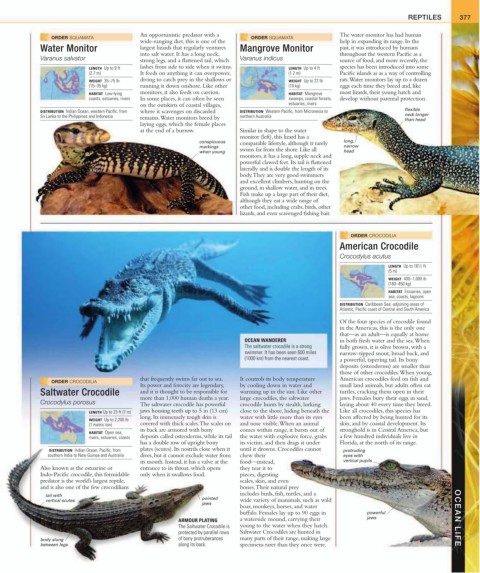
ORDER SQUAMATA An opportunistic predator with a ORDER SQUAMATA The water monitor has had human
wide-ranging diet, this is one of the help in expanding its range. In the
Water Monitor largest lizards that regularly ventures Mangrove Monitor past, it was introduced by humans
into salt water. It has a long neck, throughout the western Pacific as a
Varanus salvator strong legs, and a flattened tail, which Varanus indicus source of food, and more recently, the
LENGTH Up to 9 ft lashes from side to side when it swims. LENGTH Up to 4 ft species has been introduced into some
(2.7 m) It feeds on anything it can overpower, (1.2 m) Pacific islands as as a way of controlling
WEIGHT 35–75 lb diving to catch prey in the shallows or WEIGHT Up to 22 lb rats. Water monitors lay up to a dozen
(15–35 kg) running it down onshore. Like other (10 kg) eggs each time they breed and, like
HABITAT Low-lying monitors, it also feeds on carrion. HABITAT Mangrove most lizards, their young hatch and
coasts, estuaries, rivers In some places, it can often be seen swamps, coastal forests, develop without parental protection.
on the outskirts of coastal villages, estuaries, rivers
DISTRIBUTION Indian Ocean, western Pacific, from where it scavenges on discarded DISTRIBUTION Western Pacific, from Micronesia to flexible
Sri Lanka to the Philippines and Indonesia remains. Water monitors breed by northern Australia neck longer
than head
laying eggs, which the female places
at the end of a burrow. Similar in shape to the water
monitor (left), this lizard has a
conspicuous comparable lifestyle, although it rarely long,
markings narrow
when young swims far from the shore. Like all head
monitors, it has a long, supple neck and
powerful clawed feet. Its tail is flattened
laterally and is double the length of its
body. They are very good swimmers
and excellent climbers, hunting on the
ground, in shallow water, and in trees.
Fish make up a large part of their diet,
although they eat a wide range of
other food, including crabs, birds, other
lizards, and even scavenged fishing bait.
ORDER CROCODILIA
American Crocodile
Crocodylus acutus
1
LENGTH Up to 16 / 2 ft
(5 m)
WEIGHT 400–1,000 lb
(180–450 kg)
HABITAT Estuaries, open
sea, coasts, lagoons
DISTRIBUTION Caribbean Sea, adjoining areas of
Atlantic, Pacific coast of Central and South America
Of the four species of crocodile found
in the Americas, this is the only one
that—as an adult—is equally at home
OCEAN WANDERER in both fresh water and the sea. When
The saltwater crocodile is a strong fully grown, it is olive brown, with a
swimmer. It has been seen 600 miles narrow-tipped snout, broad back, and
(1000 km) from the nearest coast. a powerful, tapering tail. Its bony
deposits (osteoderms) are smaller than
those of other crocodiles. When young,
ORDER CROCODILIA that frequently swims far out to sea. It controls its body temperature American crocodiles feed on fish and
Its power and ferocity are legendary, by cooling down in water and small land animals, but adults often eat
Saltwater Crocodile and it is thought to be responsible for warming up in the sun. Like other turtles, cracking them open in their
more than 1,000 human deaths a year. large crocodiles, the saltwater jaws. Females bury their eggs in sand,
Crocodylus porosus The saltwater crocodile has powerful crocodile hunts by stealth, lurking laying about 40 every time they breed.
LENGTH Up to 23 ft (7 m) jaws housing teeth up to 5 in (13 cm) close to the shore, hiding beneath the Like all crocodiles, this species has
long. Its immensely tough skin is water with little more than its eyes been affected by being hunted for its
WEIGHT Up to 2,200 lb
(1 metric ton) covered with thick scales. The scales on and nose visible. When an animal skin, and by coastal development. Its
its back are armored with bony comes within range, it bursts out of stronghold is in Central America, but
HABITAT Open sea,
rivers, estuaries, coasts deposits called osteoderms, while its tail the water with explosive force, grabs a few hundred individuals live in
has a double row of upright bony its victim, and then drags it under Florida, at the north of its range.
DISTRIBUTION Indian Ocean, Pacific, from plates (scutes). Its nostrils close when it until it drowns. Crocodiles cannot protruding
southern India to New Guinea and Australia dives, but it cannot exclude water from chew their eyes with
its mouth. Instead, it has a valve at the food—instead, vertical pupils
Also known as the estuarine or entrance to its throat, which opens they tear it to
Indo-Pacific crocodile, this formidable only when it swallows food. pieces, digesting
predator is the world’s largest reptile, scales, skin, and even
and is also one of the few crocodilians bones. Their natural prey
includes birds, fish, turtles, and a
tail with
vertical scutes pointed wide variety of mammals, such as wild
jaws
boar, monkeys, horses, and water
buffalo. Females lay up to 90 eggs in powerful
ARMOUR PLATING a waterside mound, carrying their jaws OCEAN LIFE
The Saltwater Crocodile is young to the water when they hatch.
protected by parallel rows Saltwater Crocodiles are hunted in
body slung of bony protruberances many parts of their range, making large
between legs along its back. specimens rarer than they once were.

