


Page 390 - (DK) Ocean - The Definitive Visual Guide
P. 390
388     ANIMAL LIFE


                  ORDER PROCELLARIIFORMES       ORDER PROCELLARIIFORMES    Often mistaken for a gull, this fulmar   small animals at or near the sea’s
                                                                           is actually a petrel and, like other   surface, and they gather in large flocks
               Southern Giant                Northern Fulmar               petrels, has distinctive tubular nostrils.   to scavenge around fishing boats. They
                                                                           Common throughout northern   breed on exposed cliff ledges, with
               Petrel                        Fulmarus glacialis            waters, it is often seen flying over cliffs   each female laying a single egg directly
                                                           LENGTH  18–20 in   on its stiff, outstretched wings. Its   onto the rock. The incubation period
               Macronectes giganteus
                                                           (45–51 cm)      weak feet make it clumsy on land, and   is 52 days—almost twice as long as
                              LENGTH  34–39 in             WEIGHT  1 / 2 –2 lb   its eyes are dark with a distinct brow   that in gulls of similar size. Despite its
                                                                 1
                              (86–99 cm)
                                                           (700–900 g)     ridge. Most northern fulmars in the   low reproductive rate, the northern
                              WEIGHT  11 lb (5 kg)                         Atlantic have white bodies and   fulmar has increased both in range
                                                           HABITAT  Rocky coasts,
                              HABITAT  Coasts, open        open sea        blue-gray upper wings, but in the   and in numbers in recent years. It is
                              sea; nests on ice-free   DISTRIBUTION  North Pacific, north Atlantic,    Pacific many of the birds are much   exceptionally long-lived for its size,
                              coasts
                                             ice-free areas of Arctic Ocean  darker. Northern fulmars feed on   with ages of over 50 years recorded.
               DISTRIBUTION  Southern hemisphere, from Antarctica
               as far north as the tropics
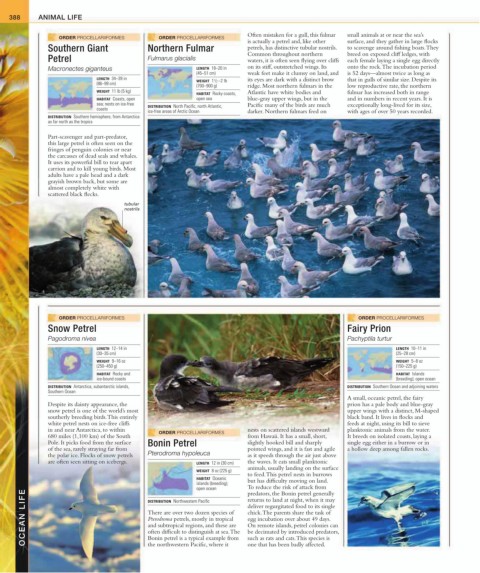
               Part-scavenger and part-predator,
               this large petrel is often seen on the
               fringes of penguin colonies or near
               the carcasses of dead seals and whales.
               It uses its powerful bill to tear apart
               carrion and to kill young birds. Most
               adults have a pale head and a dark
               grayish brown back, but some are
               almost completely white with
               scattered black flecks.
                                      tubular
                                      nostrils


                  ORDER PROCELLARIIFORMES                                                                   ORDER PROCELLARIIFORMES
               Snow Petrel                                                                              Fairy Prion

               Pagodroma nivea                                                                          Pachyptila turtur
                              LENGTH  12–14 in                                                                         LENGTH  10–11 in
                              (30–35 cm)                                                                               (25–28 cm)
                              WEIGHT  9–16 oz                                                                          WEIGHT  5–8 oz
                              (250–450 g)                                                                              (150–225 g)
                              HABITAT  Rocky and                                                                       HABITAT  Islands
                              ice-bound coasts                                                                         (breeding); open ocean
               DISTRIBUTION  Antarctica, subantarctic islands,                                          DISTRIBUTION  Southern Ocean and adjoining waters
               Southern Ocean
                                                                                                        A small, oceanic petrel, the fairy
               Despite its dainty appearance, the                                                       prion has a pale body and blue-gray
               snow petrel is one of the world’s most                                                   upper wings with a distinct, M-shaped
               southerly breeding birds. This entirely                                                  black band. It lives in flocks and
               white petrel nests on ice-free cliffs                                                    feeds at night, using its bill to sieve
               in and near Antarctica, to within   ORDER PROCELLARIIFORMES  nests on scattered islands westward   planktonic animals from the water.
               680 miles (1,100 km) of the South                           from Hawaii. It has a small, short,   It breeds on isolated coasts, laying a
               Pole. It picks food from the surface    Bonin Petrel        slightly hooked bill and sharply   single egg either in a burrow or in
               of the sea, rarely straying far from                        pointed wings, and it is fast and agile   a hollow deep among fallen rocks.
               the polar ice. Flocks of snow petrels   Pterodroma hypoleuca   as it speeds through the air just above
               are often seen sitting on icebergs.         LENGTH  12 in (30 cm)  the waves. It eats small planktonic
                                                                           animals, usually landing on the surface
                                                           WEIGHT  8 oz (225 g)
                                                                           to feed. This petrel nests in burrows
                                                           HABITAT  Oceanic
                                                           islands (breeding);    but has difficulty moving on land.
                                                           open ocean      To reduce the risk of attack from
        OCEAN LIFE                           There are over two dozen species of   deliver regurgitated food to its single
                                                                           predators, the Bonin petrel generally
                                                                           returns to land at night, when it may
                                             DISTRIBUTION  Northwestern Pacific
                                                                           chick. The parents share the task of
                                                                           egg incubation over about 49 days.
                                             Pterodroma petrels, mostly in tropical
                                                                           On remote islands, petrel colonies can
                                             and subtropical regions, and these are
                                                                           be decimated by introduced predators,
                                             often difficult to distinguish at sea. The
                                                                           such as rats and cats. This species is
                                             Bonin petrel is a typical example from
                                                                           one that has been badly affected.
                                             the northwestern Pacific, where it

