


Page 394 - (DK) Ocean - The Definitive Visual Guide
P. 394
392     ANIMAL LIFE


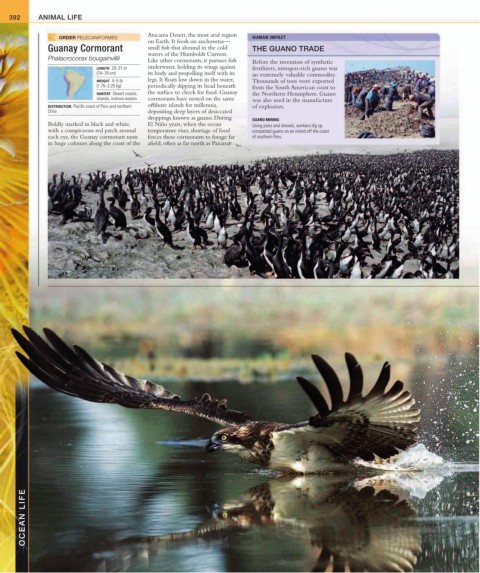
                  ORDER PELECANIFORMES       Atacama Desert, the most arid region   HUMAN IMPACT
                                             on Earth. It feeds on anchovetas—
               Guanay Cormorant              small fish that abound in the cold   THE GUANO TRADE
                                             waters of the Humboldt Current.
               Phalacrocorax bougainvillii   Like other cormorants, it pursues fish   Before the invention of synthetic
                              LENGTH  29–31 in   underwater, holding its wings against   fertilizers, nitrogen-rich guano was
                              (74–78 cm)     its body and propelling itself with its   an extremely valuable commodity.
                              WEIGHT  4–5 lb   legs. It floats low down in the water,   Thousands of tons were exported
                              (1.75–2.25 kg)  periodically dipping its head beneath   from the South American coast to
                              HABITAT  Desert coasts,   the surface to check for food. Guanay   the Northern Hemisphere. Guano
                              islands, inshore waters  cormorants have nested on the same   was also used in the manufacture
               DISTRIBUTION  Pacific coast of Peru and northern   offshore islands for millennia,   of explosives.
               Chile                         depositing deep layers of desiccated
                                             droppings known as guano. During    GUANO MINING
               Boldly marked in black and white,   El Niño years, when the ocean   Using picks and shovels, workers dig up
               with a conspicuous red patch around   temperature rises, shortage of food   compacted guano on an island off the coast
               each eye, the Guanay cormorant nests   forces these cormorants to forage far   of southern Peru.
               in huge colonies along the coast of the  afield, often as far north as Panama.


        OCEAN LIFE

