


Page 391 - (DK) Ocean - The Definitive Visual Guide
P. 391
389


                ORDER PROCELLARIIFORMES
             Great Shearwater

             Puffinus gravis
                           LENGTH  18–21 in
                           (46–53 cm)
                           WEIGHT  1 / 4 –2 lb
                                 3
                           (800–900 kg)
                           HABITAT  Oceanic islands
                           (breeding); open ocean
             DISTRIBUTION  Atlantic Ocean, except off west coast
             of Africa south of Sierra Leone
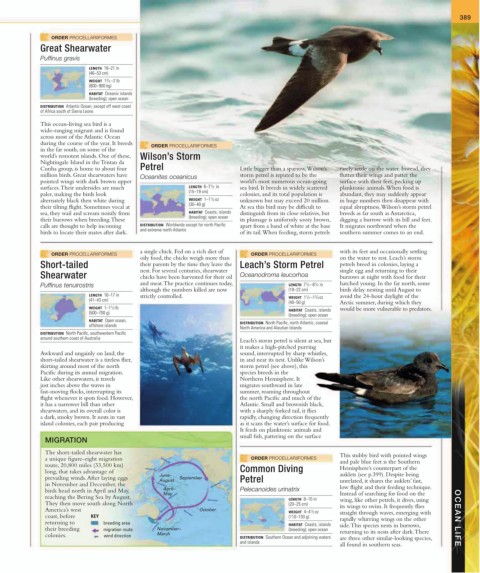
             This ocean-living sea bird is a
             wide-ranging migrant and is found
             across most of the Atlantic Ocean
             during the course of the year. It breeds   ORDER PROCELLARIIFORMES
             in the far south, on some of the
             world’s remotest islands. One of these,   Wilson’s Storm
             Nightingale Island in the Tristan da
             Cunha group, is home to about four   Petrel                Little bigger than a sparrow, Wilson’s   rarely settle on the water. Instead, they
             million birds. Great shearwaters have                      storm petrel is reputed to be the   flutter their wings and patter the
             pointed wings with dark brown upper   Oceanites oceanicus  world’s most numerous ocean-going   surface with their feet, pecking up
                                                                1
             surfaces. Their undersides are much         LENGTH  6–7 / 2  in   sea bird. It breeds in widely scattered   planktonic animals. When food is
             paler, making the birds look                (15–19 cm)     colonies, and its total population is   abundant, they may suddenly appear
                                                                1
             alternately black then white during         WEIGHT  1–1 / 2 oz   unknown but may exceed 20 million.   in huge numbers then disappear with
             their tilting flight. Sometimes vocal at    (30–40 g)      At sea this bird may be difficult to   equal abruptness. Wilson’s storm petrel
             sea, they wail and scream noisily from      HABITAT  Coasts, islands   distinguish from its close relatives, but   breeds as far south as Antarctica,
             their burrows when breeding. These          (breeding); open ocean  its plumage is uniformly sooty brown,   digging a burrow with its bill and feet.
             calls are thought to help incoming   DISTRIBUTION  Worldwide except for north Pacific   apart from a band of white at the base   It migrates northward when the
             birds to locate their mates after dark.  and extreme north Atlantic  of its tail. When feeding, storm petrels   southern summer comes to an end.


                ORDER PROCELLARIIFORMES    a single chick. Fed on a rich diet of   ORDER PROCELLARIIFORMES  with its feet and occasionally settling
                                           oily food, the chicks weigh more than                      on the water to rest. Leach’s storm
             Short-tailed                  their parents by the time they leave the   Leach’s Storm Petrel  petrels breed in colonies, laying a
                                           nest. For several centuries, shearwater                    single egg and returning to their
             Shearwater                    chicks have been harvested for their oil   Oceanodroma leucorhoa  burrows at night with food for their
                                           and meat. The practice continues today,     LENGTH  7 / 2 –8 / 2 in   hatched young. In the far north, some
                                                                                               1
                                                                                            1
             Puffinus tenuirostris
                                           although the numbers killed are now         (19–22 cm)     birds delay nesting until August to
                           LENGTH  16–17 in   strictly controlled.                     WEIGHT  1 / 2 –1 / 4 oz   avoid the 24-hour daylight of the
                                                                                            1
                                                                                               3
                           (41–43 cm)
                                                                                       (40–50 g)      Arctic summer, during which they
                                  1
                           WEIGHT  1–1 / 2 lb                                          HABITAT  Coasts, islands   would be more vulnerable to predators.
                           (500–700 g)
                                                                                       (breeding); open ocean
                           HABITAT  Open ocean,                         DISTRIBUTION  North Pacific, north Atlantic, coastal
                           offshore islands
                                                                        North America and Aleutian Islands
             DISTRIBUTION  North Pacific, southwestern Pacific
             around southern coast of Australia
                                                                        Leach’s storm petrel is silent at sea, but
                                                                        it makes a high-pitched purring
             Awkward and ungainly on land, the                          sound, interrupted by sharp whistles,
             short-tailed shearwater is a tireless flier,               in and near its nest. Unlike Wilson’s
             skirting around most of the north                          storm petrel (see above), this
             Pacific during its annual migration.                       species breeds in the
             Like other shearwaters, it travels                         Northern Hemisphere. It
             just inches above the waves in                             migrates southward in late
             fast-moving flocks, interrupting its                       summer, roaming throughout
             flight whenever it spots food. However,                    the north Pacific and much of the
             it has a narrower bill than other                          Atlantic. Small and brownish black,
             shearwaters, and its overall color is                      with a sharply forked tail, it flies
             a dark, smoky brown. It nests in vast                      rapidly, changing direction frequently
             island colonies, each pair producing                       as it scans the water’s surface for food.
                                                                        It feeds on planktonic animals and
              MIGRATION                                                 small fish, pattering on the surface
              The short-tailed shearwater has                                                         This stubby bird with pointed wings
              a unique figure-eight migration                               ORDER PROCELLARIIFORMES   and pale blue feet is the Southern
              route, 20,800 miles (33,500 km)                                                         Hemisphere’s counterpart of the
              long, that takes advantage of                             Common Diving
                                                June–                                                 auklets (see p.399). Despite being
              prevailing winds. After laying eggs   August  September   Petrel                        unrelated, it shares the auklets’ fast,
              in November and December, the                                                           low flight and their feeding technique.
              birds head north in April and May,   April–               Pelecanoides urinatrix        Instead of searching for food on the
                                                  May
              reaching the Bering Sea by August.
                                                                                       LENGTH  8–10 in   wing, like other petrels, it dives, using
              They then move south along North                                         (20–25 cm)     its wings to swim. It frequently flies
              America’s west                                October
                                                                                             1
                                                                                       WEIGHT  4–4 / 2 oz   straight through waves, emerging with
              coast, before   KEY                                                      (110–130 g)    rapidly whirring wings on the other   OCEAN LIFE
              returning to      breeding area                                          HABITAT  Coasts, islands   side. This species nests in burrows,
              their breeding    migration route  November–                             (breeding); open ocean  returning to its nests after dark. There
              colonies.         wind direction  March                   DISTRIBUTION  Southern Ocean and adjoining waters   are three other similar-looking species,
                                                                        and islands
                                                                                                      all found in southern seas.

