


Page 393 - (DK) Ocean - The Definitive Visual Guide
P. 393
BIRDS       391


                ORDER PELECANIFORMES                                        ORDER PELECANIFORMES      to mature, gradually losing their brown
                                                                                                      plumage. During that time, they roam
             Brown Pelican                                              Northern Gannet               far over the ocean before returning to
                                                                                                      their native colony to breed.
             Pelecanus occidentalis                                     Morus bassanus
                                  1
                           LENGTH  4–5 / 4  ft                                         LENGTH  34–39 in
                           (1.2–1.6 m)                                                 (87–100 cm)
                                 3
                                                                                            1
                           WEIGHT  7 / 4 –10 lb                                        WEIGHT  6 / 4 –7 lb
                           (3.5–4.5 kg)                                                (2.8–3.2 kg)
                           HABITAT  Coastal waters,                                    HABITAT  Open sea,rocky
                           estuaries, islands                                          coasts, offshore islands
             DISTRIBUTION  Pacific and Atlantic coasts of North          DISTRIBUTION  Eastern and western coasts of
             and South America, Galápagos Islands                       north Atlantic
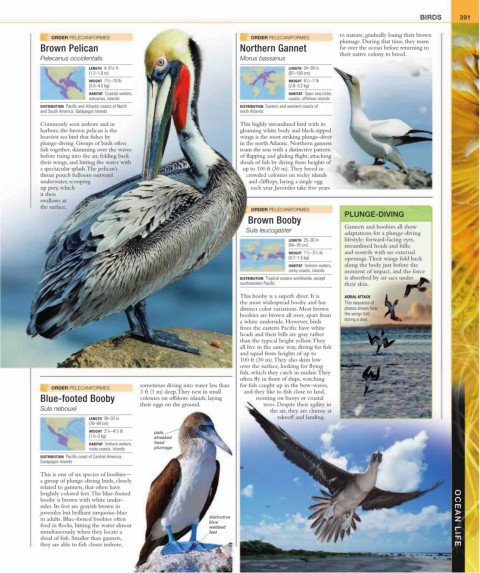
             Commonly seen inshore and in                               This highly streamlined bird with its
             harbors, the brown pelican is the                          gleaming white body and black-tipped
             heaviest sea bird that fishes by                           wings is the most striking plunge-diver
             plunge-diving. Groups of birds often                       in the north Atlantic. Northern gannets
             fish together, skimming over the waves                     roam the seas with a distinctive pattern
             before rising into the air, folding back                   of flapping and gliding flight, attacking
             their wings, and hitting the water with                    shoals of fish by diving from heights of
             a spectacular splash. The pelican’s                         up to 100 ft (30 m).  They breed in
             throat pouch balloons outward                                crowded colonies on rocky islands
             underwater, scooping                                          and clifftops, laying a single egg
             up prey, which                                                 each year. Juveniles take five years
             it then
             swallows at
             the surface.
                                                                            ORDER PELECANIFORMES
                                                                                                        PLUNGE-DIVING
                                                                           Brown Booby
                                                                                                        Gannets and boobies all show
                                                                                                        adaptations for a plunge-diving
                                                                          Sula leucogaster
                                                                                       LENGTH  25–30 in   lifestyle: forward-facing eyes,
                                                                                       (64–76 cm)       streamlined heads and bills;
                                                                                               1
                                                                                       WEIGHT  1 / 2 –3 / 4 lb   and nostrils with no external
                                                                                            1
                                                                                       (0.7–1.5 kg)     openings. Their wings fold back
                                                                                       HABITAT  Inshore waters,   along the body just before the
                                                                                       rocky coasts, islands  moment of impact, and the force
                                                                        DISTRIBUTION  Tropical oceans worldwide, except   is absorbed by air sacs under
                                                                        southeastern Pacific             their skin.
                                                                        This booby is a superb diver. It is    AERIAL ATTACK
                                                                        the most widespread booby and has   This sequence of
                                                                        distinct color variations. Most brown   photos shows how
                                                                        boobies are brown all over, apart from   the wings fold
                                                                        a white underside. However, birds   during a dive.
                                                                        from the eastern Pacific have white
                                                                        heads and their bills are gray rather
                                                                        than the typical bright yellow. They
                                                                        all live in the same way, diving for fish
                                                                        and squid from heights of up to
                                                                        100 ft (30 m). They also skim low
                                                                        over the surface, looking for flying
                                                                        fish, which they catch in midair. They
                                                                        often fly in front of ships, watching
                ORDER PELECANIFORMES       sometimes diving into water less than   for fish caught up in the bow-waves,
                                           3 ft (1 m) deep. They nest in small   and they like to fish close to land,
             Blue-footed Booby             colonies on offshore islands, laying   roosting on buoys or coastal
                                           their eggs on the ground.           trees. Despite their agility in
                                                                                 the air, they are clumsy at
             Sula nebouxii
                           LENGTH  30–33 in                                         takeoff and landing.
                           (76–84 cm)
                                   1
                                 1
                           WEIGHT  2 / 4 –4 / 2  lb   pale,
                           (1.5–2 kg)          streaked
                           HABITAT  Inshore waters,   head
                           rocky coasts, islands  plumage
             DISTRIBUTION  Pacific coast of Central America,
             Galápagos Islands
             This is one of six species of boobies—
             a group of plunge-diving birds, closely
             related to gannets, that often have
             brightly colored feet. The blue-footed
             booby is brown with white under-
             sides. Its feet are grayish brown in
             juveniles but brilliant turquoise-blue
             in adults. Blue-footed boobies often              distinctive                                                               OCEAN LIFE
                                                               blue
             feed in flocks, hitting the water almost
                                                               webbed
             simultaneously when they locate a                 feet
             shoal of fish. Smaller than gannets,
             they are able to fish closer inshore,

