Page 395 - (DK) Ocean - The Definitive Visual Guide
P. 395
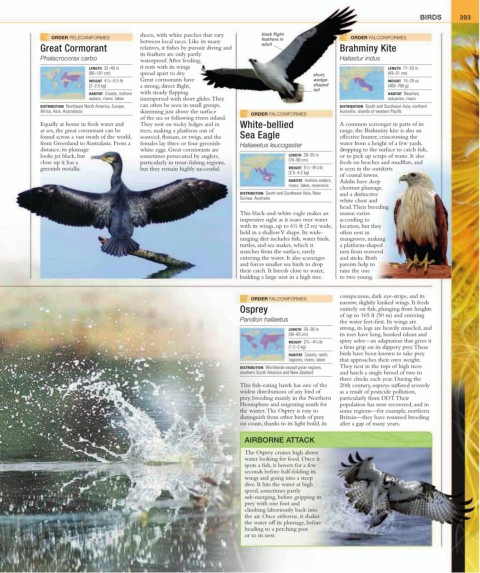
BIRDS       393


                ORDER PELECANIFORMES       sheen, with white patches that vary   black flight             ORDER FALCONIFORMES
                                                                               feathers in
                                           between local races. Like its many   adult
             Great Cormorant               relatives, it fishes by pursuit diving and                 Brahminy Kite
                                           its feathers are only partly
             Phalacrocorax carbo           waterproof. After feeding,                                 Haliastur indus
                           LENGTH  32–40 in   it rests with its wings                                                LENGTH  17–20 in
                           (80–101 cm)     spread apart to dry.                               short,                 (43–51 cm)
                           WEIGHT  4 / 4 –5 / 2 lb   Great cormorants have                    wedge-                 WEIGHT  14–25 oz
                                   1
                                 1
                           (2–2.5 kg)      a strong, direct flight,                           shaped                 (400–700 g)
                                                                                              tail
                           HABITAT  Coasts, inshore   with steady flapping                                           HABITAT  Beaches,
                           waters, rivers, lakes  interspersed with short glides. They                               estuaries, rivers
             DISTRIBUTION  Northeast North America, Europe,   can often be seen in small groups,      DISTRIBUTION  South and Southeast Asia, northern
             Africa, Asia, Australasia     skimming just above the surface    ORDER FALCONIFORMES     Australia, islands of western Pacific
                                           of the sea or following rivers inland.
             Equally at home in fresh water and    They nest on rocky ledges and in   White-bellied    A common scavenger in parts of its
             at sea, the great cormorant can be   trees, making a platform out of                     range, the Brahminy kite is also an
             found across a vast swath of the world,   seaweed, flotsam, or twigs, and the   Sea Eagle  effective hunter, crisscrossing the
             from Greenland to Australasia. From a   females lay three or four greenish-              water from a height of a few yards,
             distance, its plumage         white eggs. Great cormorants are   Haliaeetus leucogaster  dropping to the surface to catch fish,
             looks jet black, but          sometimes persecuted by anglers,            LENGTH  28–35 in   or to pick up scraps of waste. It also
             close up it has a             particularly in trout-fishing regions,      (70–90 cm)     feeds on beaches and mudflats, and
                                                                                               1
                                                                                            1
             greenish metallic             but they remain highly successful.          WEIGHT  5 / 2 –9 / 4 lb   is seen in the outskirts
                                                                                       (2.5–4.2 kg)
                                                                                                      of coastal towns.
                                                                                       HABITAT  Inshore waters,   Adults have deep
                                                                                       rivers, lakes, reservoirs
                                                                                                      chestnut plumage,
                                                                        DISTRIBUTION  South and Southeast Asia, New   and a distinctive
                                                                        Guinea, Australia
                                                                                                      white chest and
                                                                                                      head. Their breeding
                                                                        This black-and-white eagle makes an   season varies
                                                                        impressive sight as it soars over water   according to
                                                                        with its wings, up to 6½ ft (2 m) wide,   location, but they
                                                                        held in a shallow V shape. Its wide-  often nest in
                                                                        ranging diet includes fish, water birds,   mangroves, making
                                                                        turtles, and sea snakes, which it   a platform-shaped
                                                                        snatches from the surface, rarely   nest from seaweed
                                                                        entering the water. It also scavenges   and sticks. Both
                                                                        and forces smaller sea birds to drop   parents help to
                                                                        their catch. It breeds close to water,   raise the one
                                                                        building a large nest in a high tree.  to two young.
                                                                                                      conspicuous, dark eye-stripe, and its
                                                                            ORDER FALCONIFORMES
                                                                                                      narrow, slightly kinked wings. It feeds
                                                                        Osprey                        entirely on fish, plunging from heights
                                                                                                      of up to 165 ft (50 m) and entering
                                                                        Pandion haliaetus             the water feet-first. Its wings are
                                                                                       LENGTH  20–26 in   strong, its legs are heavily muscled, and
                                                                                       (50–65 cm)     its toes have long, hooked talons and
                                                                                       WEIGHT  2 / 4 –4 / 2 lb   spiny soles—an adaptation that gives it
                                                                                               1
                                                                                            3
                                                                                       (1.2–2 kg)     a firm grip on its slippery prey. These
                                                                                       HABITAT  Coasts, reefs,   birds have been known to take prey
                                                                                       lagoons, rivers, lakes  that approaches their own weight.
                                                                        DISTRIBUTION  Worldwide except polar regions,   They nest in the tops of high trees
                                                                        southern South America and New Zealand  and hatch a single brood of two to
                                                                                                      three chicks each year. During the
                                                                        This fish-eating hawk has one of the   20th century, ospreys suffered severely
                                                                        widest distributions of any bird of   as a result of pesticide pollution,
                                                                        prey, breeding mainly in the Northern   particularly from DDT. Their
                                                                        Hemisphere and migrating south for   population has now recovered, and in
                                                                        the winter. The Osprey is easy to   some regions—for example, northern
                                                                        distinguish from other birds of prey    Britain—they have resumed breeding
                                                                        on coasts, thanks to its light build, its   after a gap of many years.

                                                                          AIRBORNE ATTACK

                                                                          The Osprey cruises high above
                                                                          water looking for food. Once it
                                                                          spots a fish, it hovers for a few
                                                                          seconds before half-folding its
                                                                          wings and going into a steep
                                                                          dive. It hits the water at high
                                                                          speed, sometimes partly
                                                                          sub-merging, before gripping its
                                                                          prey with one foot and
                                                                          climbing laboriously back into
                                                                          the air. Once airborne, it shakes
                                                                          the water off its plumage, before
                                                                          heading to a perching post
                                                                          or to its nest.
   390   391   392   393   394   395   396   397   398   399   400