


Page 396 - (DK) Ocean - The Definitive Visual Guide
P. 396
394     ANIMAL LIFE


                  ORDER CHARADRIIFORMES         ORDER CHARADRIIFORMES      limpets, and other mollusks, using its   ORDER CHARADRIIFORMES
                                                                           bill to smash or pry apart their shells.
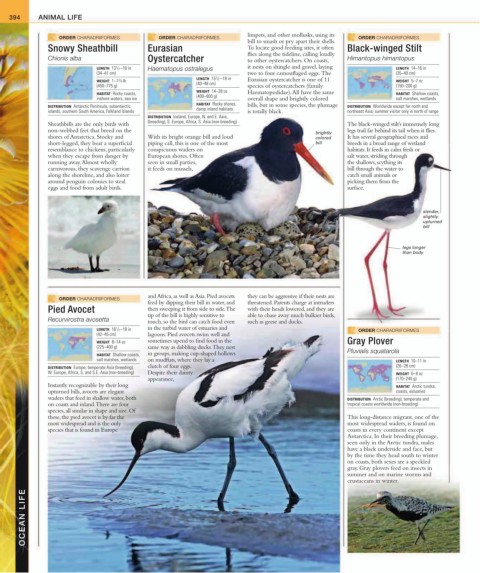
               Snowy Sheathbill              Eurasian                      To locate good feeding sites, it often   Black-winged Stilt
                                                                           flies along the tideline, calling loudly
                                             Oystercatcher
               Chionis alba                                                to other oystercatchers. On coasts,    Himantopus himantopus
                                   1
                              LENGTH  13 / 2 –16 in                        it nests on shingle and gravel, laying      LENGTH  14–16 in
                                             Haematopus ostralegus
                              (34–41 cm)                                   two to four camouflaged eggs.  The          (35–40 cm)
                                                                 1
                                                           LENGTH  15 / 2 –19 in   Eurasian oystercatcher is one of 11
                              WEIGHT  1–1 / 4 lb                                                                       WEIGHT  5–7 oz
                                    3
                              (450–775 g)                  (40–48 cm)      species of oystercatchers (family           (150–200 g)
                                                           WEIGHT  14–28 oz
                              HABITAT  Rocky coasts,                       Haematopodidae). All have the same          HABITAT  Shallow coasts,
                              inshore waters, sea ice      (400–800 g)     overall shape and brightly colored          salt marshes, wetlands
                                                           HABITAT  Rocky shores,
               DISTRIBUTION  Antarctic Peninsula, subantarctic             bills, but in some species, the plumage   DISTRIBUTION  Worldwide except far north and
               islands, southern South America, Falkland Islands  damp inland habitats  is totally black.  northeast Asia; summer visitor only in north of range
                                             DISTRIBUTION  Iceland, Europe, N. and E. Asia,
                                             (breeding); S. Europe, Africa, S. Asia (non-breeding)
               Sheathbills are the only birds with                                                      The black-winged stilt’s immensely long
               non-webbed feet that breed on the                                                        legs trail far behind its tail when it flies.
                                                                                               brightly
               shores of Antarctica. Stocky and    With its bright orange bill and loud        colored   It has several geographical races and
               short-legged, they bear a superficial   piping call, this is one of the most    bill     breeds in a broad range of wetland
               resemblance to chickens, particularly   conspicuous waders on                            habitats. It feeds in calm fresh or
               when they escape from danger by   European shores. Often                                 salt water, striding through
               running away. Almost wholly   seen in small parties,                                     the shallows, scything its
               carnivorous, they scavenge carrion   it feeds on mussels,                                bill through the water to
               along the shoreline, and also loiter                                                     catch small animals or
               around penguin colonies to steal                                                         picking them from the
               eggs and food from adult birds.                                                          surface.
                                                                                                                               slender,
                                                                                                                               slightly
                                                                                                                               upturned
                                                                                                                               bill
                                                                                                                         legs longer
                                                                                                                         than body


                                             and Africa, as well as Asia. Pied avocets   they can be aggressive if their nests are
                  ORDER CHARADRIIFORMES
                                             feed by dipping their bill in water, and   threatened. Parents charge at intruders
               Pied Avocet                   then sweeping it from side to side. The   with their heads lowered, and they are
                                             tip of the bill is highly sensitive to   able to chase away much bulkier birds,
               Recurvirostra avosetta        touch, so the bird can catch food even   such as geese and ducks.
                                   1
                              LENGTH  16 / 2 –18 in   in the turbid water of estuaries and                  ORDER CHARADRIIFORMES
                              (42–45 cm)     lagoons. Pied avocets swim well and
                              WEIGHT  8–14 oz   sometimes upend to find food in the                     Gray Plover
                              (225–400 g)    same way as dabbling ducks. They nest
                              HABITAT  Shallow coasts,   in groups, making cup-shaped hollows           Pluvialis squatarola
                              salt marshes, wetlands  on mudflats, where they lay a                                    LENGTH  10–11 in
               DISTRIBUTION  Europe, temperate Asia (breeding);    clutch of four eggs.                                (26–28 cm)
               W. Europe, Africa, S. and S.E. Asia (non-breeding)  Despite their dainty                                WEIGHT  6–8 oz
                                             appearance,                                                               (170–240 g)
               Instantly recognizable by their long                                                                    HABITAT  Arctic tundra,
               upturned bills, avocets are elegant                                                                     coasts, estuaries
               waders that feed in shallow water, both                                                  DISTRIBUTION  Arctic (breeding); temperate and
               on coasts and inland. There are four                                                     tropical coasts worldwide (non-breeding)
               species, all similar in shape and size. Of
               these, the pied avocet is by far the                                                     This long-distance migrant, one of the
               most widespread and is the only                                                          most widespread waders, is found on
               species that is found in Europe                                                          coasts in every continent except
                                                                                                        Antarctica. In their breeding plumage,
                                                                                                        seen only in the Arctic tundra, males
                                                                                                        have a black underside and face, but
                                                                                                        by the time they head south to winter
                                                                                                        on coasts, both sexes are a speckled
                                                                                                        gray. Gray plovers feed on insects in
                                                                                                        summer and on marine worms and
                                                                                                        crustaceans in winter.
        OCEAN LIFE

