


Page 405 - (DK) Ocean - The Definitive Visual Guide
P. 405
MAMMALS         403


                ORDER CARNIVORA               ORDER CARNIVORA           Of the nine species of fur seals, most   snub-nosed look. Their large eyes
                                                                        live in the Southern Hemisphere; this   allow them to see at night, which is
             Antarctic Fur Seal            Northern Fur Seal            is the only northern species that exists   when they do most of their feeding,
                                                                        in significant numbers. Like other fur   as their prey is closer to the surface.
             Arctocephalus gazella         Callorhinus ursinus          seals, it has a thick, dark coat, external   They feed mainly on fish, but also on
                           LENGTH  5–6 / 2 ft            LENGTH  4 / 2–7 ft   ears, and long front flippers that it uses   squid and sea birds, and migrate far
                                                              1
                                  1
                           (1.5–2 m)                     (1.4–2.1 m)    for swimming and for moving around   out into the Pacific after they breed.
                           WEIGHT  110–350 lb            WEIGHT  110–600 lb   on land. Males can be   Most northern fur seals breed on
                           (50–160 kg)                   (50–270 kg)    five times heavier than       islands in the Bering Sea. Decimated
                           HABITAT  Rocky coasts,        HABITAT  Coasts and sea   females, but both sexes   by commercial hunters from the
                           open sea in polar waters      in cold-water regions  have short muzzles,    mid-1700s onward, they are now
             DISTRIBUTION  Southern Ocean  DISTRIBUTION  North Pacific, Bering Sea  giving them a        protected by hunting controls.
                                                                        characteristic
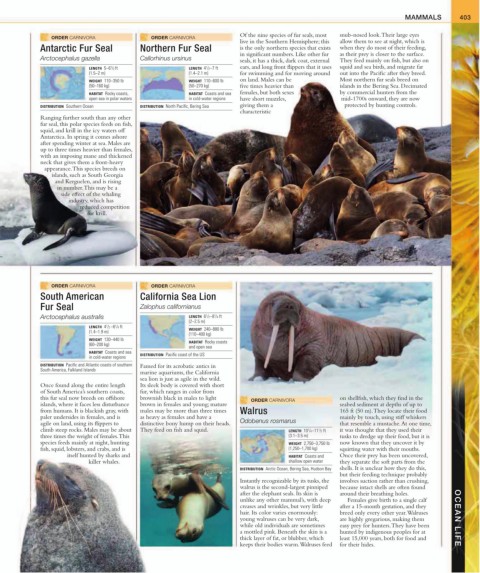
             Ranging further south than any other
             fur seal, this polar species feeds on fish,
             squid, and krill in the icy waters off
             Antarctica. In spring it comes ashore
             after spending winter at sea. Males are
             up to three times heavier than females,
             with an imposing mane and thickened
             neck that gives them a front-heavy
              appearance. This species breeds on
                islands, such as South Georgia
                 and Kerguelen, and is rising
                  in number. This may be a
                   side effect of the whaling
                     industry, which has
                         reduced competition
                           for krill.


                ORDER CARNIVORA               ORDER CARNIVORA
             South American                California Sea Lion
             Fur Seal                      Zalophus californianus
                                                              1
                                                         LENGTH  6 / 2–8 / 4 ft
                                                                 1
             Arctocephalus australis
                                                         (2–2.5 m)
                                   1
                                 1
                           LENGTH  4 / 2 –6 / 4 ft       WEIGHT  240–880 lb
                           (1.4–1.9 m)
                                                         (110–400 kg)
                           WEIGHT  130–440 lb            HABITAT  Rocky coasts
                           (60–200 kg)
                                                         and open sea
                           HABITAT  Coasts and sea   DISTRIBUTION  Pacific coast of the US
                           in cold-water regions
             DISTRIBUTION  Pacific and Atlantic coasts of southern   Famed for its acrobatic antics in
             South America, Falkland Islands
                                           marine aquariums, the California
                                           sea lion is just as agile in the wild.
             Once found along the entire length    Its sleek body is covered with short
             of South America’s southern coasts,   fur, which ranges in color from
             this fur seal now breeds on offshore   brownish black in males to light    ORDER CARNIVORA  on shellfish, which they find in the
             islands, where it faces less disturbance   brown in females and young; mature            seabed sediment at depths of up to
             from humans. It is blackish gray, with   males may be more than three times    Walrus    165 ft (50 m). They locate their food
             paler undersides in females, and is   as heavy as females and have a                     mainly by touch, using stiff whiskers
             agile on land, using its flippers to   distinctive bony hump on their heads.   Odobenus rosmarus  that resemble a mustache. At one time,
             climb steep rocks. Males may be about   They feed on fish and squid.      LENGTH  10 / 4–11 / 2 ft   it was thought that they used their
                                                                                             1
                                                                                                1
             three times the weight of females. This                                   (3.1–3.5 m)    tusks to dredge up their food, but it is
             species feeds mainly at night, hunting                                    WEIGHT  2,750–3,750 lb   now known that they uncover it by
             fish, squid, lobsters, and crabs, and is                                  (1,250–1,700 kg)  squirting water with their mouths.
                     itself hunted by sharks and                                       HABITAT  Coasts and   Once their prey has been uncovered,
                           killer whales.                                              shallow open water  they separate the soft parts from the
                                                                        DISTRIBUTION  Arctic Ocean, Bering Sea, Hudson Bay  shells. It is unclear how they do this,
                                                                                                      but their feeding technique probably
                                                                        Instantly recognizable by its tusks, the   involves suction rather than crushing,
                                                                        walrus is the second-largest pinniped   because intact shells are often found
                                                                        after the elephant seals. Its skin is   around their breathing holes.
                                                                        unlike any other mammal’s, with deep   Females give birth to a single calf
                                                                        creases and wrinkles, but very little   after a 15-month gestation, and they
                                                                        hair. Its color varies enormously:   breed only every other year. Walruses
                                                                        young walruses can be very dark,   are highly gregarious, making them   OCEAN LIFE
                                                                        while old individuals are sometimes    easy prey for hunters. They have been
                                                                        a mottled pink. Beneath the skin is a   hunted by indigenous peoples for at
                                                                        thick layer of fat, or blubber, which   least 15,000 years, both for food and
                                                                        keeps their bodies warm. Walruses feed  for their hides.

