


Page 437 - (DK) Ocean - The Definitive Visual Guide
P. 437
435


                                     Wind-farming in the Baltic


                                     Declining oil stocks, threats to fuel supplies, and the risks
                                                                                         OFFSHORE WIND FARMS
                                     of climate change are increasingly focusing attention on
                                     alternative sources of energy that do not generate
                                     greenhouse gases. After hydroelectricity, wind-farming
                                     is the most advanced source of renewable energy. It is
                                     easiest to build wind farms on land, but many people do
                                     not want turbines built near their homes. Wind farms
                                     built at sea are less controversial, although costlier to
                                     build and maintain. Since it is usually windier at sea and
                                     there are no hills or trees to cause turbulence, offshore
                                     turbines are more efficient than land-based ones.
                                      The world’s first commercial offshore wind farm was
                                     built in the Baltic (see below). Other large wind farms
                                     are in place or under construction in the nearby    MASSIVE BLADES
                                                                                         Wind-turbine blades are
                                     Kattegat sea area; in British, German, Danish, Dutch,    assembled on the dockside,
                                     and Belgian areas of the North Sea; and off the coast of   then carried to the tower on
                                                                                         a barge. The rotors reach
                                     China. There are also wind farms in the Mediterranean   295 ft (95 m) in diameter.
                                     and off Ireland, Japan, Norway, and Spain, while a large
                                     farm is planned in South Korea. The US and Canada   UNDER CONSTRUCTION  FOUNDATIONS
                                     also have various proposed offshore projects for the   The concrete foundations of
                                                                                         a turbine are cast onshore
                                     Pacific Coast, East Coast, and Great Lakes.         in a dry dock. They are then
                                      Because they burn no fossil fuels, wind farms can help   floated out to sea and sunk
                                                                                         in shallow water on site.
                                     reduce greenhouse gases. However, the overall benefits
                                     may take some time to appear. It can take 1,000 tons
                                     of concrete just to build the foundations of an offshore
                                     turbine, and concrete production is one of the biggest
                                     sources of greenhouse gases.


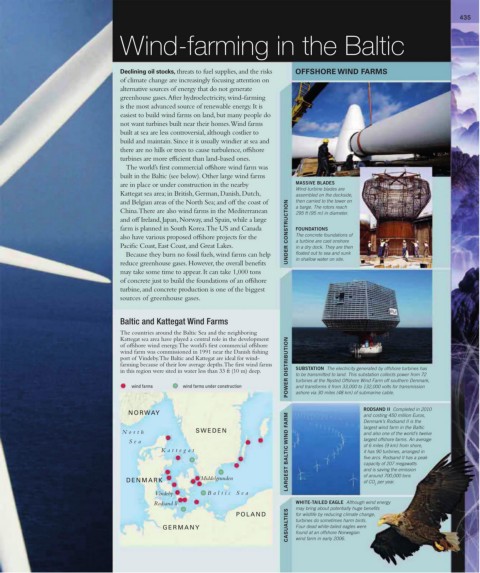
                                     Baltic and Kattegat Wind Farms

                                     The countries around the Baltic Sea and the neighboring
                                     Kattegat sea area have played a central role in the development
                                     of offshore wind energy. The world’s first commercial offshore
                                     wind farm was commissioned in 1991 near the Danish fishing
                                     port of  Vindeby. The Baltic and Kattegat are ideal for wind-
                                     farming because of their low average depths. The first wind farms   POWER DISTRIBUTION
                                     in this region were sited in water less than 33 ft (10 m) deep.  SUBSTATION  The electricity generated by offshore turbines has
                                                                                         to be transmitted to land. This substation collects power from 72
                                        wind farms     wind farms under construction     turbines at the Nysted Offshore Wind Farm off southern Denmark,
                                                                                         and transforms it from 33,000 to 132,000 volts for transmission
                                                                                         ashore via 30 miles (48 km) of submarine cable.
                                                                                                             RODSAND II  Completed in 2010
                                       NORWAY                                                                and costing 450 million Euros,
                                                                                       LARGEST BALTIC WIND FARM  it has 90 turbines, arranged in
                                                                                                             Denmark’s Rodsand II is the
                                     Nor th                SWEDEN                                            largest wind farm in the Baltic
                                                                                                             and also one of the world’s twelve
                                       Sea                                                                   largest offshore farms. An average
                                                                                                             of 6 miles (9 km) from shore,
                                                 Kattegat
                                                                                                             five arcs. Rodsand II has a peak
                                                                                                             capacity of 207 megawatts
                                                                                                             of around 700,000 tons
                                       DENMARK               Middelgrunden                                   and is saving the emission
                                                                                                             of CO  per year.
                                                                                                                 2
                                               Vindeby         Baltic Sea
                                               Rodsand ll                                WHITE-TAILED EAGLE  Although wind energy
                                                                                         may bring about potentially huge benefits
                                                                                       CASUALTIES  turbines do sometimes harm birds.
                                                                       POLAND            for wildlife by reducing climate change,
                                                 GERMANY                                 found at an offshore Norwegian
                                                                                         Four dead white-tailed eagles were
                                                                                         wind farm in early 2006.

