


Page 442 - (DK) Ocean - The Definitive Visual Guide
P. 442
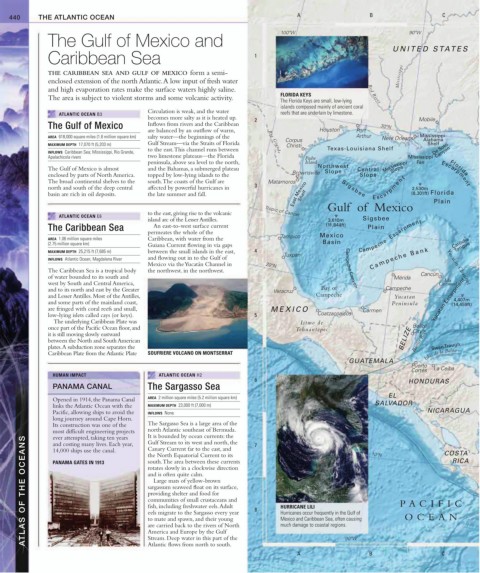
440 THE ATLANTIC OCEAN A B C
100ºW 90ºW
The Gulf of Mexico and
UNITED S TATES
Caribbean Sea 1
THE CARIBBEAN SEA AND GULF OF MEXICO form a semi- Mississippi
enclosed extension of the north Atlantic. A low input of fresh water
and high evaporation rates make the surface waters highly saline.
FLORIDA KEYS Red River
The area is subject to violent storms and some volcanic activity.
The Florida Keys are small, low-lying
islands composed mainly of ancient coral
Circulation is weak, and the water
ATLANTIC OCEAN B3 reefs that are underlain by limestone.
becomes more salty as it is heated up. 2 Mobile
The Gulf of Mexico Inflows from rivers and the Caribbean 30ºN
are balanced by an outflow of warm, Houston Port
AREA 618,000 square miles (1.6 million square km) salty water—the beginnings of the Corpus Arthur New Orleans Mississippi-
Alabama
MAXIMUM DEPTH 17,070 ft (5,203 m) Gulf Stream—via the Straits of Florida Rio Grande Christi Shelf
to the east. This channel runs between Texas-Louisiana Shelf De Soto
INFLOWS Caribbean Sea; Mississippi, Rio Grande, Canyon
Apalachicola rivers two limestone plateaus—the Florida Padre Mississippi
peninsula, above sea level to the north, Island Fan
Slope
The Gulf of Mexico is almost and the Bahamas, a submerged plateau Northwest Central Mississippi Florida
Slope
enclosed by parts of North America. topped by low-lying islands to the Brownsville Slope Escarpment
The broad continental shelves to the south. The coasts of the Gulf are Matamoros S i g s b e e E s c a r p m e n t
north and south of the deep central affected by powerful hurricanes in 3 2,530m
basin are rich in oil deposits. the late summer and fall. East Mexico Shelf (8,301ft) Florida
Plain
to the east, giving rise to the volcanic Tropic of Cancer Gulf of Mexico
ATLANTIC OCEAN E6
island arc of the Lesser Antilles. 3,610m Sigsbee
The Caribbean Sea An east-to-west surface current (11,844ft) Plain
permeates the whole of the
AREA 1.06 million square miles Caribbean, with water from the Tampico Mexico Campeche Escarpment
Tongue
(2.75 million square km) Guiana Current flowing in via gaps Basin Catoche
MAXIMUM DEPTH 25,215 ft (7,685 m) between the small islands in the east, 4 Tuxpán
INFLOWS Atlantic Ocean, Magdalena River and flowing out in to the Gulf of C a m p e c h e B a n k
Mexico via the Yucatán Channel in 20ºN
The Caribbean Sea is a tropical body the northwest. in the northwest. Campeche Canyon Yucatan Channel
of water bounded to its south and Mérida Cancún
Isla
west by South and Central America, Cozumel
and to its north and east by the Greater Veracruz Bay of Campeche
and Lesser Antilles. Most of the Antilles, Campeche Yucatan
4,407m
and some parts of the mainland coast, Peninsula Yucatan Escarpment
(14,459ft)
are fringed with coral reefs and small, MEXICO Carmen
low-lying islets called cays (or keys). 5 Coatzacoalcos
The underlying Caribbean Plate was Istmo de
once part of the Pacific Ocean floor, and Tehuantepec
City
it is still moving slowly eastward BELIZE Belize
between the North and South American Barrier Reef
plates. A subduction zone separates the Swan Trough
Caribbean Plate from the Atlantic Plate SOUFRIERE VOLCANO ON MONTSERRAT Islas de la Bahía
GUATEMALA
Puerto
Cortés La Ceiba
HUMAN IMPACT ATLANTIC OCEAN H2
6 HONDURAS
PANAMA CANAL The Sargasso Sea
EL
AREA 2 million square miles (5.2 million square km)
Opened in 1914, the Panama Canal
links the Atlantic Ocean with the MAXIMUM DEPTH 23,000 ft (7,000 m) SALVADOR
Pacific, allowing ships to avoid the INFLOWS None NICARAGUA
long journey around Cape Horn.
Its construction was one of the The Sargasso Sea is a large area of the
most difficult engineering projects north Atlantic southeast of Bermuda. 7 10ºN COSTA
It is bounded by ocean currents: the
ATLAS OF THE OCEANS PANAMA GATES IN 1913 south. The area between these currents 8 HURRICANE LILI P A CIFIC
ever attempted, taking ten years
Gulf Stream to its west and north, the
and costing many lives. Each year,
Canary Current far to the east, and
14,000 ships use the canal.
the North Equatorial Current to its
RICA
rotates slowly in a clockwise direction
and is often quite calm.
Large mats of yellow-brown
sargassum seaweed float on its surface,
providing shelter and food for
communities of small crustaceans and
fish, including freshwater eels. Adult
eels migrate to the Sargasso every year
Hurricanes occur frequently in the Gulf of
OCEAN
to mate and spawn, and their young
Mexico and Caribbean Sea, often causing
are carried back to the rivers of North
much damage to coastal regions.
America and Europe by the Gulf
Stream. Deep water in this part of the
Atlantic flows from north to south.
A 90ºW B C

