


Page 56 - (DK) Ocean - The Definitive Visual Guide
P. 56
54 CIRCULATION AND CLIMATE
polar easterly
Ocean Winds polar-front jet stream—narrow polar cell air rises in
subpolar
latitudes
ribbon of strong wind at high
altitude at top of front Ferrel cell
THE PATTERN OF AIR MOVEMENT over the oceans air descends
southwesterly
results from solar heating of the atmosphere and wind in subtropical
latitudes
Earth’s rotation. This pattern of winds is modified by
Hadley
linked areas of low and high pressure (cyclones and cell
anticyclones), which continually move over the oceans’
air rises
surface. Near coasts, additional onshore and offshore at equator
breezes are common. These are caused by differences
in the capacity of sea and land to absorb heat.
direction of
Earth’s spin
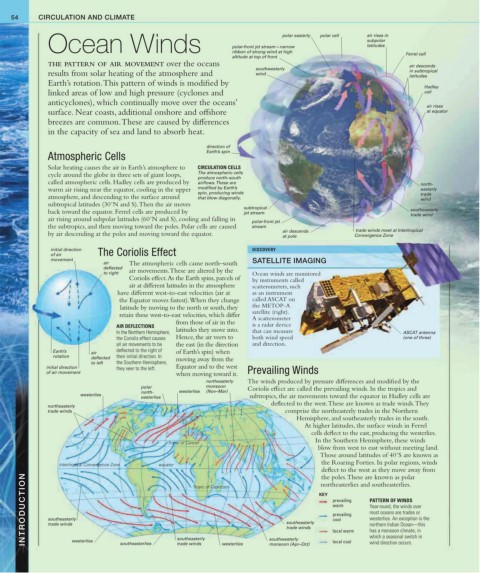
Atmospheric Cells
Solar heating causes the air in Earth’s atmosphere to CIRCULATION CELLS
cycle around the globe in three sets of giant loops, The atmospheric cells
produce north–south
called atmospheric cells. Hadley cells are produced by airflows. These are north-
warm air rising near the equator, cooling in the upper modified by Earth’s easterly
spin, producing winds trade
atmosphere, and descending to the surface around that blow diagonally. wind
subtropical latitudes (30˚N and S). Then the air moves
subtropical
back toward the equator. Ferrel cells are produced by jet stream southeasterly
trade wind
air rising around subpolar latitudes (60˚N and S), cooling and falling in
polar-front jet
the subtropics, and then moving toward the poles. Polar cells are caused stream trade winds meet at Intertropical
by air descending at the poles and moving toward the equator. air descends
at pole Convergence Zone
initial direction The Coriolis Effect DISCOVERY
of air
movement SATELLITE IMAGING
air The atmospheric cells cause north–south
deflected
to right air movements. These are altered by the Ocean winds are monitored
Coriolis effect. As the Earth spins, parcels of by instruments called
air at different latitudes in the atmosphere scatterometers, such
have different west-to-east velocities (air at as an instrument
the Equator moves fastest). When they change called ASCAT on
latitude by moving to the north or south, they the METOP-A
retain these west-to-east velocities, which differ satellite (right).
A scatterometer
from those of air in the
AIR DEFLECTIONS is a radar device
In the Northern Hemisphere, latitudes they move into. that can measure ASCAT antenna
the Coriolis effect causes Hence, the air veers to both wind speed (one of three)
all air movements to be the east (in the direction and direction.
Earth’s air deflected to the right of of Earth’s spin) when
rotation deflected their initial direction. In moving away from the
to left the Southern Hemisphere,
initial direction they veer to the left. Equator and to the west
of air movement when moving toward it. Prevailing Winds
northeasterly The winds produced by pressure differences and modified by the
polar monsoon Coriolis effect are called the prevailing winds. In the tropics and
north- westerlies (Nov–Mar)
westerlies
easterlies subtropics, the air movements toward the equator in Hadley cells are
deflected to the west. These are known as trade winds. They
northeasterly
trade winds comprise the northeasterly trades in the Northern
Hemisphere, and southeasterly trades in the south.
At higher latitudes, the surface winds in Ferrel
cells deflect to the east, producing the westerlies.
In the Southern Hemisphere, these winds
Tropic of Cancer
blow from west to east without meeting land.
Those around latitudes of 40˚S are known as
the Roaring Forties. In polar regions, winds
Intertropical Convergence Zone equator
deflect to the west as they move away from
INTRODUCTION southeasterly southeasterlies southeasterly westerlies southwesterly KEY prevailing PATTERN OF WINDS
the poles. These are known as polar
northeasterlies and southeasterlies.
Tropic of Capricorn
warm
Year-round, the winds over
most oceans are trades or
prevailing
westerlies. An exception is the
cool
southeasterly
northern Indian Ocean—this
trade winds
trade winds
has a monsoon climate, in
local warm
which a seasonal switch in
westerlies
local cool
wind direction occurs.
trade winds
monsoon (Apr–Oct)

