


Page 60 - (DK) Ocean - The Definitive Visual Guide
P. 60
58      CIRCULATION AND CLIMATE


               Surface Currents


               FLOWING FOR ENORMOUS DISTANCES within the upper regions of
               the oceans are various wind-driven currents. Many join to produce
               large circular fluxes of water, called gyres, around the surfaces of the
               main ocean basins. Surface currents affect only about 10 percent of ocean water, but     Coriolis
                                                                                                        deflection
               they are important to the world’s climate (see p.66), because their overall effect is to
                                                                                                        wind
               transfer huge amounts of heat energy from the tropics to cooler parts of the globe.
               They also impact shipping and the world’s fishing industries.       direction of
                                                                                   frictional wind drag
               Wind on Water                                                       resultant direction
                                                                                   of water motion
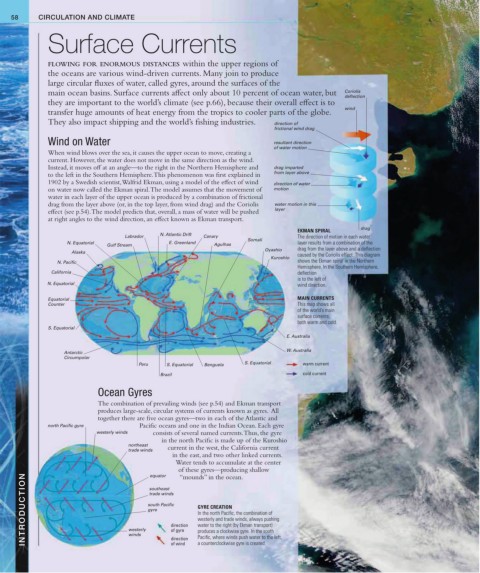
               When wind blows over the sea, it causes the upper ocean to move, creating a
               current. However, the water does not move in the same direction as the wind.
               Instead, it moves off at an angle—to the right in the Northern Hemisphere and    drag imparted
               to the left in the Southern Hemisphere. This phenomenon was first explained in   from layer above
               1902 by a Swedish scientist, Walfrid Ekman, using a model of the effect of wind    direction of water
               on water now called the Ekman spiral. The model assumes that the movement of   motion
               water in each layer of the upper ocean is produced by a combination of frictional
               drag from the layer above (or, in the top layer, from wind drag) and the Coriolis   water motion in this
               effect (see p.54). The model predicts that, overall, a mass of water will be pushed    layer
               at right angles to the wind direction, an effect known as Ekman transport.
                                                                                                            drag
                                                                                          EKMAN SPIRAL
                                                 N. Atlantic Drift
                                      Labrador                Canary                      The direction of motion in each water
                                                                           Somali
                     N. Equatorial                 E. Greenland                           layer results from a combination of the
                                 Gulf Stream                     Agulhas
                                                                                Oyashio   drag from the layer above and a deflection
                      Alaska                                                              caused by the Coriolis effect. This diagram
                                                                                  Kuroshio
                  N. Pacific                                                               shows the Ekman spiral in the Northern
                                                                                          Hemisphere. In the Southern Hemisphere,
                California                                                                deflection
                                                                                          is to the left of
               N. Equatorial                                                              wind direction.
               Equatorial                                                                 MAIN CURRENTS
               Counter                                                                    This map shows all
                                                                                          of the world’s main
                                                                                          surface currents,
                                                                                          both warm and cold.
               S. Equatorial
                                                                                      E. Australia
                                                                                      W. Australia
                    Antarctic
                    Circumpolar
                                          Peru     S. Equatorial  Benguela  S. Equatorial  warm current
                                                 Brazil                                    cold current

                              Ocean Gyres

                              The combination of prevailing winds (see p.54) and Ekman transport
                              produces large-scale, circular systems of currents known as gyres.  All
                              together there are five ocean gyres—two in each of the Atlantic and
               north Pacific gyre          Pacific oceans and one in the Indian Ocean. Each gyre
                              westerly winds  consists of several named currents. Thus, the gyre
                                                 in the north Pacific is made up of the Kuroshio
                                       northeast
                                       trade winds   current in the west, the California current
                                                    in the east, and two other linked currents.
                                                     Water tends to accumulate at the center
                                                      of these gyres—producing shallow
                                              equator
        INTRODUCTION                   westerly   south Pacific direction    GYRE CREATION
                                                      “mounds” in the ocean.
                                             southeast
                                             trade winds

                                             gyre
                                                            In the north Pacific, the combination of
                                                            westerly and trade winds, always pushing
                                                            water to the right (by Ekman transport)
                                                    of gyre
                                                            produces a clockwise gyre. In the south
                                       winds
                                                            Pacific, where winds push water to the left,
                                                    direction
                                                            a counterclockwise gyre is created.
                                                    of wind

