


Page 57 - (DK) Ocean - The Definitive Visual Guide
P. 57
55


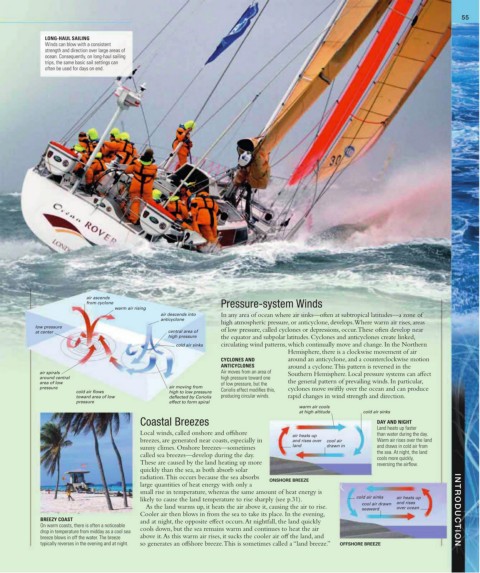
              LONG-HAUL SAILING
              Winds can blow with a consistent
              strength and direction over large areas of
              ocean. Consequently, on long-haul sailing
              trips, the same basic sail settings can
              often be used for days on end.


                           air ascends
                           from cyclone                            Pressure-system Winds
                                   warm air rising
                                                 air descends into   In any area of ocean where air sinks—often at subtropical latitudes—a zone of
                                                 anticyclone
                                                                   high atmospheric pressure, or anticyclone, develops. Where warm air rises, areas
           low pressure
           at center                               central area of   of low pressure, called cyclones or depressions, occur. These often develop near
                                                   high pressure   the equator and subpolar latitudes. Cyclones and anticyclones create linked,
                                                     cold air sinks   circulating wind patterns, which continually move and change. In the Northern
                                                                                       Hemisphere, there is a clockwise movement of air
                                                                   CYCLONES AND        around an anticyclone, and a counterclockwise motion
                                                                   ANTICYCLONES        around a cyclone. This pattern is reversed in the
             air spirals                                           Air moves from an area of   Southern Hemisphere. Local pressure systems can affect
             around central                                        high pressure toward one
             area of low                                           of low pressure, but the   the general pattern of prevailing winds. In particular,
             pressure                              air moving from    Coriolis effect modifies this,   cyclones move swiftly over the ocean and can produce
                        cold air flows              high to low pressure
                        toward area of low         deflected by Coriolis   producing circular winds.  rapid changes in wind strength and direction.
                        pressure                   effect to form spiral
                                                                                          warm air cools
                                                                                          at high altitude   cold air sinks
                                           Coastal Breezes                                                       DAY AND NIGHT
                                                                                                                 Land heats up faster
                                           Local winds, called onshore and offshore                              than water during the day.
                                                                                        air heats up
                                           breezes, are generated near coasts, especially in   and rises over  cool air   Warm air rises over the land
                                           sunny climes. Onshore breezes—sometimes      land      drawn in       and draws in cold air from
                                           called sea breezes—develop during the day.                            the sea. At night, the land
                                                                                                                 cools more quickly,
                                           These are caused by the land heating up more                          reversing the airflow.
                                           quickly than the sea, as both absorb solar
                                           radiation. This occurs because the sea absorbs
                                           large quantities of heat energy with only a   ONSHORE BREEZE
                                           small rise in temperature, whereas the same amount of heat energy is
                                           likely to cause the land temperature to rise sharply (see p.31).   cold air sinks  air heats up
                                                                                                             cool air drawn   and rises
                                            As the land warms up, it heats the air above it, causing the air to rise.   seaward  over ocean   INTRODUCTION
                                           Cooler air then blows in from the sea to take its place. In the evening,
             BREEZY COAST                  and at night, the opposite effect occurs. At nightfall, the land quickly
             On warm coasts, there is often a noticeable
             drop in temperature from midday as a cool sea   cools down, but the sea remains warm and continues to heat the air
             breeze blows in off the water. The breeze   above it. As this warm air rises, it sucks the cooler air off the land, and
             typically reverses in the evening and at night.  so generates an offshore breeze. This is sometimes called a “land breeze.”  OFFSHORE BREEZE

