


Page 59 - (DK) Ocean - The Definitive Visual Guide
P. 59
57


                                     Ocean Yacht Racing


                                     Ocean yacht racing is the sport of competitive sailing,
                                                                                         EQUIPPED TO WIN
                                     held over long distances and in open water. These
                                     races range from short but robust challenges lasting
                                     a few days, such as the famous Fastnet Race off
                                     southwest England and the annual Sydney-to-Hobart
                                     race, to long, multi-stage, around-the-world races,
                                     which can involve up to 6 months at sea. Some races
                                     are multi-handers, with crews that can be as large as
                                     20 or more per yacht; others are single-handers. The
                                     participants are typically highly experienced sailors.In
                                     multi-handed races, there will be a skipper/tactician,
                                     a navigator, and general crew whose responsibilities
                                     include sail changing and trimming. Solo racers have
                                     to do everything themselves. One race, the Clipper
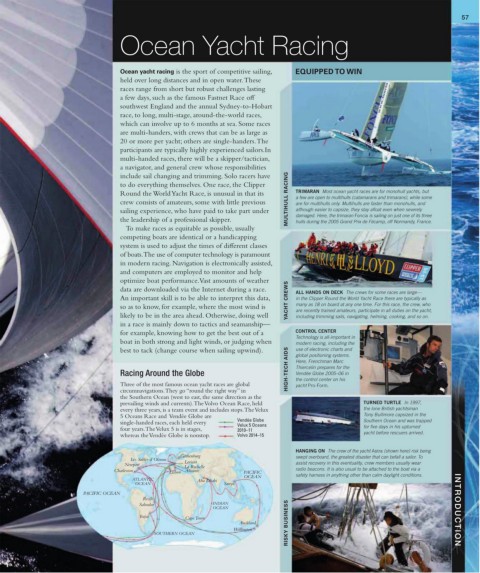
                                     Round the World Yacht Race, is unusual in that its   TRIMARAN  Most ocean yacht races are for monohull yachts, but
                                                                                         a few are open to multihulls (catamarans and trimarans), while some
                                     crew consists of amateurs, some with little previous   MULTIHULL RACING  are for multihulls only. Multihulls are faster than monohulls, and
                                     sailing experience, who have paid to take part under   although easier to capsize, they stay afloat even when severely
                                                                                         damaged. Here, the trimaran Foncia is sailing on just one of its three
                                     the leadership of a professional skipper.           hulls during the 2005 Grand Prix de Fécamp, off Normandy, France.
                                      To make races as equitable as possible, usually
                                     competing boats are identical or a handicapping
                                     system is used to adjust the times of different classes
                                     of boats. The use of computer technology is paramount
                                     in modern racing. Navigation is electronically assisted,
                                     and computers are employed to monitor and help
                                     optimize boat performance. Vast amounts of weather
                                     data are downloaded via the Internet during a race.   ALL HANDS ON DECK  The crews for some races are large—
                                     An important skill is to be able to interpret this data,   YACHT CREWS  in the Clipper Round the World Yacht Race there are typically as
                                     so as to know, for example, where the most wind is   many as 18 on board at any one time. For this race, the crew, who
                                                                                         are recently trained amateurs, participate in all duties on the yacht,
                                     likely to be in the area ahead. Otherwise, doing well   including trimming sails, navigating, helming, cooking, and so on.
                                     in a race is mainly down to tactics and seamanship—
                                     for example, knowing how to get the best out of a   CONTROL CENTER
                                                                                         Technology is all-important in
                                     boat in both strong and light winds, or judging when   modern racing, including the
                                                                                       HIGH-TECH AIDS  Here, Frenchman Marc
                                     best to tack (change course when sailing upwind).   use of electronic charts and
                                                                                         global positioning systems.
                                                                                         Thiercelin prepares for the
                                     Racing Around the Globe                             Vendée Globe 2005–06 in
                                     Three of the most famous ocean yacht races are global   the control center on his
                                                                                         yacht Pro-Form.
                                     circumnavigations. They go “round the right way” in
                                     the Southern Ocean (west to east, the same direction as the
                                     prevailing winds and currents). The Volvo Ocean Race, held              TURNED TURTLE  In 1997,
                                     every three years, is a team event and includes stops. The Velux        the lone British yachtsman
                                     5 Oceans Race and  Vendée Globe are                                     Tony Bullimore capsized in the
                                     single-handed races, each held every   Vendée Globe                     Southern Ocean and was trapped
                                                                        Velux 5 Oceans                       for five days in his upturned
                                     four years. The Velux 5 is in stages,   2010–11
                                     whereas the Vendée Globe is nonstop.  Volvo 2014–15                     yacht before rescuers arrived.

                                                                                         HANGING ON  The crew of the yacht Astra (shown here) risk being
                                                       Göthenburg                        swept overboard, the greatest disaster that can befall a sailor. To
                                        Les Sables-d’Olonne
                                      Newport           Lorient                          assist recovery in this eventuality, crew members usually wear
                                                        La Rochelle
                                   Charleston      Lisbon  Alicante      PACIFIC         radio beacons. It is also usual to be attached to the boat via a
                                                                          OCEAN          safety harness in anything other than calm daylight conditions.
                                        ATLANTIC            Abu Dhabi
                                         OCEAN                      Sanya
                          PACIFIC OCEAN
                                           Recife
                                          Salvador              INDIAN
                                                                OCEAN                                                                    INTRODUCTION
                                           Itajai
                                                        Cape Town
                                                                        Auckland       RISKY BUSINESS
                                                                      Wellington
                                               SOUTHERN OCEAN

