


Page 61 - (DK) Ocean - The Definitive Visual Guide
P. 61
SURFACE CURRENTS            59


                                                                          PEOPLE
                                                                          BENJAMIN FRANKLIN

                                                                          The American statesman and
                                                                          inventor Benjamin Franklin
                                                                          (1706–90) made one of the
                                                                          earliest studies of an ocean
                                                                          current, publishing a map of the
                                                                          Gulf Stream’s course. He became
                                                                          interested in it after the British
                                                                          postal authorities asked him why
                                                                          American postal ships crossed the
                                                                          Atlantic faster than English ships.
                                                                          The answer was that American
                                                                          ships were utilizing an eastward
                                                                          extension of the Gulf Stream.

                                                                        Boundary Currents

                                                                        The currents at the edges of gyres are called boundary currents. Those on
                                                                        the western side of gyres are strong, narrow, and warm—they move heat
                                                                        energy away from the equator. Examples of these currents are the Gulf
                                                                                  Stream and the Brazil Current in the southwestern Atlantic.
                                                                                  Eastern boundary currents are weaker, broader cold currents
                                                                                  that move water back toward the tropics. Examples are the
                                                                                  Benguela Current off southwest Africa and the California
                                                                                  Current. At the gyre boundaries close to the equator are
                                                                                  warm, west-flowing equatorial currents. Other currents feed
                                                                                  into or out of the main gyres. These include, for example,
                                                                                                             the warm North Atlantic
                                                                                                             Drift, an offshoot of the
                                                                                                             Gulf Stream, and cold
                                                                                                             currents that bring water
                                                                                                             down from the Arctic,
                                                                                                             such as the Oyashio and
                                                                                                             East Greenland currents.
                                                            WARM CURRENT
                                                            Satellite devices can detect                     COLD CURRENT
                                                            phytoplankton levels in the                      In this satellite view, sea
                                                            water, which can be related                      ice is visible flowing past the
                                                            to temperature. Here, yellow                     Kamchatka Peninsula in the cold
                                                            and red indicate high levels                     Oyashio Current. Eddies within
                                                            of plankton and the warm                         the current have produced spiral
                                                            Brazil Current.                                  patterns in the sea ice.

                                                                         Meeting of Currents

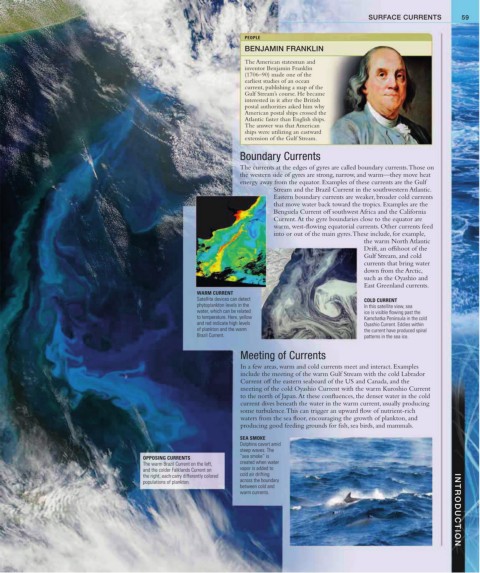
                                                                         In a few areas, warm and cold currents meet and interact. Examples
                                                                         include the meeting of the warm Gulf Stream with the cold Labrador
                                                                         Current off the eastern seaboard of the US and Canada, and the
                                                                         meeting of the cold Oyashio Current with the warm Kuroshio Current
                                                                         to the north of Japan. At these confluences, the denser water in the cold
                                                                         current dives beneath the water in the warm current, usually producing
                                                                         some turbulence. This can trigger an upward flow of nutrient-rich
                                                                         waters from the sea floor, encouraging the growth of plankton, and
                                                                         producing good feeding grounds for fish, sea birds, and mammals.
                                                                        SEA SMOKE
                                                                        Dolphins cavort amid
                                                                        steep waves. The
                                            OPPOSING CURRENTS           “sea smoke” is
                                            The warm Brazil Current on the left,    created when water
                                            and the colder Falklands Current on    vapor is added to
                                            the right, each carry differently colored   cold air drifting
                                            populations of plankton.    across the boundary
                                                                        between cold and
                                                                        warm currents.                                                   INTRODUCTION

