


Page 51 - (DK) Ocean - The Definitive Visual Guide
P. 51
TECTONICS AND THE OCEAN FLOOR               49


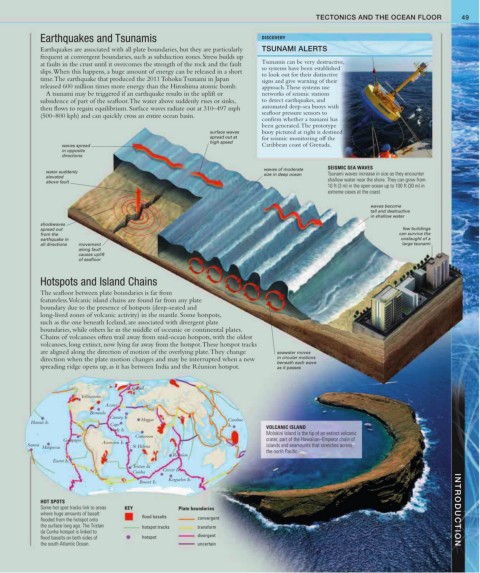
             Earthquakes and Tsunamis                                          DISCOVERY

             Earthquakes are associated with all plate boundaries, but they are particularly   TSUNAMI ALERTS
             frequent at convergent boundaries, such as subduction zones. Stress builds up
             at faults in the crust until it overcomes the strength of the rock and the fault   Tsunamis can be very destructive,
             slips. When this happens, a huge amount of energy can be released in a short   so systems have been established
                                                                               to look out for their distinctive
             time. The earthquake that produced the 2011 Tohoku Tsunami in Japan   signs and give warning of their
             released 600 million times more energy than the Hiroshima atomic bomb.   approach. These systems use
               A tsunami may be triggered if an earthquake results in the uplift or   networks of seismic stations
             subsidence of part of the seafloor. The water above suddenly rises or sinks,   to detect earthquakes, and
             then flows to regain equilibrium. Surface waves radiate out at 310–497 mph   automated deep-sea buoys with
             (500–800 kph) and can quickly cross an entire ocean basin.        seafloor pressure sensors to
                                                                               confirm whether a tsunami has
                                                                               been generated. The prototype
                                                               surface waves   buoy pictured at right is destined
                                                               spread out at   for seismic monitoring off the
                                                               high speed
                   waves spread                                                Caribbean coast of Grenada.
                   in opposite
                   directions
                                                                                waves of moderate   SEISMIC SEA WAVES
               water suddenly                                                   size in deep ocean   Tsunami waves increase in size as they encounter
               elevated
               above fault                                                                         shallow water near the shore. They can grow from
                                                                                                   10 ft (3 m) in the open ocean up to 100 ft (30 m) in
                                                                                                   extreme cases at the coast.
                                                                                                               waves become
                                                                                                               tall and destructive
                                                                                                               in shallow water
             shockwaves
             spread out                                                                                                  few buildings
             from the                                                                                                   can survive the
             earthquake in                                                                                              onslaught of a
             all directions  movement                                                                                    large tsunami
                        along fault
                        causes uplift
                        of seafloor


             Hotspots and Island Chains
             The seafloor between plate boundaries is far from
             featureless. Volcanic island chains are found far from any plate
             boundary due to the presence of hotspots (deep-seated and
             long-lived zones of volcanic activity) in the mantle. Some hotspots,
             such as the one beneath Iceland, are associated with divergent plate
             boundaries, while others lie in the middle of oceanic or continental plates.
             Chains of volcanoes often trail away from mid-ocean hotspots, with the oldest
             volcanoes, long extinct, now lying far away from the hotspot. These hotspot tracks
             are aligned along the direction of motion of the overlying plate. They change    seawater moves
             direction when the plate motion changes and may be interrupted when a new    in circular motions
                                                                                   beneath each wave
             spreading ridge opens up, as it has between India and the Réunion hotspot.  as it passes


                                        Iceland
                         Yellowstone
                                Azores
                            Bermuda
                                  Canary Is.  Hoggar
          Hawaii Is.                                                 Caroline
                                  Cape                               Is.
                                  Verde Is.                                     VOLCANIC ISLAND
                                         Cameroon                               Molokini Island is the tip of an extinct volcanic
                    Galapagos  Ascension Is.                                    crater, part of the Hawaiian–Emperor chain of
         Samoa                          St Helena                               islands and seamounts that stretches across
             Marquesas
                                                                                the north Pacific.
                                                    Réunion
                 Easter Is.
                                        Tristan da
                                        Cunha    Crozet Is.
                                                   Kerguelen Is.
                                          Bouvet Is.
             HOT SPOTS
             Some hot spot tracks link to areas   KEY  Plate boundaries                                                                  INTRODUCTION
             where huge amounts of basalt   flood basalts
             flooded from the hotspot onto                   convergent
             the surface long ago. The Tristan    hotspot tracks  transform
             da Cunha hotspot is linked to
             flood basalts on both sides of    hotspot       divergent
             the south Atlantic Ocean.                      uncertain

