


Page 62 - (DK) Ocean - The Definitive Visual Guide
P. 62
60 CIRCULATION AND CLIMATE
Underwater Circulation
THE WATERS THAT MAKE UP EARTH’S OCEANS circulate deep below
the surface. Subsurface currents are complex. Some are vertical, G
R
moving water upward and downward to and from the surface, Baffin E
Bay E
processes called upwelling and downwelling. Surface and subsurface N Arctic circle
currents are all linked in a global pattern of deep-water circulation. C L
A
ICELAND
A
N
D
Downwelling N
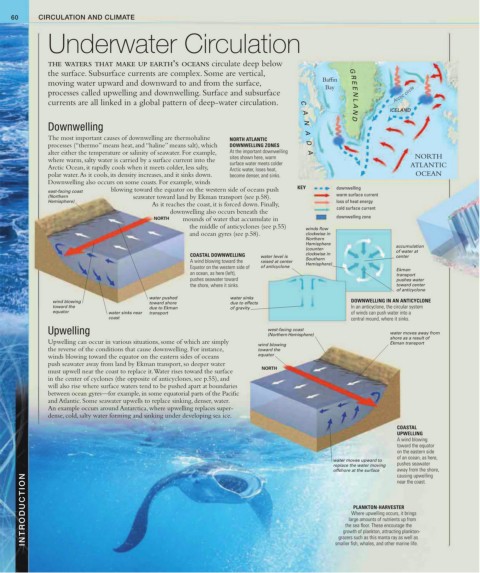
The most important causes of downwelling are thermohaline NORTH ATLANTIC A
processes (“thermo” means heat, and “haline” means salt), which DOWNWELLING ZONES D
alter either the temperature or salinity of seawater. For example, At the important downwelling A
where warm, salty water is carried by a surface current into the sites shown here, warm NORTH
surface water meets colder
Arctic Ocean, it rapidly cools when it meets colder, less salty, Arctic water, loses heat, ATLANTIC
polar water. As it cools, its density increases, and it sinks down. become denser, and sinks. OCEAN
Downwelling also occurs on some coasts. For example, winds
blowing toward the equator on the western side of oceans push KEY downwelling
east-facing coast
(Northern seawater toward land by Ekman transport (see p.58). warm surface current
Hemisphere) loss of heat energy
As it reaches the coast, it is forced down. Finally,
cold surface current
downwelling also occurs beneath the
mounds of water that accumulate in downwelling zone
NORTH
the middle of anticyclones (see p.55) winds flow
and ocean gyres (see p.58). clockwise in
Northern
Hemisphere accumulation
(counter- of water at
COASTAL DOWNWELLING water level is clockwise in center
A wind blowing toward the raised at center Southern
Hemisphere)
Equator on the western side of of anticyclone
Ekman
an ocean, as here (left), transport
pushes seawater toward pushes water
the shore, where it sinks. toward center
of anticyclone
water pushed water sinks
wind blowing toward shore due to effects DOWNWELLING IN AN ANTICYCLONE
toward the due to Ekman of gravity In an anticyclone, the circular system
equator water sinks near transport of winds can push water into a
coast central mound, where it sinks.
Upwelling west-facing coast water moves away from
(Northern Hemisphere)
shore as a result of
Upwelling can occur in various situations, some of which are simply Ekman transport
wind blowing
the reverse of the conditions that cause downwelling. For instance, toward the
winds blowing toward the equator on the eastern sides of oceans equator
push seawater away from land by Ekman transport, so deeper water
must upwell near the coast to replace it. Water rises toward the surface NORTH
in the center of cyclones (the opposite of anticyclones, see p.55), and
will also rise where surface waters tend to be pushed apart at boundaries
between ocean gyres—for example, in some equatorial parts of the Pacific
and Atlantic. Some seawater upwells to replace sinking, denser, water.
An example occurs around Antarctica, where upwelling replaces super-
dense, cold, salty water forming and sinking under developing sea ice.
COASTAL
UPWELLING
A wind blowing
toward the equator
on the eastern side
of an ocean, as here,
water moves upward to
replace the water moving pushes seawater
offshore at the surface away from the shore,
causing upwelling
INTRODUCTION smaller fish, whales, and other marine life.
near the coast.
PLANKTON-HARVESTER
Where upwelling occurs, it brings
large amounts of nutrients up from
the sea floor. These encourage the
growth of plankton, attracting plankton-
grazers such as this manta ray as well as

