


Page 63 - (DK) Ocean - The Definitive Visual Guide
P. 63
UNDERWATER CIRCULATION              61


                                                                Deep-water Circulation

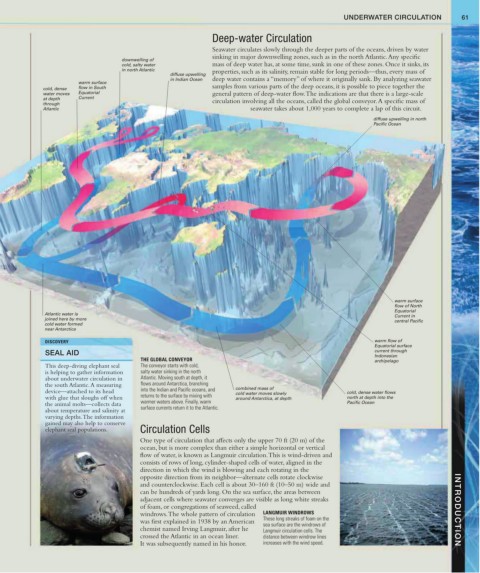
                                                                Seawater circulates slowly through the deeper parts of the oceans, driven by water
                                                                sinking in major downwelling zones, such as in the north Atlantic. Any specific
                                     downwelling of
                                     cold, salty water          mass of deep water has, at some time, sunk in one of these zones. Once it sinks, its
                                     in north Atlantic          properties, such as its salinity, remain stable for long periods—thus, every mass of
                                                    diffuse upwelling
                                                    in Indian Ocean   deep water contains a “memory” of where it originally sank. By analyzing seawater
                        warm surface
              cold, dense   flow in South                        samples from various parts of the deep oceans, it is possible to piece together the
              water moves   Equatorial                          general pattern of deep-water flow. The indications are that there is a large-scale
              at depth   Current                                circulation involving all the oceans, called the global conveyor. A specific mass of
              through
              Atlantic                                                      seawater takes about 1,000 years to complete a lap of this circuit.
                                                                                                                diffuse upwelling in north
                                                                                                                Pacific Ocean


                                                                                                                       warm surface
                                                                                                                       flow of North
                                                                                                                       Equatorial
              Atlantic water is                                                                                        Current in
              joined here by more                                                                                      central Pacific
              cold water formed
              near Antarctica
              DISCOVERY                                                                                          warm flow of
                                                                                                                 Equatorial surface
              SEAL AID                                                                                           current through
                                                                                                                 Indonesian
                                           THE GLOBAL CONVEYOR                                                   archipelago
              This deep-diving elephant seal    The conveyor starts with cold,
              is helping to gather information   salty water sinking in the north
              about underwater circulation in   Atlantic. Moving south at depth, it
              the south Atlantic. A measuring   flows around Antarctica, branching    combined mass of
              device—attached to its head    into the Indian and Pacific oceans, and   cold water moves slowly    cold, dense water flows
              with glue that sloughs off when   returns to the surface by mixing with   around Antarctica, at depth  north at depth into the
              the animal molts—collects data    warmer waters above. Finally, warm                      Pacific Ocean
              about temperature and salinity at   surface currents return it to the Atlantic.
              varying depths. The information
              gained may also help to conserve
              elephant seal populations.   Circulation Cells
                                           One type of circulation that affects only the upper 70 ft (20 m) of the
                                           ocean, but is more complex than either a simple horizontal or vertical
                                           flow of water, is known as Langmuir circulation. This is wind-driven and
                                           consists of rows of long, cylinder-shaped cells of water, aligned in the
                                           direction in which the wind is blowing and each rotating in the
                                           opposite direction from its neighbor—alternate cells rotate clockwise
                                           and counterclockwise. Each cell is about 30–160 ft (10–50 m) wide and
                                           can be hundreds of yards long. On the sea surface, the areas between
                                           adjacent cells where seawater converges are visible as long white streaks
                                           of foam, or congregations of seaweed, called                                                  INTRODUCTION
                                           windrows. The whole pattern of circulation   LANGMUIR WINDROWS
                                                                               These long streaks of foam on the
                                           was first explained in 1938 by an American
                                                                               sea surface are the windrows of
                                           chemist named Irving Langmuir, after he   Langmuir circulation cells. The
                                           crossed the Atlantic in an ocean liner.    distance between windrow lines
                                           It was subsequently named in his honor.  increases with the wind speed.

