


Page 75 - (DK) Ocean - The Definitive Visual Guide
P. 75
73


                                     Typhoon Haiyan


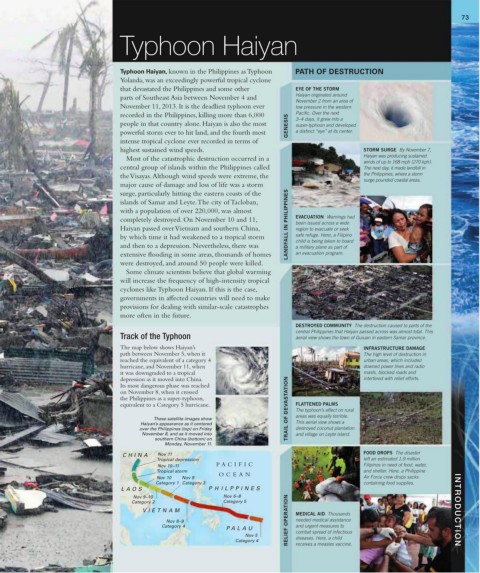
                                     Typhoon Haiyan, known in the Philippines as Typhoon
                                                                                         PATH OF DESTRUCTION
                                     Yolanda, was an exceedingly powerful tropical cyclone
                                     that devastated the Philippines and some other      EYE OF THE STORM
                                                                                         Haiyan originated around
                                     parts of Southeast Asia between November 4 and
                                                                                         November 2 from an area of
                                     November 11, 2013. It is the deadliest typhoon ever   low pressure in the western
                                     recorded in the Philippines, killing more than 6,000   Pacific. Over the next
                                                                                         3–4 days, it grew into a
                                     people in that country alone. Haiyan is also the most   GENESIS   super-typhoon and developed
                                     powerful storm ever to hit land, and the fourth most   a distinct “eye” at its center.
                                     intense tropical cyclone ever recorded in terms of
                                     highest sustained wind speeds.                                          STORM SURGE  By November 7,
                                                                                                             Haiyan was producing sustained
                                        Most of the catastrophic destruction occurred in a
                                                                                                             winds of up to 168 mph (270 kph).
                                     central group of islands within the Philippines called                  The next day, it made landfall in
                                     the Visayas. Although wind speeds were extreme, the                     the Philippines, where a storm
                                                                                                             surge pounded coastal areas.
                                     major cause of damage and loss of life was a storm
                                     surge, particularly hitting the eastern coasts of the
                                     islands of Samar and Leyte. The city of Tacloban,
                                     with a population of over 220,000, was almost
                                     completely destroyed. On November 10 and 11,        EVACUATION  Warnings had
                                                                                         been issued across a wide
                                     Haiyan passed over Vietnam and southern China,    LANDFALL IN PHILIPPINES  region to evacuate or seek
                                     by which time it had weakened to a tropical storm   safe refuge. Here, a Filipino
                                                                                         child is being taken to board
                                     and then to a depression. Nevertheless, there was   a military plane as part of
                                     extensive flooding in some areas, thousands of homes   an evacuation program.
                                     were destroyed, and around 50 people were killed.
                                        Some climate scientists believe that global warming
                                     will increase the frequency of high-intensity tropical
                                     cyclones like Typhoon Haiyan. If this is the case,
                                     governments in affected countries will need to make
                                     provisions for dealing with similar-scale catastrophes
                                     more often in the future.
                                                                                         DESTROYED COMMUNITY  The destruction caused to parts of the
                                                                                         central Philippines that Haiyan passed across was almost total. This
                                     Track of the Typhoon                                aerial view shows the town of Guiuan in eastern Samar province.
                                     The map below shows Haiyan’s                                            INFRASTRUCTURE DAMAGE
                                     path between November 5, when it                                        The high level of destruction in
                                     reached the equivalent of a category 4                                  urban areas, which included
                                     hurricane, and November 11, when                                        downed power lines and radio
                                     it was downgraded to a tropical                                         masts, blocked roads and
                                     depression as it moved into China.                                      interfered with relief efforts.
                                     Its most dangerous phase was reached
                                     on November 8, when it crossed
                                     the Philippines as a super-typhoon,
                                     equivalent to a Category 5 hurricane.             TRAIL OF DEVASTATION   FLATTENED PALMS
                                                                                         The typhoon’s effect on rural
                                               These satellite images show               areas was equally terrible.
                                           Haiyan’s appearance as it centered            This aerial view shows a
                                          over the Philippines (top) on Friday           destroyed coconut plantation
                                           November 8, and as it moved into              and village on Leyte island.
                                               southern China (bottom) on
                                                  Monday, November 11.
                                     CHINA      Nov 11                                                       FOOD DROPS  The disaster
                                                Tropical depression                                          left an estimated 1.9 million
                                                Nov 10–11        P A CIFIC                                   Filipinos in need of food, water,
                                                Tropical storm                                               and shelter. Here, a Philippine
                                                                  OCEAN
                                                Nov 10  Nov 9                                                Air Force crew drops sacks
                                               Category 1 Category 3                                         containing food supplies.
                                     LA OS                     P H ILPPINES
                                         Nov 9–10                  Nov 6–8
                                        Category 2                 Category 5
                                           VIETNAM                                       MEDICAL AID  Thousands                          INTRODUCTION
                                                  Nov 8–9                              RELIEF OPERATION  needed medical assistance
                                                 Category 4                              and urgent measures to
                                                                    P ALA U              combat spread of infectious
                                                                          Nov 5
                                                                       Category 4        diseases. Here, a child
                                                                                         receives a measles vaccine.

