


Page 71 - (DK) Ocean - The Definitive Visual Guide
P. 71
EL NIÑO AND LA NIÑA          69


                                           La Niña Events                            low-pressure     winds         associated with dry
              DISCOVERY                                                                               southeast trade   descending air
              MONITORING                   La niña is Spanish for “the little girl.”  A La Niña   system, positioned   conditions and high
                                                                                     farther west
                                                                                                                    pressure
                                                                                     than normal
                                           event is the reverse of an El Niño event. It is
              The tropical Pacific is regularly   characterized by unusually cold ocean temperatures
              monitored for temperature
              changes. The main monitoring   in the eastern and central equatorial Pacific, and
              methods are the use of satellites,   by stronger winds and warmer seas to the north
              which measure sea temperatures   of Australia. La Niña conditions frequently, but
              indirectly from slight variations    not always, follow closely on an El Niño.
              in the shape of the ocean surface,   Like El Niño, La Niña causes increased
              and an array of instrumented   rainfall in some world regions and
              weather buoys.
                                           drought in others. India, Southeast
                                           Asia, and eastern Australia
              INSTRUMENTED BUOY
              Buoys such as this one, strung in an array   are lashed by rains, but
              across the equatorial Pacific, are used to make   southwestern US generally
              regular measurements of water temperature
              at varying depths.           experiences higher temperatures
                                           and low rainfall. Meanwhile,
                                           northwestern states of the US   pool of warm
                                           experience colder, snowier winters.    water positioned   South
                                                                          farther west than   Equatorial
                                           La Niña is also associated with an    normal  Current  upwelling of
                                           increase in Atlantic hurricane activity.              cold, nutrient-
                                           Overall, the effects of a La Niña                     rich water
                                           event often tend to be strongest                                           sea surface
                                           during Northern Hemisphere winters.                                        cooler than
                                                                                                                      normal in
                                                                                                                      eastern Pacific


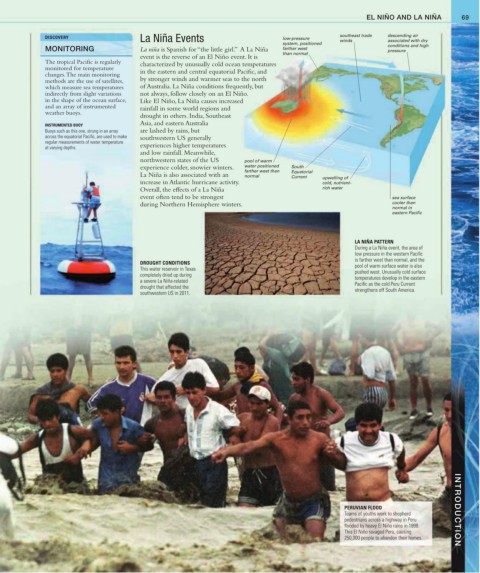
                                                                                                           LA NIÑA PATTERN
                                                                                                           During a La Niña event, the area of
                                                                                                           low pressure in the western Pacific
                                                                                                           is farther west than normal, and the
                                           DROUGHT CONDITIONS                                              pool of warm surface water is also
                                           This water reservoir in Texas                                   pushed west. Unusually cold surface
                                           completely dried up during                                      temperatures develop in the eastern
                                           a severe La Niña-related                                        Pacific as the cold Peru Current
                                           drought that affected the                                       strengthens off South America.
                                           southwestern US in 2011.


                                                                                                        PERUVIAN FLOOD                   INTRODUCTION
                                                                                                        Teams of youths work to shepherd
                                                                                                        pedestrians across a highway in Peru
                                                                                                        flooded by heavy El Niño rains in 1998.
                                                                                                        This El Niño ravaged Peru, causing
                                                                                                        250,000 people to abandon their homes.

