


Page 78 - (DK) Ocean - The Definitive Visual Guide
P. 78
76      WAVES AND TIDES


               Ocean Waves                                                 Wave Generation

                                                                           Wind energy is imparted to the sea surface through friction and
                                                                           pressure, causing waves. As the wind gains strength, the surface develops
               WAVES ARE DISTURBANCES in the ocean that transmit           gradually from flat and smooth through growing levels of roughness.
               energy from one place to another. The most familiar         First, ripples form, then larger waves, called chop. The waves continue
                                                                           to build, their maximum size depending on three factors: wind speed,
               types of waves—the ones that cause boats to bob up
                                                                           wind duration, and the area over which the wind is blowing, called
               and down on the open sea and dissipate as breakers          the fetch. When waves are as large as they can get under the current
               on beaches—are generated by wind on the ocean               conditions of wind speed and size of
                                                                           fetch, the sea surface is said to be “fully
               surface. Other wave types include tsunamis, which
                                                                           developed.”  The overall state of a sea surface
               are often caused by underwater earthquakes (see p.49),      can be summarized by the significant wave
               and internal waves, which travel underwater between         height—defined as the average height of the
                                                                           highest one-third of the waves. For example,
               water masses. Tides (see p.78) are also a type of wave.
                                                                           in a fully developed sea produced by winds
                                                                           of about 25 mph (40 kph), the significant
               Wave Properties                                             wave height is typically about 8 ft (2.5 m).
                                                                                                               CAPILLARY WAVES (RIPPLES)
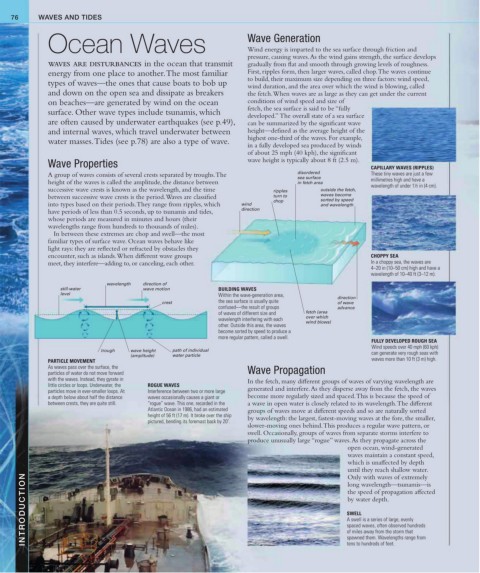
               A group of waves consists of several crests separated by troughs. The      disordered           These tiny waves are just a few
                                                                                          sea surface          millimetres high and have a
               height of the waves is called the amplitude, the distance between          in fetch area        wavelength of under 1½ in (4 cm).
               successive wave crests is known as the wavelength, and the time    ripples       outside the fetch,
               between successive wave crests is the period. Waves are classified    turn to    waves become
                                                                                  chop          sorted by speed
               into types based on their periods. They range from ripples, which    wind        and wavelength
               have periods of less than 0.5 seconds, up to tsunamis and tides,    direction
               whose periods are measured in minutes and hours (their
               wavelengths range from hundreds to thousands of miles).
                 In between these extremes are chop and swell—the most
               familiar types of surface wave. Ocean waves behave like
               light rays: they are reflected or refracted by obstacles they
               encounter, such as islands. When different wave groups                                          CHOPPY SEA
               meet, they interfere—adding to, or canceling, each other.                                       In a choppy sea, the waves are
                                                                                                               4–20 in (10–50 cm) high and have a
                                                                                                               wavelength of 10–40 ft (3–12 m).
                                 wavelength    direction of
                   still-water             wave motion            BUILDING WAVES
                   level                                          Within the wave-generation area,    direction
                                                 crest            the sea surface is usually quite   of wave
                                                                  confused—the result of groups      advance
                                                                  of waves of different size and   fetch (area
                                                                  wavelength interfering with each   over which
                                                                                            wind blows)
                                                                  other. Outside this area, the waves
                                                                  become sorted by speed to produce a
                                                                  more regular pattern, called a swell.
                                                                                                                FULLY DEVELOPED ROUGH SEA
                                                                                                                Wind speeds over 40 mph (60 kph)
                               trough    wave height    path of individual                                      can generate very rough seas with
                                        (amplitude)   water particle
               PARTICLE MOVEMENT                                                                                waves more than 10 ft (3 m) high.
               As waves pass over the surface, the
               particles of water do not move forward                      Wave Propagation
               with the waves. Instead, they gyrate in                     In the fetch, many different groups of waves of varying wavelength are
               little circles or loops. Underwater, the   ROGUE WAVES
               particles move in ever-smaller loops. At   Interference between two or more large    generated and interfere. As they disperse away from the fetch, the waves
               a depth below about half the distance   waves occasionally causes a giant or    become more regularly sized and spaced. This is because the speed of
               between crests, they are quite still.  “rogue” wave. This one, recorded in the   a wave in open water is closely related to its wavelength. The different
                                             Atlantic Ocean in 1986, had an estimated   groups of waves move at different speeds and so are naturally sorted
                                             height of 56 ft (17 m). It broke over the ship
                                             pictured, bending its foremast back by 20˚.  by wavelength: the largest, fastest-moving waves at the fore, the smaller,
                                                                           slower-moving ones behind. This produces a regular wave pattern, or
                                                                           swell. Occasionally, groups of waves from separate storms interfere to
                                                                           produce unusually large “rogue” waves. As they propagate across the
                                                                                                         open ocean, wind-generated
                                                                                                         waves maintain a constant speed,
                                                                                                         which is unaffected by depth
                                                                                                         until they reach shallow water.
        INTRODUCTION                                                                                    SWELL
                                                                                                         Only with waves of extremely
                                                                                                         long wavelength—tsunamis—is
                                                                                                         the speed of propagation affected
                                                                                                         by water depth.


                                                                                                        A swell is a series of large, evenly
                                                                                                        spaced waves, often observed hundreds
                                                                                                        of miles away from the storm that
                                                                                                        spawned them. Wavelengths range from
                                                                                                        tens to hundreds of feet.

