


Page 70 - (DK) Ocean - The Definitive Visual Guide
P. 70
68      CIRCULATION AND CLIMATE


               El Niño and La Niña                                                                                       descending air


                                                                                                          southeast
                                                                                                                         high pressure and
                                                                                                          trade winds    associated with
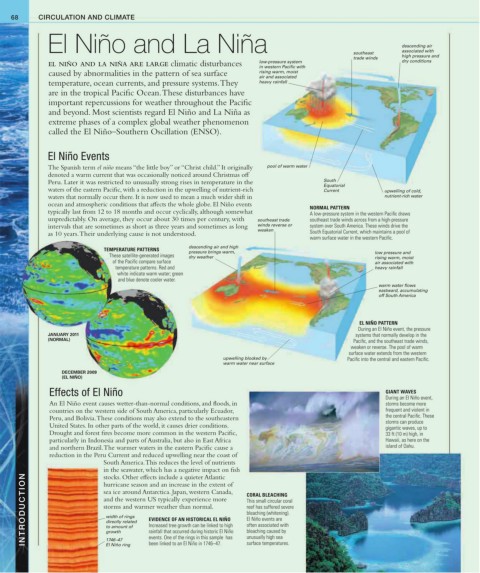
               EL NIÑO AND LA NIÑA ARE LARGE climatic disturbances            low-pressure system                        dry conditions
                                                                              in western Pacific with
               caused by abnormalities in the pattern of sea surface          rising warm, moist
                                                                              air and associated
               temperature, ocean currents, and pressure systems. They        heavy rainfall
               are in the tropical Pacific Ocean. These disturbances have
               important repercussions for weather throughout the Pacific
               and beyond. Most scientists regard El Niño and La Niña as
               extreme phases of a complex global weather phenomenon
               called the El Niño–Southern Oscillation (ENSO).


               El Niño Events

               The Spanish term el niño means “the little boy” or “Christ child.” It originally   pool of warm water
               denoted a warm current that was occasionally noticed around Christmas off
               Peru. Later it was restricted to unusually strong rises in temperature in the     South
                                                                                                 Equatorial
               waters of the eastern Pacific, with a reduction in the upwelling of nutrient-rich   Current         upwelling of cold,
               waters that normally occur there. It is now used to mean a much wider shift in                      nutrient-rich water
               ocean and atmospheric conditions that affects the whole globe. El Niño events   NORMAL PATTERN
               typically last from 12 to 18 months and occur cyclically, although somewhat   A low-pressure system in the western Pacific draws
               unpredictably. On average, they occur about 30 times per century, with   southeast trade   southeast trade winds across from a high-pressure
               intervals that are sometimes as short as three years and sometimes as long    winds reverse or   system over South America. These winds drive the
                                                                              weaken
               as 10 years. Their underlying cause is not understood.                        South Equatorial Current, which maintains a pool of
                                                                                             warm surface water in the western Pacific.
                                                         descending air and high
                                TEMPERATURE PATTERNS     pressure brings warm,
                                 These satellite-generated images    dry weather                                 low pressure and
                                                                                                                 rising warm, moist
                                  of the Pacific compare surface                                                  air associated with
                                   temperature patterns. Red and                                                 heavy rainfall
                                    white indicate warm water; green
                                    and blue denote cooler water.
                                                                                                                  warm water flows
                                                                                                                  eastward, accumulating
                                                                                                                  off South America


                                                                                                            EL NIÑO PATTERN
                                                                                                            During an El Niño event, the pressure
                                                                                                           systems that normally develop in the
               JANUARY 2011
               (NORMAL)                                                                                   Pacific, and the southeast trade winds,
                                                                                                         weaken or reverse. The pool of warm
                                                                                                         surface water extends from the western
                                                                   upwelling blocked by                 Pacific into the central and eastern Pacific.
                                                                   warm water near surface
                   DECEMBER 2009
                   (EL NIÑO)
                Effects of El Niño                                                                                  GIANT WAVES
                                                                                                                    During an El Niño event,
                An El Niño event causes wetter-than-normal conditions, and floods, in                               storms become more
                countries on the western side of South America, particularly Ecuador,                               frequent and violent in
                Peru, and Bolivia. These conditions may also extend to the southeastern                             the central Pacific. These
                                                                                                                    storms can produce
                United States. In other parts of the world, it causes drier conditions.                             gigantic waves, up to
                Drought and forest fires become more common in the western Pacific,                                 33 ft (10 m) high, in
                particularly in Indonesia and parts of Australia, but also in East Africa                           Hawaii, as here on the
                and northern Brazil. The warmer waters in the eastern Pacific cause a                               island of Oahu.
                reduction in the Peru Current and reduced upwelling near the coast of
                                South America. This reduces the level of nutrients
                                in the seawater, which has a negative impact on fish
        INTRODUCTION            sea ice around Antarctica. Japan, western Canada,   CORAL BLEACHING
                                stocks. Other effects include a quieter Atlantic
                                hurricane season and an increase in the extent of
                                and the western US typically experience more
                                                                          This small circular coral
                                storms and warmer weather than normal.
                                                                          reef has suffered severe
                                                                          bleaching (whitening).
                                width of rings
                                                                          El Niño events are
                                             EVIDENCE OF AN HISTORICAL EL NIÑO
                                directly related
                                                                          often associated with
                                             Increased tree growth can be linked to high
                                to amount of
                                                                          bleaching caused by
                                             rainfall that occurred during historic El Niño
                                growth
                                                                          unusually high sea
                                             events. One of the rings in this sample  has
                                1746–47
                                                                          surface temperatures.
                                             been linked to an El Niño in 1746–47.
                                El Niño ring

